

RESEARCH GUIDE Quick Guide to the 2021 NCAS findings for young Australians
The National Community Attitudes towards Violence against Women Survey
The National Community Attitudes towards Violence against Women Survey (NCAS) is a periodic, representative survey of the Australian population that is conducted every four years. It provides insights into the Australian community’s understanding and attitudes regarding violence against women, their attitudes towards gender inequality and their intentions to intervene if witnessing violence or disrespect against women. The NCAS gauges Australia’s progress towards changing the broader climate that facilitates and maintains violence against women. It can therefore help inform policy and programs aimed at the prevention of violence against women.
A series of reports based on the NCAS findings looks at the attitudes and understandings held by different population groups. This Quick Guide supports the report titled Attitudes matter: The 2021 National Community Attitudes towards Violence against Women Survey (NCAS), Findings for young Australians (“Young Australians report”), which focuses on findings for young Australians aged 16 to 24 years (“young people”).
Findings for young Australians
It is important, for multiple reasons, to study the understandings and attitudes held by young people as a distinct group. First, young people themselves experience violence and specific impacts of violence. Young women, in particular, are at high risk of some forms of violence victimisation. Exposure to domestic and family violence is also increasingly recognised as a form of child abuse, and growing evidence shows that early exposure to violence has long-term negative impacts on physical and mental health. Second, young people are at a life stage where they are developing their values, attitudes and understandings. As a key group, they can be catalysts of social change to shape a culture that rejects violence against women and fosters gender equality. Researching their attitudes and understandings is the first step to supporting such social change.
Fast facts
For fast facts about the 2021 NCAS as a whole, please see the ‘Fast facts about the NCAS’ section of the Quick Guide to the 2021 National Community Attitudes towards Violence against Women Survey (NCAS). For a detailed description of the 2021 NCAS methodology, please see the 2021 NCAS Technical report.
What were the aims?
The key purpose of the NCAS is to measure the Australian community’s understanding and attitudes regarding violence against women. The Young Australians report looks specifically at understandings and attitudes held by young people.
The Young Australians report aims to:
- benchmark understanding and attitudes regarding violence against women, attitudes towards gender equality and intention to intervene when witnessing abuse or disrespect of women among young people as at 2021
- determine whether understanding and attitudes had improved among young people since the 2017 NCAS
- identify gaps in understanding or problematic attitudes held by young people in 2021
- identify demographic, attitudinal and contextual factors associated with problematic understanding and attitudes among young people
- compare the attitudes and understanding of young people to those of all NCAS respondents and to respondents aged 25 years or older.
What was the sample?
Findings for all NCAS respondents were drawn from a random sample of 19,100 people aged 16 years or older who were interviewed via mobile telephone. This total sample is referred to as “all respondents” and findings based on the total sample are discussed in depth in Attitudes matter: The 2021 National Community Attitudes towards Violence against Women Survey (NCAS), Findings for Australia (“Main report”).
The total sample of young Australians included 1,669 young respondents aged 16 to 24 years. Of these, 207 were aged 16 to 17 years and 1,462 were aged 18 to 24 years. There were 913 young men, 715 young women and 36 young non-binary respondents (five young respondents did not provide information on gender). This group is referred to as “young people” or “young respondents”.
How did we make comparisons?
The Young Australians report examines:
- young people (16- to 24-year-olds) compared to older people (25 years or older)
- 16- to 17-year-olds compared to 18- to 24-year-olds.
Statistically significant differences based on these comparisons are reported.
In addition, the report sometimes notes where the high-level pattern of responses for young Australians differed from the pattern observed for all Australians in the Main report. However, the statistical significance of these comparisons could not be examined because the “all respondents” category included the young respondents.
What are we aiming for?
Respondents were classified into “advanced” or “developing” categories to highlight the proportion of the Australian population that could improve understanding and attitudes. “Advanced” is an aspirational level that we believe all Australians can and should achieve if we are to end violence against women.
Respondents had “advanced” understanding if they recognised that all behaviours measured by a scale “always” or “usually” constitute domestic violence or violence against women. They had “advanced” attitudes if they “strongly” or “somewhat” disagreed with all problematic attitudes measured by a scale.
What were the key findings?
Trends in attitudes and understanding show improvement
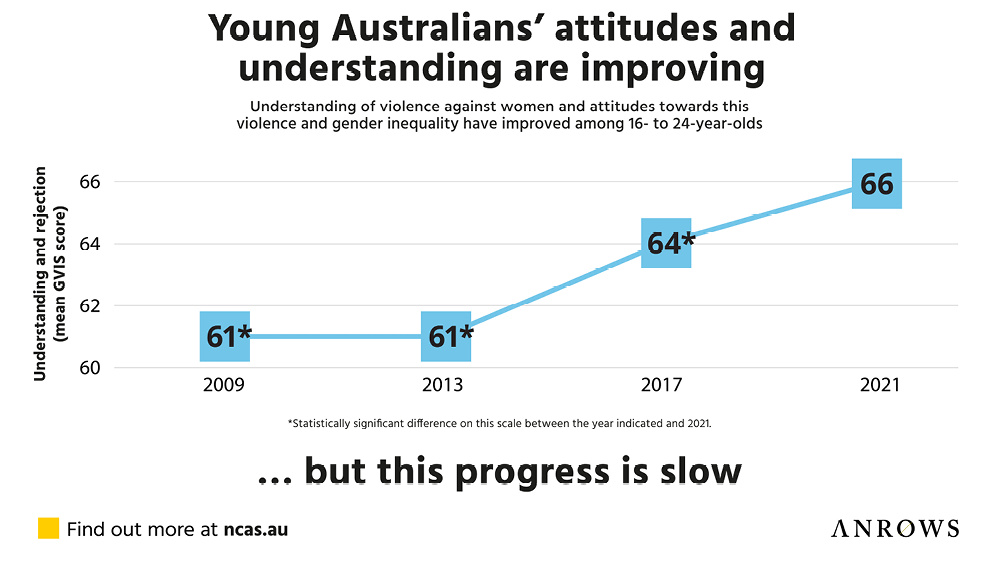
Many of the 2021 NCAS findings for young people were similar to those for all respondents, as seen in the Main report, and respondents aged 25 years or older. Similar to all respondents, young respondents demonstrated slow but positive shifts over time in understanding of violence against women and improvements in attitudes towards this violence and towards gender inequality.
Young people showed significant improvement in 2021 for all understandings and attitudes measured by the NCAS compared to one or more previous years (2017, 2013 or 2009). Between 2017 and 2021 specifically, young people’s understanding of violence against women, rejection of gender inequality, rejection of violence against women and rejection of sexual violence significantly improved. However, attitudes towards domestic violence plateaued between 2017 and 2021, despite improvements over the longer term.
These trends were also seen for all Australians, as seen in the Main report, except that all Australians did not demonstrate a significant increase in rejection of violence against women between 2017 and 2021.
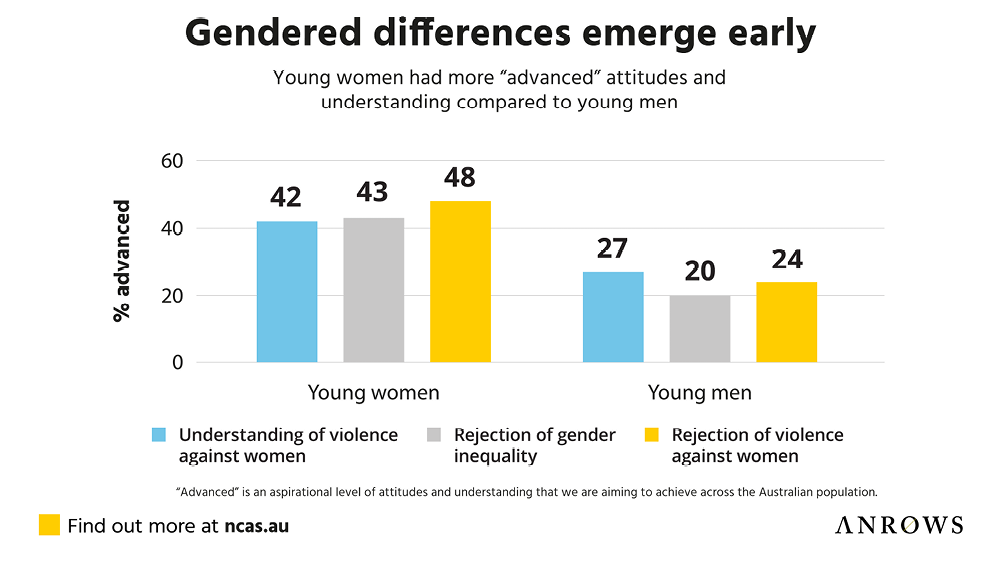
A minority of young people (27–43%) demonstrated “advanced” understanding of violence against women, rejection of gender inequality, rejection of violence against women, and understanding and rejection of technology-facilitated abuse. These findings indicate that most young people could still improve their understanding and attitudes.
Gender differences in attitudes and understanding persist
The 2021 NCAS highlighted a statistically significant gender gap in young people’s attitudes and understanding, with young men consistently lagging behind young women. Occasionally, young men also lagged behind young non-binary respondents (although the small number of young non-binary respondents reduced the ability to conduct some comparisons and to detect significant differences involving this group). For example:
- Young men’s understanding of violence against women, rejection of gender inequality, rejection of violence against women and intention to intervene prosocially when witnessing violence or abuse were not as developed as those of young women.
- Young men lagged behind young non-binary respondents in their rejection of gender inequality and rejection of some aspects of violence against women.
In 2021 young men and young women had similar levels of understanding of the gendered nature of domestic violence as perpetrated mainly by men against women, with women more likely to experience fear or physical harm as a result. However, young men and young women both demonstrated a decline since 2013 in understanding of the gendered nature of domestic violence.
Understanding of violence against women varies by age and type of violence
Young people are still developing their understanding of violence against women. Overall, young respondents were significantly less likely to have an “advanced” understanding of violence against women compared to people aged 25 years or older. For example, young people were:
- significantly more likely to think that men and women experience fear equally as a result of domestic violence
- significantly less likely to recognise technology-facilitated abuse as a type of violence against women.
Young people recognised that domestic violence and violence against women can include a range of physical and non-physical behaviours. However, they were more likely to recognise physical behaviours as violence compared to non-physical behaviours, including those that involve exploitation of aspects of a partner’s identity or experience (e.g. their gender identity, disability, visa status etc.).
In 2021 compared to both 2009 and 2013, young people had a lower understanding that domestic violence is gendered, with men being the main perpetrators and women being the most likely to suffer physical harm as a result.
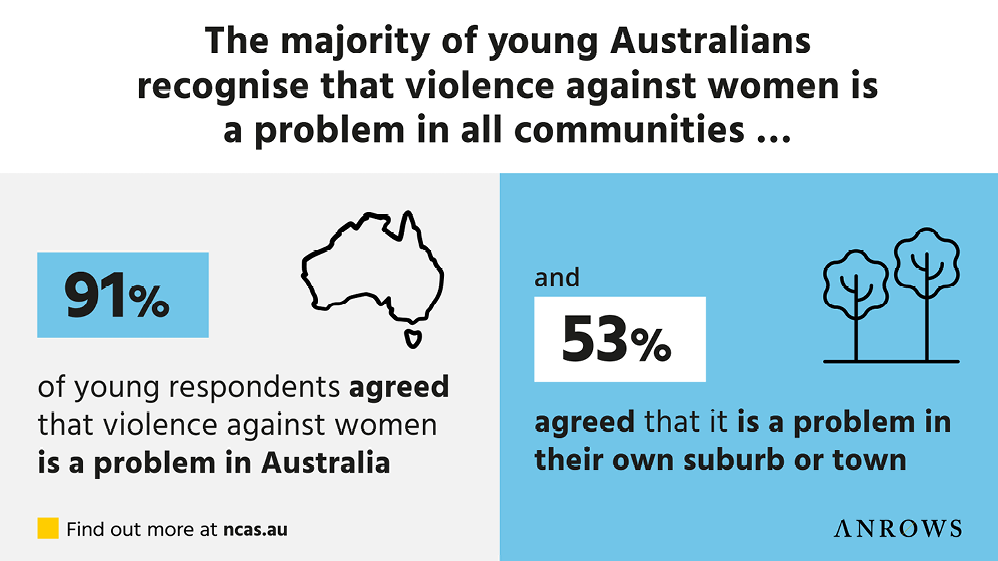
Young people were more likely to recognise that violence against women is a problem in Australia (91% agreed) than in their own local area (53% agreed). However, compared to respondents aged 25 years or older, young people had a higher understanding that violence against women occurs in their own suburb or town.
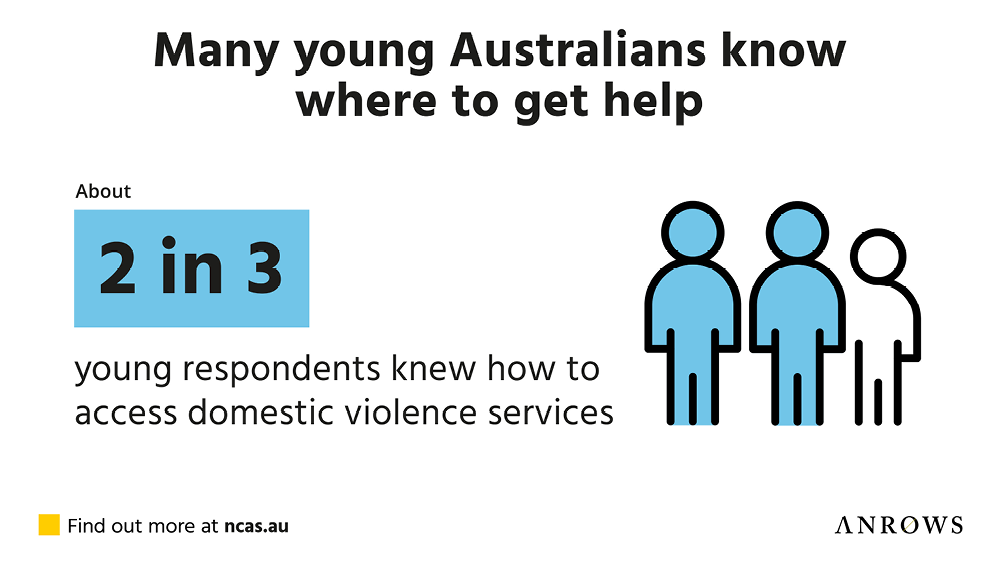
Young people were significantly more likely than respondents aged 25 or older to “somewhat” or “strongly” agree that they knew where to get support for someone experiencing domestic violence.
Attitudes towards gender inequality develop early
Attitudes towards gender inequality were similar for 16- to 17-year-olds, 18- to 24-year-olds and respondents aged 25 years or older, suggesting that attitudes towards gender inequality are formed early.
The exception to this was that younger respondents were less likely to reject some problematic gender norms that limit women’s autonomy in relationships. Rejection of some norms limiting women’s autonomy was lower for 16- to 17-year-olds compared to 18- to 24-year-olds, and also for young people (16 to 24 years) compared to respondents aged 25 years or older.
Compared to respondents aged 25 years or older, young people were significantly less likely to “strongly disagree” that women prefer men to be in charge in relationships or that jokes about being violent towards women are okay. However, young people were more likely than those aged 25 years or older to “strongly disagree” with the notion that women need children to be fulfilled.
Some but not all attitudes towards gender inequality are improving
While attitudes towards gender inequality appear to form early, comparing young people in 2021 to young people in 2017 revealed some improvements in attitudes towards gender inequality. Similar to all respondents, young people in 2021 showed significantly improved rejection of attitudes that reinforce gender roles, deny inequality and normalise sexism.
During this period, however, young people, like all respondents, did not show significant improvement in attitudes that undermine women’s leadership. Young people also showed no significant improvement in rejection of problematic attitudes that condone limiting women’s autonomy in relationships, whereas all respondents did show significant improvement.
Attitudes towards violence against women are improving and continue to develop with age
Young people demonstrated some progress in their attitudes towards violence against women. Between 2017 and 2021, young people significantly improved their rejection of attitudes that condone violence against women, whereas this rejection plateaued for all respondents as seen in the Main report).
Rejection of problematic attitudes towards violence against women was often stronger for young people aged 18 to 24 years compared to those aged 16 to 17 years. This finding suggests that youth is a period within which attitudes towards violence against women are noticeably changing.
Young people demonstrate nuance and uncertainty about sexual consent and objectification of women
Young people expressed nuance and uncertainty in their attitudes in some areas. Some of this uncertainty focused on sexual violence and occasionally on intoxication. While young people significantly increased their rejection of sexual violence between 2017 and 2021, a concerning minority still held problematic attitudes that excuse rape, particularly in scenarios where the woman had initially shown interest in sex.
Young people’s attitudes towards sexual violence involving alcohol or drugs also depended on whether it was the victim or perpetrator who was intoxicated. When compared to those aged 25 years or older, young people were significantly:
- more likely to excuse the perpetrator if he was drunk or affected by drugs
- less likely to excuse the perpetrator if the victim was drunk and fell asleep.
Young people were significantly more likely than respondents aged 25 years or older to “strongly disagree” with some attitudes that objectify women, including beliefs that women should be flattered by wolf-whistles or cat-calls and that it is understandable for a man to continue having sex with a drunk women who falls asleep.
A minority of young people also agreed with the rape myth that sexual assault is mostly committed by strangers.
Mistrust of women and minimisation of violence persists
Young people’s rejection of attitudes that mistrust women’s reports of violence and those that minimise violence is still developing. Developments between 2017 and 2021 included a significant increase in young people’s rejection of attitudes that:
- mistrust women’s reports of violence
- objectify women and disregard their consent.
Young people’s rejection of attitudes that minimise violence has also significantly improved over the long term, although this improvement stalled between 2017 and 2021.
In 2021, a minority of young people agreed with stereotypes of women as vengeful and untrustworthy, and attitudes that perpetrators are less responsible if under the influence of drugs or alcohol. Such attitudes demonstrate mistrust in women’s reports of violence and minimise violence or shift blame from the perpetrator to the victim or survivor.
Young people had significantly weaker rejection of problematic attitudes that excuse and minimise violence compared to people aged 25 years or older. For example, they were significantly less likely to “strongly disagree” with beliefs that domestic violence can be excused if the perpetrator was drunk or later regrets their behaviour, and attitudes that domestic violence is a private matter that should be handled within the family.
Bystander responses depend on context
While most young people expressed the intention to intervene prosocially when witnessing abuse or disrespect against women, this depended on the context, the type of behaviour and the presence of power differentials.
Young people were significantly more likely than those aged 25 years or older to be bothered by sexist jokes in the workplace but were significantly less likely to intervene if bothered by a sexist joke told by a boss.
Young people were also significantly more likely to be bothered by, and to say they would intervene if they witnessed, verbal abuse compared to a sexist joke. Promisingly, most young people thought that their peers would support them either publicly or privately if they intervened.
What are the implications for prevention?
The 2021 NCAS findings for young people tell us about programs and initiatives that could be beneficial, where energy should be focused in relation to attitudes and understanding, and where further research is needed.
Overarching implications
- Begin violence prevention early because understanding and attitudes develop early. Gender‑transformative parenting models and consent and respectful relationships education are promising prevention approaches.
- Continue prevention efforts throughout the formative years in an age-appropriate way as understanding and attitudes continue to change and mature throughout adolescence and young adulthood.
- Work across genders, and particularly with boys and men, since the 2021 NCAS results highlight consistent gender differences.
- Strengthen co-design with young people and victims and survivors to ensure that prevention initiatives are developed with young people’s unique insights, perspectives and experiences at the forefront and are tailored to their needs.
Areas of focus for programs and initiatives
- Adopt gender-transformative approaches to break down rigid gender norms among young people. Such approaches could be used across a broad range of settings, including through education in schools and by supporting parents to model gender-transformative behaviours, speech and practices to their children.
- Implement sexual violence prevention initiatives with young people and across the population to improve understanding that consent must be active and ongoing and cannot be disregarded when people are under the influence of alcohol or other drugs. This depiction of consent should be embedded in existing respectful relationships education curricula.
- Increase young people’s knowledge, skills and confidence to act as prosocial bystanders by conducting tailored initiatives in different settings. Such initiatives could address common concerns about intervening and leverage the influence of peers to strengthen positive social norms.
- Decision makers in workplaces and other settings should consider how power dynamics impact willingness to intervene when witnessing disrespect and abuse in these settings and should respond with clear policies, tools and resources.
Areas of focus for respectful relationships education
- Challenge the gender-ignoring bias held by young people by highlighting the pervasive gendered differences in structures and systems.
- Reframe young people’s perceptions that some problematic and abusive behaviours are acceptable if they are seen to involve “care and concern”.
- Challenge young people’s acceptance of male power in intimate relationships and gendered stereotypes about dating.
Areas of focus for further research
- Investigate the drivers of the continued improvement in young people’s rejection of violence against women and leverage this to facilitate further improvement for both young people and all Australians.
- Investigate the reasons why young people have a higher recognition than people aged 25 years or older that violence is a problem in their local area and use this to inform the framing of initiatives to increase awareness and action to address violence against women.
- Conduct research with perpetrators to understand the nature of perpetration and to develop effective education models and early intervention strategies.
- Learn from the finding that most young people know where to seek help for domestic violence to bolster knowledge for young people, identify any barriers to reporting and accessing services, and to further leverage these learnings for all Australians.
Many of the findings for young people were similar to the findings for all respondents, suggesting that their understandings and attitudes may be influenced by similar factors. As such, many of the implications outlined in Chapter 10 of the Main report are also relevant for young people.
What are the key messages for prevention?
Key messages combine the findings and implications for prevention from the Young Australians report and are underpinned by relevant supporting statistics. These key messages inform the resources published with the Young Australians report and provide high-level guidance for policymakers and practitioners.
Key message
Supporting statistics
Young people’s understanding of, and attitudes towards, violence against women and gender inequality are slowly improving over time.
There is still room for improvement for all Australians.
Young people showed statistically significant improvement in 2021 in understanding and attitudes according to all NCAS scales compared to one or more previous years (2017, 2013 or 2009).
However, a minority of young people (27–43%) demonstrated “advanced” understanding of violence against women and “advanced” rejection of problematic attitudes in 2021.
Young people are still developing their understanding of, and attitudes towards, violence against women.
There is an opportunity to support young people to improve before problematic beliefs become stronger.
Rejection of problematic attitudes towards violence against women was often stronger for young people aged 18 to 24 years compared to those aged 16 to 17 years.
In 2021, 18- to 24-year-olds had significantly higher rejection of violence against women according to the mean scores on the NCAS scale and subscales measuring attitudes towards violence against women compared to 16- to 17-year-old respondents.
At an item level, 18- to 24-year-olds were significantly more likely compared to 16- to 17-year-old respondents to “strongly disagree” with the following problematic attitudes:
- Domestic violence can be excused if:
-
- the violent person genuinely regrets what they have done (57% compared to 44%)
- the offender is heavily affected by alcohol (86% compared to 74%)
- the victim is heavily affected by alcohol (82% compared to 71%)
- the violent person was abused as a child (71% compared to 59%).
- A man is less responsible for rape if he is drunk or affected by drugs (85% compared to 64%).
Despite improvements over time, a minority of young people still demonstrate attitudes that minimise violence and mistrust women.
More work needs to be done to reframe narratives to place responsibility for violence on the perpetrator and to foster a culture of trust and support for victims and survivors.
Multiple positive improvements in attitudes that minimise violence and mistrust and objectify women were seen for young people, similar to those demonstrated by all respondents. Young people significantly increased their rejection of:
- attitudes that mistrust women’s reports of violence and those that objectify women and disregard consent between 2017 and 2021
- attitudes that minimise violence since 2009, although this improvement stalled between 2017 and 2021.
However, young respondents were significantly less likely than those aged 25 years or older to “strongly disagree” with some attitudes that minimise violence, specifically attitudes that:
- domestic violence should be handled in the family (55% of 16- to 24‑year-olds compared to 71% of respondents aged 25 or older)
- domestic violence should be excused if the violent person later regrets their behaviour (54% compared to 73%)
- rape should be excused if the perpetrator is affected by alcohol or drugs (81% compared to 90%).
Nevertheless, in a few instances young respondents were more likely than others to reject problematic attitudes towards violence against women. For example, young respondents were significantly more likely than those aged 25 years or older to disagree (“strongly” or “somewhat”) that women often exaggerate claims of domestic violence to gain an advantage in custody battles (56% compared to 46%).
Some young people still hold concerning beliefs about sexual consent.
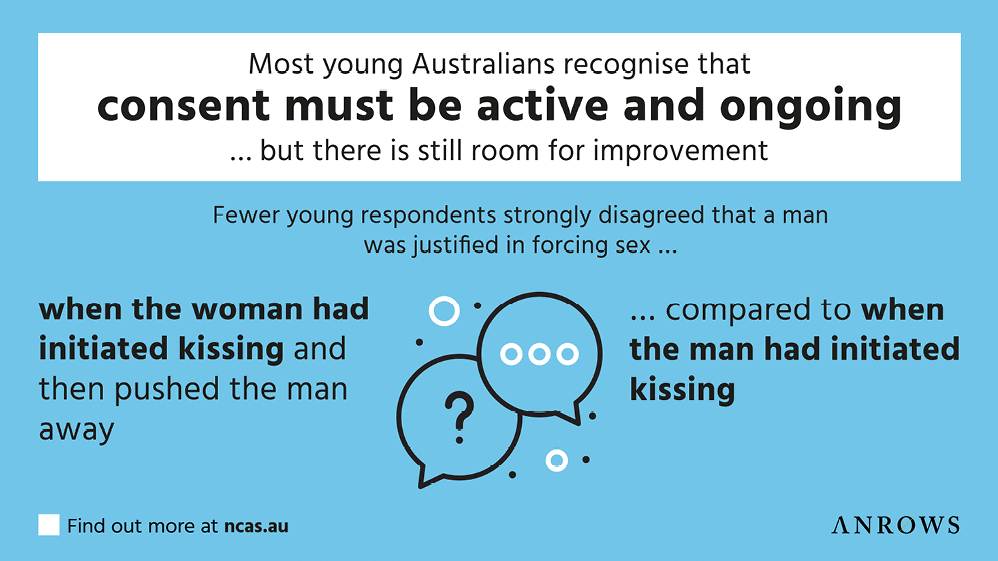
The ambiguity surrounding sexual consent, particularly when alcohol and drugs are involved, must be addressed with the concept of affirmative consent, which defines consent as an ongoing and mutually confirmed agreement.
Young people’s understanding and attitudes regarding sexual violence demonstrated some uncertainty about consent and demonstrated mixed results when compared to respondents aged 25 years or older.
Some young people still hold problematic beliefs about sexual violence. A concerning minority incorrectly thought that women are more likely to be raped by a stranger than someone they know (18%) or agreed that sexual harassment is flattering or benign (11%).
While most young respondents “strongly disagreed” that a man was justified in forcing sex, fewer respondents “strongly disagreed” when the woman had initiated intimacy and then withdrawn consent (70‑72%) compared to when the man had initiated intimacy (89–90%).
Young people were also significantly more likely than those aged 25 years or older to excuse a man for perpetrating rape if he was drunk or affected by drugs at the time:
- 90% of respondents aged 25 years or older “strongly disagreed” that intoxication made a man less responsible for rape, compared to 81% of 16- to 24-year-olds.
In contrast, young people were significantly less likely than those aged 25 or older to excuse a perpetrator for continuing to have sex with a woman if she was drunk and then fell asleep:
- 87% of 16- to 24-year-olds “strongly disagreed” that it is understandable that a man would continue having sex in this scenario, compared to 79% of those aged 25 years or older.
Young people have greater recognition that violence occurs in their own local area and are more likely to know where to seek help compared to Australians aged 25 years or older.
There are opportunities to learn from young people to support all Australians to develop improved attitudes and understanding.
Most young respondents agreed that violence against women is a problem in Australia (91%), but fewer agreed that violence against women is a problem in the suburb or town where they live (53%).
However, young people’s understanding that violence against women occurs in their own suburb or town was higher than that of other respondents. Specifically, compared to respondents aged 25 years or older, young respondents were both significantly more likely to “somewhat agree” (36% compared to 27%) with this statement and significantly less likely to say they were “unsure” (13% compared to 23%).
Young people were significantly more likely than respondents aged 25 or older to agree that they would know where to get support for someone experiencing domestic violence (64% compared to 55%).
Gender differences in understanding and attitudes regarding violence against women and attitudes towards gender inequality are already evident among young people.
Young people must be supported to challenge problematic gender norms and to recognise the gendered inequalities that are a cause and symptom of violence against women.
Young men consistently lagged behind young women in their understanding and attitudes. For example:
- Young women (72%) were significantly more likely than young men (57%) to recognise that repeatedly keeping track of a partner on electronic devices is “always” a form of domestic violence.
- Young men (48%) were significantly more likely than young women (25%) to agree that women exaggerate how unequally women are treated in Australia.
- Young women were significantly more likely to “strongly disagree” (81%) than young men (56%) that women with mental health issues who report being sexually assaulted are probably lying.
Young men also lagged behind young non-binary respondents in their rejection of gender inequality and rejection of some aspects of violence against women.
However, young men and young women had similar levels of understanding of the gendered nature of domestic violence in 2021:
- 48% of young men and 60% of young women correctly identified that domestic violence is mainly committed by men
- 72% of both young men and young women correctly identified that women are more likely to suffer physical harm from domestic violence
- 54% of young men and 55% of young women correctly identified that women are more likely to experience fear as a result of domestic violence.
Between 2013 and 2021, young men and young women also both demonstrated a decline in understanding of the gendered nature of domestic violence.
Young people want to intervene when witnessing violence or abuse against women but their confidence to do so depends on the context.
Young people must be encouraged to develop the skills to stand up and speak out, and must be supported by broader social and system change to ensure that it is safe to do so.
Young respondents typically indicated that they would be bothered by witnessing abuse or disrespect of women (78–98%). Most of the young respondents who said they would be bothered expressed the intention to intervene prosocially (63–96%).
Young people were significantly more likely than those aged 25 years or older to be bothered by sexist jokes in the workplace but their intention to intervene depended on the context. Specifically:
- Young respondents (75%) were significantly more likely than respondents aged 25 years or older (64%) to say they would be bothered by a male work friend telling a sexist joke about women.
- Young respondents (31%) were significantly more likely than respondents aged 25 years or older (17%) to say that they would be bothered but would not intervene if a boss told a sexist joke.
Young people were also significantly more likely to be bothered by and say they would intervene if they witnessed verbal abuse compared to a sexist joke. Specifically:
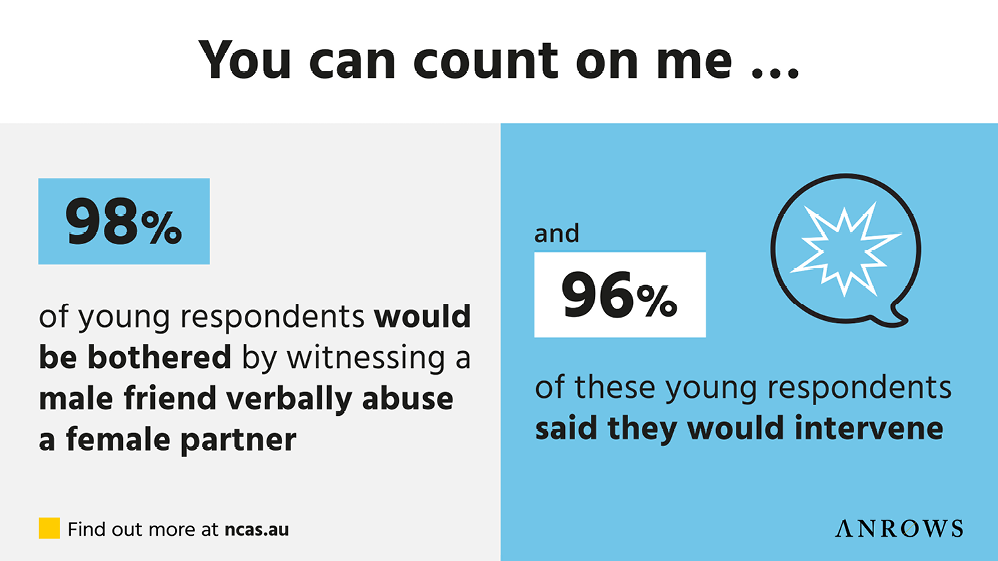
- Virtually all young respondents said they would be bothered by witnessing a male friend verbally abusing a woman he is in a relationship with (98%). Fewer young respondents said they would be bothered by a male work friend or boss telling a sexist joke (78–89%).
- Young respondents were more likely to express intention to intervene when witnessing verbal abuse (96%) than when witnessing a boss telling a sexist joke (63%).
Promisingly, most young respondents thought that their peers would support them either publicly or privately if they intervened (79–89%) when witnessing a friend using verbal abuse or telling a sexist joke.
Young people’s understandings and attitudes regarding violence against women and gender inequality are still developing and are open to change.
Understandings and attitudes are not uniform among young people, with 16- to 17-year-olds sometimes lagging behind 18- to 24-year-olds. Specifically, compared to 18- to 24-year-olds, 16- to 17-year-olds had significantly:
- weaker understanding of violence against women in some areas
- weaker rejection of gender inequality in some areas
- weaker rejection of violence against women.
For example, young people aged 16 to 17 years were significantly:
more likely (15%) to “strongly agree” that many women don’t appreciate what men do for them compared to those aged 18 to 24 years (4%)
less likely (74%) to “strongly disagree” that domestic violence can be excused if the perpetrator is affected by alcohol compared to those aged 18 to 24 years (86%).
Social media infographics
Social media infographics have been developed to assist with online communications about the 2021 NCAS findings for young Australians. High-resolution images are available on the ANROWS website. ANROWS suggests including a link to the 2021 NCAS Young Australians report where possible in online communications.
Further reading and resources
2021 NCAS
Coumarelos, C., Honey, N., Ward, A., Weeks, N., & Minter, K. (2023). Attitudes matter: The 2021 National Community Attitudes towards Violence against Women Survey (NCAS), Technical report (Insights 02/2023). ANROWS. https://www.anrows.org.au/publication/attitudes-matter-the-2021-national‑community-attitudes-towards-violence-against-women-survey-ncas-technical-report/
Coumarelos, C., Roberts, N., Weeks, N., Bernstein, S., & Honey, N. (2023). Attitudes matter: The 2021 National Community Attitudes towards Violence against Women Survey (NCAS), Findings for Australian states and territories (Research report, 05/2023). ANROWS. https://www.anrows.org.au/publication/attitudes-matter-the-2021-national-community-attitudes-towards-violence-against-women-survey-ncas-summary-for-australia/
Coumarelos, C., Roberts, N., Weeks, N., & Rasmussen, V. (2023). Attitudes matter: The 2021 National Community Attitudes towards Violence against Women Survey (NCAS), Findings for young Australians (Research report, 08/2023). ANROWS. https://www.anrows.org.au/publication/ncas-2021-findings-for-young-australians
Coumarelos, C., Weeks, N., Bernstein, S., Roberts, N., Honey, N., Minter, K., & Carlisle, E. (2023a). Attitudes matter: The 2021 National Community Attitudes towards Violence against Women Survey (NCAS), Findings for Australia (Research report 02/2023). ANROWS. https://www.anrows.org.au/publication/attitudes-matter-the-2021-national-community-attitudes-towards-violence-against-women-survey-ncas-findings-for-australia/
Coumarelos, C., Weeks, N., Bernstein, S., Roberts, N., Honey, N., Minter, K., & Carlisle, E. (2023b). Attitudes matter: The 2021 National Community Attitudes towards Violence against Women Survey (NCAS), Summary for Australia (Research report, 03/2023). ANROWS. https://www.anrows.org.au/publication/attitudes-matter-the-2021-national-community-attitudes-towards-violence-against-women-survey-ncas-summary-for-australia/
2017 NCAS
Qualitative research studies based on 2017 NCAS findings
Carlisle, E., Coumarelos, C., Minter, K., & Lohmeyer, B. (2022). “It depends on what the definition of domestic violence is”: How young Australians conceptualise domestic violence and abuse. ANROWS. https://www.anrows.org.au/publication/it-depends-on-what-the-definition-of-domestic-violence-is-how-young-people-conceptualise-domestic-violence-and-abuse/
Minter, K., Carlisle, E., & Coumarelos, C. (2021). “Chuck her on a lie detector”: Investigating Australians’ mistrust in women’s reports of sexual assault. ANROWS. https://www.anrows.org.au/publication/chuck-her-on-a-lie-detector-investigating-australians-mistrust-in-womens-reports-of-sexual-assault/

Suggested citation
Australia’s National Research Organisation for Women’s Safety. (2023). Quick Guide to the 2021 NCAS findings for young Australians [Fact sheet]. ANROWS.
© ANROWS 2023
Published by
Australia’s National Research Organisation for Women’s Safety Limited (ANROWS)
PO Box Q389, Queen Victoria Building, NSW 1230 | www.anrows.org.au
ABN 67 162 349 171
Please note that there is the potential for minor revisions of this fact sheet.
Please check the online version at www.anrows.org.au for any amendments.
The National Community Attitudes towards Violence against Women Survey
The National Community Attitudes towards Violence against Women Survey (NCAS) is a periodic, representative survey of the Australian population that is conducted every four years. It provides insights into the Australian community’s understanding and attitudes regarding violence against women, their attitudes towards gender inequality and their intentions to intervene if witnessing violence or disrespect against women. The NCAS gauges Australia’s progress towards changing the broader climate that facilitates and maintains violence against women. It can therefore help inform policy and programs aimed at the prevention of violence against women.
A series of reports based on the NCAS findings looks at the attitudes and understandings held by different population groups. This Quick Guide supports the report titled Attitudes matter: The 2021 National Community Attitudes towards Violence against Women Survey (NCAS), Findings for young Australians (“Young Australians report”), which focuses on findings for young Australians aged 16 to 24 years (“young people”).
Findings for young Australians
It is important, for multiple reasons, to study the understandings and attitudes held by young people as a distinct group. First, young people themselves experience violence and specific impacts of violence. Young women, in particular, are at high risk of some forms of violence victimisation. Exposure to domestic and family violence is also increasingly recognised as a form of child abuse, and growing evidence shows that early exposure to violence has long-term negative impacts on physical and mental health. Second, young people are at a life stage where they are developing their values, attitudes and understandings. As a key group, they can be catalysts of social change to shape a culture that rejects violence against women and fosters gender equality. Researching their attitudes and understandings is the first step to supporting such social change.
Fast facts
For fast facts about the 2021 NCAS as a whole, please see the ‘Fast facts about the NCAS’ section of the Quick Guide to the 2021 National Community Attitudes towards Violence against Women Survey (NCAS). For a detailed description of the 2021 NCAS methodology, please see the 2021 NCAS Technical report.
What were the aims?
The key purpose of the NCAS is to measure the Australian community’s understanding and attitudes regarding violence against women. The Young Australians report looks specifically at understandings and attitudes held by young people.
The Young Australians report aims to:
- benchmark understanding and attitudes regarding violence against women, attitudes towards gender equality and intention to intervene when witnessing abuse or disrespect of women among young people as at 2021
- determine whether understanding and attitudes had improved among young people since the 2017 NCAS
- identify gaps in understanding or problematic attitudes held by young people in 2021
- identify demographic, attitudinal and contextual factors associated with problematic understanding and attitudes among young people
- compare the attitudes and understanding of young people to those of all NCAS respondents and to respondents aged 25 years or older.
What was the sample?
Findings for all NCAS respondents were drawn from a random sample of 19,100 people aged 16 years or older who were interviewed via mobile telephone. This total sample is referred to as “all respondents” and findings based on the total sample are discussed in depth in Attitudes matter: The 2021 National Community Attitudes towards Violence against Women Survey (NCAS), Findings for Australia (“Main report”).
The total sample of young Australians included 1,669 young respondents aged 16 to 24 years. Of these, 207 were aged 16 to 17 years and 1,462 were aged 18 to 24 years. There were 913 young men, 715 young women and 36 young non-binary respondents (five young respondents did not provide information on gender). This group is referred to as “young people” or “young respondents”.
How did we make comparisons?
The Young Australians report examines:
- young people (16- to 24-year-olds) compared to older people (25 years or older)
- 16- to 17-year-olds compared to 18- to 24-year-olds.
Statistically significant differences based on these comparisons are reported.
In addition, the report sometimes notes where the high-level pattern of responses for young Australians differed from the pattern observed for all Australians in the Main report. However, the statistical significance of these comparisons could not be examined because the “all respondents” category included the young respondents.
What are we aiming for?
Respondents were classified into “advanced” or “developing” categories to highlight the proportion of the Australian population that could improve understanding and attitudes. “Advanced” is an aspirational level that we believe all Australians can and should achieve if we are to end violence against women.
Respondents had “advanced” understanding if they recognised that all behaviours measured by a scale “always” or “usually” constitute domestic violence or violence against women. They had “advanced” attitudes if they “strongly” or “somewhat” disagreed with all problematic attitudes measured by a scale.
What were the key findings?
Trends in attitudes and understanding show improvement
Many of the 2021 NCAS findings for young people were similar to those for all respondents, as seen in the Main report, and respondents aged 25 years or older. Similar to all respondents, young respondents demonstrated slow but positive shifts over time in understanding of violence against women and improvements in attitudes towards this violence and towards gender inequality.
Young people showed significant improvement in 2021 for all understandings and attitudes measured by the NCAS compared to one or more previous years (2017, 2013 or 2009). Between 2017 and 2021 specifically, young people’s understanding of violence against women, rejection of gender inequality, rejection of violence against women and rejection of sexual violence significantly improved. However, attitudes towards domestic violence plateaued between 2017 and 2021, despite improvements over the longer term.
These trends were also seen for all Australians, as seen in the Main report, except that all Australians did not demonstrate a significant increase in rejection of violence against women between 2017 and 2021.
A minority of young people (27–43%) demonstrated “advanced” understanding of violence against women, rejection of gender inequality, rejection of violence against women, and understanding and rejection of technology-facilitated abuse. These findings indicate that most young people could still improve their understanding and attitudes.
Gender differences in attitudes and understanding persist
The 2021 NCAS highlighted a statistically significant gender gap in young people’s attitudes and understanding, with young men consistently lagging behind young women. Occasionally, young men also lagged behind young non-binary respondents (although the small number of young non-binary respondents reduced the ability to conduct some comparisons and to detect significant differences involving this group). For example:
- Young men’s understanding of violence against women, rejection of gender inequality, rejection of violence against women and intention to intervene prosocially when witnessing violence or abuse were not as developed as those of young women.
- Young men lagged behind young non-binary respondents in their rejection of gender inequality and rejection of some aspects of violence against women.
In 2021 young men and young women had similar levels of understanding of the gendered nature of domestic violence as perpetrated mainly by men against women, with women more likely to experience fear or physical harm as a result. However, young men and young women both demonstrated a decline since 2013 in understanding of the gendered nature of domestic violence.
Understanding of violence against women varies by age and type of violence
Young people are still developing their understanding of violence against women. Overall, young respondents were significantly less likely to have an “advanced” understanding of violence against women compared to people aged 25 years or older. For example, young people were:
- significantly more likely to think that men and women experience fear equally as a result of domestic violence
- significantly less likely to recognise technology-facilitated abuse as a type of violence against women.
Young people recognised that domestic violence and violence against women can include a range of physical and non-physical behaviours. However, they were more likely to recognise physical behaviours as violence compared to non-physical behaviours, including those that involve exploitation of aspects of a partner’s identity or experience (e.g. their gender identity, disability, visa status etc.).
In 2021 compared to both 2009 and 2013, young people had a lower understanding that domestic violence is gendered, with men being the main perpetrators and women being the most likely to suffer physical harm as a result.
Young people were more likely to recognise that violence against women is a problem in Australia (91% agreed) than in their own local area (53% agreed). However, compared to respondents aged 25 years or older, young people had a higher understanding that violence against women occurs in their own suburb or town.
Young people were significantly more likely than respondents aged 25 or older to “somewhat” or “strongly” agree that they knew where to get support for someone experiencing domestic violence.
Attitudes towards gender inequality develop early
Attitudes towards gender inequality were similar for 16- to 17-year-olds, 18- to 24-year-olds and respondents aged 25 years or older, suggesting that attitudes towards gender inequality are formed early.
The exception to this was that younger respondents were less likely to reject some problematic gender norms that limit women’s autonomy in relationships. Rejection of some norms limiting women’s autonomy was lower for 16- to 17-year-olds compared to 18- to 24-year-olds, and also for young people (16 to 24 years) compared to respondents aged 25 years or older.
Compared to respondents aged 25 years or older, young people were significantly less likely to “strongly disagree” that women prefer men to be in charge in relationships or that jokes about being violent towards women are okay. However, young people were more likely than those aged 25 years or older to “strongly disagree” with the notion that women need children to be fulfilled.
Some but not all attitudes towards gender inequality are improving
While attitudes towards gender inequality appear to form early, comparing young people in 2021 to young people in 2017 revealed some improvements in attitudes towards gender inequality. Similar to all respondents, young people in 2021 showed significantly improved rejection of attitudes that reinforce gender roles, deny inequality and normalise sexism.
During this period, however, young people, like all respondents, did not show significant improvement in attitudes that undermine women’s leadership. Young people also showed no significant improvement in rejection of problematic attitudes that condone limiting women’s autonomy in relationships, whereas all respondents did show significant improvement.
Attitudes towards violence against women are improving and continue to develop with age
Young people demonstrated some progress in their attitudes towards violence against women. Between 2017 and 2021, young people significantly improved their rejection of attitudes that condone violence against women, whereas this rejection plateaued for all respondents as seen in the Main report).
Rejection of problematic attitudes towards violence against women was often stronger for young people aged 18 to 24 years compared to those aged 16 to 17 years. This finding suggests that youth is a period within which attitudes towards violence against women are noticeably changing.
Young people demonstrate nuance and uncertainty about sexual consent and objectification of women
Young people expressed nuance and uncertainty in their attitudes in some areas. Some of this uncertainty focused on sexual violence and occasionally on intoxication. While young people significantly increased their rejection of sexual violence between 2017 and 2021, a concerning minority still held problematic attitudes that excuse rape, particularly in scenarios where the woman had initially shown interest in sex.
Young people’s attitudes towards sexual violence involving alcohol or drugs also depended on whether it was the victim or perpetrator who was intoxicated. When compared to those aged 25 years or older, young people were significantly:
- more likely to excuse the perpetrator if he was drunk or affected by drugs
- less likely to excuse the perpetrator if the victim was drunk and fell asleep.
Young people were significantly more likely than respondents aged 25 years or older to “strongly disagree” with some attitudes that objectify women, including beliefs that women should be flattered by wolf-whistles or cat-calls and that it is understandable for a man to continue having sex with a drunk women who falls asleep.
A minority of young people also agreed with the rape myth that sexual assault is mostly committed by strangers.
Mistrust of women and minimisation of violence persists
Young people’s rejection of attitudes that mistrust women’s reports of violence and those that minimise violence is still developing. Developments between 2017 and 2021 included a significant increase in young people’s rejection of attitudes that:
- mistrust women’s reports of violence
- objectify women and disregard their consent.
Young people’s rejection of attitudes that minimise violence has also significantly improved over the long term, although this improvement stalled between 2017 and 2021.
In 2021, a minority of young people agreed with stereotypes of women as vengeful and untrustworthy, and attitudes that perpetrators are less responsible if under the influence of drugs or alcohol. Such attitudes demonstrate mistrust in women’s reports of violence and minimise violence or shift blame from the perpetrator to the victim or survivor.
Young people had significantly weaker rejection of problematic attitudes that excuse and minimise violence compared to people aged 25 years or older. For example, they were significantly less likely to “strongly disagree” with beliefs that domestic violence can be excused if the perpetrator was drunk or later regrets their behaviour, and attitudes that domestic violence is a private matter that should be handled within the family.
Bystander responses depend on context
While most young people expressed the intention to intervene prosocially when witnessing abuse or disrespect against women, this depended on the context, the type of behaviour and the presence of power differentials.
Young people were significantly more likely than those aged 25 years or older to be bothered by sexist jokes in the workplace but were significantly less likely to intervene if bothered by a sexist joke told by a boss.
Young people were also significantly more likely to be bothered by, and to say they would intervene if they witnessed, verbal abuse compared to a sexist joke. Promisingly, most young people thought that their peers would support them either publicly or privately if they intervened.
What are the implications for prevention?
The 2021 NCAS findings for young people tell us about programs and initiatives that could be beneficial, where energy should be focused in relation to attitudes and understanding, and where further research is needed.
Overarching implications
- Begin violence prevention early because understanding and attitudes develop early. Gender‑transformative parenting models and consent and respectful relationships education are promising prevention approaches.
- Continue prevention efforts throughout the formative years in an age-appropriate way as understanding and attitudes continue to change and mature throughout adolescence and young adulthood.
- Work across genders, and particularly with boys and men, since the 2021 NCAS results highlight consistent gender differences.
- Strengthen co-design with young people and victims and survivors to ensure that prevention initiatives are developed with young people’s unique insights, perspectives and experiences at the forefront and are tailored to their needs.
Areas of focus for programs and initiatives
- Adopt gender-transformative approaches to break down rigid gender norms among young people. Such approaches could be used across a broad range of settings, including through education in schools and by supporting parents to model gender-transformative behaviours, speech and practices to their children.
- Implement sexual violence prevention initiatives with young people and across the population to improve understanding that consent must be active and ongoing and cannot be disregarded when people are under the influence of alcohol or other drugs. This depiction of consent should be embedded in existing respectful relationships education curricula.
- Increase young people’s knowledge, skills and confidence to act as prosocial bystanders by conducting tailored initiatives in different settings. Such initiatives could address common concerns about intervening and leverage the influence of peers to strengthen positive social norms.
- Decision makers in workplaces and other settings should consider how power dynamics impact willingness to intervene when witnessing disrespect and abuse in these settings and should respond with clear policies, tools and resources.
Areas of focus for respectful relationships education
- Challenge the gender-ignoring bias held by young people by highlighting the pervasive gendered differences in structures and systems.
- Reframe young people’s perceptions that some problematic and abusive behaviours are acceptable if they are seen to involve “care and concern”.
- Challenge young people’s acceptance of male power in intimate relationships and gendered stereotypes about dating.
Areas of focus for further research
- Investigate the drivers of the continued improvement in young people’s rejection of violence against women and leverage this to facilitate further improvement for both young people and all Australians.
- Investigate the reasons why young people have a higher recognition than people aged 25 years or older that violence is a problem in their local area and use this to inform the framing of initiatives to increase awareness and action to address violence against women.
- Conduct research with perpetrators to understand the nature of perpetration and to develop effective education models and early intervention strategies.
- Learn from the finding that most young people know where to seek help for domestic violence to bolster knowledge for young people, identify any barriers to reporting and accessing services, and to further leverage these learnings for all Australians.
Many of the findings for young people were similar to the findings for all respondents, suggesting that their understandings and attitudes may be influenced by similar factors. As such, many of the implications outlined in Chapter 10 of the Main report are also relevant for young people.
What are the key messages for prevention?
Key messages combine the findings and implications for prevention from the Young Australians report and are underpinned by relevant supporting statistics. These key messages inform the resources published with the Young Australians report and provide high-level guidance for policymakers and practitioners.
| Key message | Supporting statistics |
|---|---|
| Young people’s understanding of, and attitudes towards, violence against women and gender inequality are slowly improving over time. There is still room for improvement for all Australians. | Young people showed statistically significant improvement in 2021 in understanding and attitudes according to all NCAS scales compared to one or more previous years (2017, 2013 or 2009). However, a minority of young people (27–43%) demonstrated “advanced” understanding of violence against women and “advanced” rejection of problematic attitudes in 2021. |
| Young people are still developing their understanding of, and attitudes towards, violence against women. There is an opportunity to support young people to improve before problematic beliefs become stronger. | Rejection of problematic attitudes towards violence against women was often stronger for young people aged 18 to 24 years compared to those aged 16 to 17 years. In 2021, 18- to 24-year-olds had significantly higher rejection of violence against women according to the mean scores on the NCAS scale and subscales measuring attitudes towards violence against women compared to 16- to 17-year-old respondents. At an item level, 18- to 24-year-olds were significantly more likely compared to 16- to 17-year-old respondents to “strongly disagree” with the following problematic attitudes:
|
| Despite improvements over time, a minority of young people still demonstrate attitudes that minimise violence and mistrust women. More work needs to be done to reframe narratives to place responsibility for violence on the perpetrator and to foster a culture of trust and support for victims and survivors. | Multiple positive improvements in attitudes that minimise violence and mistrust and objectify women were seen for young people, similar to those demonstrated by all respondents. Young people significantly increased their rejection of:
However, young respondents were significantly less likely than those aged 25 years or older to “strongly disagree” with some attitudes that minimise violence, specifically attitudes that:
Nevertheless, in a few instances young respondents were more likely than others to reject problematic attitudes towards violence against women. For example, young respondents were significantly more likely than those aged 25 years or older to disagree (“strongly” or “somewhat”) that women often exaggerate claims of domestic violence to gain an advantage in custody battles (56% compared to 46%). |
| Some young people still hold concerning beliefs about sexual consent. The ambiguity surrounding sexual consent, particularly when alcohol and drugs are involved, must be addressed with the concept of affirmative consent, which defines consent as an ongoing and mutually confirmed agreement. | Young people’s understanding and attitudes regarding sexual violence demonstrated some uncertainty about consent and demonstrated mixed results when compared to respondents aged 25 years or older. Some young people still hold problematic beliefs about sexual violence. A concerning minority incorrectly thought that women are more likely to be raped by a stranger than someone they know (18%) or agreed that sexual harassment is flattering or benign (11%). While most young respondents “strongly disagreed” that a man was justified in forcing sex, fewer respondents “strongly disagreed” when the woman had initiated intimacy and then withdrawn consent (70‑72%) compared to when the man had initiated intimacy (89–90%). Young people were also significantly more likely than those aged 25 years or older to excuse a man for perpetrating rape if he was drunk or affected by drugs at the time:
In contrast, young people were significantly less likely than those aged 25 or older to excuse a perpetrator for continuing to have sex with a woman if she was drunk and then fell asleep:
|
| Young people have greater recognition that violence occurs in their own local area and are more likely to know where to seek help compared to Australians aged 25 years or older. There are opportunities to learn from young people to support all Australians to develop improved attitudes and understanding. | Most young respondents agreed that violence against women is a problem in Australia (91%), but fewer agreed that violence against women is a problem in the suburb or town where they live (53%). However, young people’s understanding that violence against women occurs in their own suburb or town was higher than that of other respondents. Specifically, compared to respondents aged 25 years or older, young respondents were both significantly more likely to “somewhat agree” (36% compared to 27%) with this statement and significantly less likely to say they were “unsure” (13% compared to 23%). Young people were significantly more likely than respondents aged 25 or older to agree that they would know where to get support for someone experiencing domestic violence (64% compared to 55%). |
| Gender differences in understanding and attitudes regarding violence against women and attitudes towards gender inequality are already evident among young people. Young people must be supported to challenge problematic gender norms and to recognise the gendered inequalities that are a cause and symptom of violence against women. | Young men consistently lagged behind young women in their understanding and attitudes. For example:
Young men also lagged behind young non-binary respondents in their rejection of gender inequality and rejection of some aspects of violence against women. However, young men and young women had similar levels of understanding of the gendered nature of domestic violence in 2021:
Between 2013 and 2021, young men and young women also both demonstrated a decline in understanding of the gendered nature of domestic violence. |
| Young people want to intervene when witnessing violence or abuse against women but their confidence to do so depends on the context. Young people must be encouraged to develop the skills to stand up and speak out, and must be supported by broader social and system change to ensure that it is safe to do so. | Young respondents typically indicated that they would be bothered by witnessing abuse or disrespect of women (78–98%). Most of the young respondents who said they would be bothered expressed the intention to intervene prosocially (63–96%). Young people were significantly more likely than those aged 25 years or older to be bothered by sexist jokes in the workplace but their intention to intervene depended on the context. Specifically:
Young people were also significantly more likely to be bothered by and say they would intervene if they witnessed verbal abuse compared to a sexist joke. Specifically:
Promisingly, most young respondents thought that their peers would support them either publicly or privately if they intervened (79–89%) when witnessing a friend using verbal abuse or telling a sexist joke. |
| Young people’s understandings and attitudes regarding violence against women and gender inequality are still developing and are open to change. | Understandings and attitudes are not uniform among young people, with 16- to 17-year-olds sometimes lagging behind 18- to 24-year-olds. Specifically, compared to 18- to 24-year-olds, 16- to 17-year-olds had significantly:
For example, young people aged 16 to 17 years were significantly: more likely (15%) to “strongly agree” that many women don’t appreciate what men do for them compared to those aged 18 to 24 years (4%) less likely (74%) to “strongly disagree” that domestic violence can be excused if the perpetrator is affected by alcohol compared to those aged 18 to 24 years (86%). |
Social media infographics
Social media infographics have been developed to assist with online communications about the 2021 NCAS findings for young Australians. High-resolution images are available on the ANROWS website. ANROWS suggests including a link to the 2021 NCAS Young Australians report where possible in online communications.
Further reading and resources
2021 NCAS
Coumarelos, C., Honey, N., Ward, A., Weeks, N., & Minter, K. (2023). Attitudes matter: The 2021 National Community Attitudes towards Violence against Women Survey (NCAS), Technical report (Insights 02/2023). ANROWS. https://www.anrows.org.au/publication/attitudes-matter-the-2021-national‑community-attitudes-towards-violence-against-women-survey-ncas-technical-report/
Coumarelos, C., Roberts, N., Weeks, N., Bernstein, S., & Honey, N. (2023). Attitudes matter: The 2021 National Community Attitudes towards Violence against Women Survey (NCAS), Findings for Australian states and territories (Research report, 05/2023). ANROWS. https://www.anrows.org.au/publication/attitudes-matter-the-2021-national-community-attitudes-towards-violence-against-women-survey-ncas-summary-for-australia/
Coumarelos, C., Roberts, N., Weeks, N., & Rasmussen, V. (2023). Attitudes matter: The 2021 National Community Attitudes towards Violence against Women Survey (NCAS), Findings for young Australians (Research report, 08/2023). ANROWS. https://www.anrows.org.au/publication/ncas-2021-findings-for-young-australians
Coumarelos, C., Weeks, N., Bernstein, S., Roberts, N., Honey, N., Minter, K., & Carlisle, E. (2023a). Attitudes matter: The 2021 National Community Attitudes towards Violence against Women Survey (NCAS), Findings for Australia (Research report 02/2023). ANROWS. https://www.anrows.org.au/publication/attitudes-matter-the-2021-national-community-attitudes-towards-violence-against-women-survey-ncas-findings-for-australia/
Coumarelos, C., Weeks, N., Bernstein, S., Roberts, N., Honey, N., Minter, K., & Carlisle, E. (2023b). Attitudes matter: The 2021 National Community Attitudes towards Violence against Women Survey (NCAS), Summary for Australia (Research report, 03/2023). ANROWS. https://www.anrows.org.au/publication/attitudes-matter-the-2021-national-community-attitudes-towards-violence-against-women-survey-ncas-summary-for-australia/
2017 NCAS
Qualitative research studies based on 2017 NCAS findings
Carlisle, E., Coumarelos, C., Minter, K., & Lohmeyer, B. (2022). “It depends on what the definition of domestic violence is”: How young Australians conceptualise domestic violence and abuse. ANROWS. https://www.anrows.org.au/publication/it-depends-on-what-the-definition-of-domestic-violence-is-how-young-people-conceptualise-domestic-violence-and-abuse/
Minter, K., Carlisle, E., & Coumarelos, C. (2021). “Chuck her on a lie detector”: Investigating Australians’ mistrust in women’s reports of sexual assault. ANROWS. https://www.anrows.org.au/publication/chuck-her-on-a-lie-detector-investigating-australians-mistrust-in-womens-reports-of-sexual-assault/
Suggested citation
Australia’s National Research Organisation for Women’s Safety. (2023). Quick Guide to the 2021 NCAS findings for young Australians [Fact sheet]. ANROWS.
© ANROWS 2023
Published by
Australia’s National Research Organisation for Women’s Safety Limited (ANROWS)
PO Box Q389, Queen Victoria Building, NSW 1230 | www.anrows.org.au
ABN 67 162 349 171
Please note that there is the potential for minor revisions of this fact sheet.
Please check the online version at www.anrows.org.au for any amendments.