

RESEARCH REPORT
Analysis of linked longitudinal administrative data on child protection involvement for NSW families with domestic and family violence, alcohol and other drug issues and mental health issues

Research report
Issue 01 | February 2024
ANROWS acknowledgement
This material was produced with funding from the Australian Government and the Australian state and territory governments. Australia’s National Research Organisation for Women’s Safety (ANROWS) gratefully acknowledges the financial and other support it has received from these governments, without which this work would not have been possible. The findings and views reported in this paper are those of the authors and cannot be attributed to the Australian Government, or any Australian state or territory government
Acknowledgement of Country
ANROWS acknowledges the Traditional Owners of the land across Australia on which we live and work. We pay our respects to Aboriginal and Torres Strait Islander Elders past and present. We value Aboriginal and Torres Strait Islander histories, cultures and knowledge. We are committed to standing and working with First Nations peoples, honouring the truths set out in the Warawarni-gu Guma Statement.
Peer review process
The quality of ANROWS publications is ensured through a rigorous peer review process that is consistent with the principles of the Committee on Publication Ethics (COPE) Ethical Guidelines for Peer Review. This report has been assessed by at least two peer reviewers with relevant academic expertise.
© ANROWS 2024

With the exception of the ANROWS branding, content provided by third parties, and any material protected by a trademark, all material presented in this publication is licensed under a Creative Commons Attribution‑NonCommercial 3.0 Australia (CC BY-NC 3.0 AU) licence.
The full licence terms are available at creativecommons.org/licenses/by-nc/3.0/au/legalcode
Published by
Australia’s National Research Organisation for Women’s Safety Limited (ANROWS)
PO Box Q389, Queen Victoria Building, NSW 1230 | www.anrows.org.au
ABN 67 162 349 171
ISBN: 978-1-922645-76-0 (paperback)
ISBN: 978-1-922645-77-7 (PDF)
Please note that there is the potential for minor revisions of this report.
Please check the online version at www.anrows.org.au for any amendment.

Dr Betty Luu
Research Fellow, Research Centre for Children and Families
The University of Sydney
Professor Amy Conley Wright
Director, Research Centre for Children and Families
The University of Sydney
Professor Stephanie Schurer
Professor of Economics, School of Economics and Charles Perkins Centre
The University of Sydney
Laura Metcalfe
Research Assistant, Research Centre for Children and Families
The University of Sydney
Professor Susan Heward-Belle
Professor, School of Education and Social Work
The University of Sydney
Dr Susan Collings
Senior Research Fellow, Research Centre for Children and Families
The University of Sydney
Associate Professor Emma Barrett
NHMRC Emerging Leadership Fellow, the Matilda Centre for Research in Mental Health and Substance Abuse
The University of Sydney
ANROWS Research reports are in-depth reports on empirical research produced under ANROWS’s Research Program. This report addresses work covered in the ANROWS research project: “Analysis of linked longitudinal administrative data on child protection involvement for NSW families with domestic and family violence, alcohol and other drug issues and mental health issues”. Please consult the ANROWS website for more information on this project.
ANROWS research contributes to the six National Outcomes of the National Plan to Reduce Violence against Women and their Children 2010–2022. This research addresses National Plan Outcome 4 – Services meet the needs of women and their children experiencing violence.
Suggested citation:
Luu, B., Wright, A. C., Schurer, S., Metcalfe, L., Heward-Belle, S., Collings, S., & Barrett, E. (2024). Analysis of linked longitudinal administrative data on child protection involvement for NSW families with domestic and family violence, alcohol and other drug issues and mental health issues (Research report, 01/2024). ANROWS.

Research Centre for Children and Families
The University of Sydney
Camperdown, New South Wales, Australia 2006
Author acknowledgement
For support of the data analysis using the NSW Human Services Dataset, thank you to Vivian Yue, Family and Community Services Insights, Analysis and Research (FACSIAR); Matthew Roberts, Sushim Acharya, Srikanth Narasimhakumar, Hussam El-Jamal, Tulika Varshney, Lucy Smallwood, Jordan Finch, Steve Xu, Rae Ho and the Helpdesk team at the NSW Data Analytics Centre. Thank you also to Merran Butler and the team at FACSIAR; Pooja Nair, NSW Ministry of Health; and Suzanne Poynton, NSW Bureau of Crime Statistics and Research (BOCSAR) for feedback on an earlier draft of this report. We also wish to thank the anonymous peer reviewers, Commonwealth and state and territory senior government officials and ANROWS staff who provided comment on an earlier version of this report.
The authors also acknowledge the technical assistance of Chris Howden and Dr Stanislaus Stadlmann of the Sydney Informatics Hub, a core research facility of the University of Sydney.
Acknowledgement of lived experiences of violence
ANROWS acknowledges the lives and experiences of the women and children affected by domestic, family and sexual violence who are represented in this report. We recognise the individual stories of courage, hope and resilience that form the basis of ANROWS research. ANROWS acknowledges that children and young people living in homes where domestic and family violence (DFV) is present are not simply “exposed” to DFV – they are experiencing it. There are no circumstances in which children and young people are exposed to DFV and are not also being impacted by this violence. Therefore, ANROWS will always default to using “experienced DFV” instead of “were exposed to DFV” or “witnessed DFV”. This language recognises that children experience DFV as victims in their own right, and also seeks to honour the voices of victims and survivors who have felt minimised, erased or unacknowledged as childhood survivors.
Caution: Some people may find parts of this content confronting or distressing. Recommended support services include 1800 RESPECT — 1800 737 732 and Lifeline — 13 11 14.
Contents
- Acronyms
- Definitions and concepts
- Executive summary
- Introduction
- Summary of findings from stage 1/research report 1 — Critical Interpretive Synthesis: Child Protection Involvement for Families with Domestic and Family Violence, Alcohol and Other Drug Issues, and Mental Health Issues
- Stage 2/research report 2 — Analysis of Linked Longitudinal Administrative Data on Child Protection Involvement for NSW Families with Domestic and Family Violence, Alcohol and Other Drug Issues and Mental Health Issues
- Literature review
- Methods
- Literature from Australia
- Use of administrative data to investigate the causes of child maltreatment — co-occurrence of two or more factors with child protection
- Use of administrative data to investigate the cause of a subtype of child maltreatment — co-occurrence of two or more factors with child protection
- Use of administrative data to investigate the cause of child maltreatment — the relationship between one risk factor and child protection
- Summary
- Gaps in existing research
- Methods
- Results
- What is the prevalence and co-occurrence of DFV, AOD use and MH issues in the sample?
- Are these risk factors associated with other markers of DFV, AOD use and MH issues outside of the NSW child protection system?
- What was the child and family service uptake of these families with co‑occurring risk factors?
- How do risk factors differ by region classification?
- Number of children who entered OOHC for the first time in the 12 months after the first child concern report and associations with co-occurring risk factors
- Discussion
- Conclusion
- Author contributions
- References
Acronyms
Acronym
Definition
AOD
Alcohol and other drugs (parental)
APDC
Admitted Patient Data Collection
BOCSAR
Bureau of Crime Statistics and Research (NSW)
CHeReL
Centre for Health Record Linkage
DAC
Data Analytics Centre (NSW)
DCJ
Department of Communities and Justice (NSW), formerly Family and Community Services and Department of Justice (NSW)
DFV
Domestic and family violence
FACSIAR
Family and Community Services Insights, Analysis and Research
HSDS
Human Services Dataset (NSW)
KTS
Keep Them Safe (reforms)
MDC
Major Diagnostic Category
MH
Mental health (parental)
MHAMB
Mental Health Ambulatory (NSW)
OOHC
Out-of-home care
RoSH
Risk of Significant Harm
SA2
Statistical Area Level 2
SHFL
Safe Home for Life (reforms)
Definitions and concepts
Concept
Definition
Admitted Patient Data Collection (APDC)
Data recorded by NSW Health of all admitted patient services provided by NSW public and private hospitals.
Alcohol and other drug (AOD) use
Alcohol and other drug use refers to the use of, or dependence on, alcohol, illicit drugs or substances and other non-illicit drugs (e.g. benzodiazepines, opioids; see Their Futures Matter, 2019). For the purposes of this report, we are only looking at AOD use as documented in Child Protection Helpline reports and hospital data in the Admitted Patient Data Collection where the Major Diagnostic Category is “substance use and substance induced organic mental disorders” or “injury, poisoning, and toxic effects of drugs” (NSW Ministry of Health, 2020).
Co-occurring risk factors
Refers to domestic and family violence, parental alcohol and other drug use and parental mental health issues that are recorded as occurring for children across all child concern reports over time as well as when such issues occur within the same child concern report at one point in time.
Domestic and family violence (DFV)
Domestic violence is defined, in the National Plan to Reduce Violence against Women and their Children 2010–2022 (the National Plan), as “acts of violence that occur between people who have, or have had, an intimate relationship” (Council of Australian Governments [COAG], 2010, p. 2). Domestic violence can include physical, sexual, emotional and psychological abuse. The National Plan defines family violence as a broader term that refers to “violence between family members, as well as violence between intimate partners” (COAG, 2010, p. 2). While this is a broad concept, for the purposes of this report, we are only looking at DFV based on Child Protection Helpline reports flagging domestic violence (DV), NSW Bureau of Crime Statistics and Research (BOCSAR) data “DV – Finalised charge involving DV (incl. court appearance)” and NSW Police Force data “DV – police reports where victim ispartner or ex-partner of perpetrator”.
Mental Health Ambulatory (MHAMB) data
Data collated by NSW Health of patients’/clients’ service contacts provided by specialised mental health services (e.g. assessment, treatment, rehabilitation or care), other than those admitted to public psychiatric hospitals or designated public psychiatric units in acute care hospitals. Data is recorded from the perspective of clinicians.
Mental health (MH) issues
Mental health issues refer to problems or deficits with one’s cognitive, behavioural or emotional wellbeing. The definition includes “mental disorders and psychosocial disabilities as well as other mental states associated with significant distress, impairment in functioning, or risk of self-harm” (World Health Organization [WHO], 2024). For the purposes of this report, we are only looking at parental mental health as documented in Child Protection Helpline reports, mental health ambulatory services and hospital data in the Admitted Patient Data Collection where the Major Diagnostic Category was for “mental diseases and disorders” (NSW Ministry of Health, 2020).
Out-of-home care (OOHC)
Out-of-home care is alternative accommodation provided to children and young people who are unable to live with their own families (Department of Communities and Justice [DCJ], 2019a).
Parental risk factors
Indicators associated with parental domestic and family violence, mental health, and alcohol and other drug use.
Restoration
A child or young person leaves out-of-home care and returns to live in the care of their parents permanently.
Risk of Significant Harm (RoSH)
(RoSH) – A child or young person is assessed as at RoSH if the circumstances that are causing concern for the safety, welfare or wellbeing of the child or young person are present to a significant extent (DCJ, 2019b). This means it is sufficiently serious to warrant a response by a statutory authority, irrespective of a family’s consent.
Statistical Area Level 2 (SA2)
Under the Australian Statistical Geography Standard (ASGS) 2016, an SA2 is a designated region with a pre-determined population describing location which represents a medium-sized general-purpose area aggregated from whole Statistical Areas Level 1 (SA1s; Australian Bureau of Statistics [ABS], 2016a). The purpose of an SA2 is to represent a community that interacts together socially and economically. SA2s generally have a population between 3,000 and 25,000 with an average of about 10,000 people. SA2s in remote and regional areas generally have smaller populations than those in urban areas. The SA2s used in this report are 2016 boundaries.
Executive summary
Families with complex needs that include domestic and family violence (DFV), alcohol and other drug (AOD) issues and mental health (MH) issues, have been identified as a national priority in Safe and Supported: The National Framework for Protecting Australia’s Children 2021–2031 (Department of Social Services [DSS], 2021). These complex needs are considered key parental behavioural risk factors to children’s safety (Heward-Belle et al., 2020). What is less well understood is the degree to which these factors intersect and interact with each other within child protection and out‑of‑home care (Humphreys et al., 2018). Approaches to addressing DFV, AOD issues and MH issues have historically been siloed and adult-focused, with efforts shifting only recently towards examination of intersections in the context of child protection (Holly & Horvath, 2012). Moreover, our understanding of the prevalence and service needs of Australianfamilies facing multiple risk factors and child protection involvement has been limited by a lack of studies examining comprehensive, population-level data (Wright et al., 2021). Linked administrative data provides a critical opportunity to build a broader understanding of the needs of these families and the services required to support them.
Study aims
The aim of this research is to produce New South Wales (NSW) prevalence statistics to build the evidence base for children and young people involved with child protection services, whose parents are impacted by these intersecting risk factors. Analyses were conducted on the NSW Human Services Dataset (HSDS), which contains linked administrative data on children born or living in NSW since 1 January 1990 (n = 3,379,922) and family members, with over 8 million records, representing 135 datasets from 11 government agencies, over a 30-year period (HSDS, 2020 version). For the purposes of this report, analyses are restricted to children who had their first ever report to the NSW Child Protection Helpline (the Helpline) from January 2004 to June 2018 (n = 584,365) and the characteristics of their parents. The data contain systematic records of parental DFV, AOD use and MH issues in the Helpline reports(otherwise referred to as “child concern reports”) derived from the current ChildStory and legacy KiDS management information systems.[1] The 12-month period after the first child concern report was received was the follow-up period for examining the co‑occurrence of parental DFV, AOD use, MH issues and children’s entry into OOHC. Notwithstanding the limitations of administrative data whereby issues and risk factors may be underestimated because of how the data are recorded in ChildStory and KiDS, these data capture, on a broad scale, families’ interactions with the child protection system.[2]
Key findings
Key findings from the analysis that enhance our understanding of the experiences of families with co-occurrence of parental DFV with AOD use and/or MH issues include:
- Of the children who had a first report to the Helpline between January 2004 and June 2018 (n = 584,365), 193,705 children (about 33%) had either parental DFV or DFV alongside parental AOD use and/or MH issues as identified concerns in Helpline reports in the subsequent 12 months. The most frequent concern was DFV on its own (82%). The most common concern identified alongside DFV was parental AOD use (16%).
- Children whose families had more co-occurring risk factors for DFV or DFV alongside parental AOD use and/or MH issues were younger at first report, had more child concern reports and more reports that met the threshold for Risk of Significant Harm (RoSH) throughout their interactions with the child protection system.
Parents’ interactions with services beyond child protection
- For children in the child protection system that could be matched with their parents (n = 330,168): when parental DFV, AOD use and MH issues were identified in child concern reports, there were often markers of these issues in parental records in other services and systems before the children’s first Helpline report. These records included court appearances, police reports, use of mental health services, and admissions to hospital for MH issues or AOD use. Over 40 per cent of the 127,884 children reported to child protection who experienced DFV (either alone or in conjunction with parental AOD use and/or MH issues) in the 12 months after the first report had at least one parent (usually the mother) who was previously recorded in police reports as a victim of a DFV incident.
- A greater number of the three co-occurring risk factors flagged in child concern reports was generally associated with more parental court appearances, police victim reports for DFV incidents, use of mental health services, and hospitalisations for AOD use or MH issues.
- Where parental AOD use and/or MH issues co-occurred with DFV as recorded in child concern reports, associations of parents’ use of mental health services as well as hospitalisations due to AOD use and/or MH issues were observed. However, there were instances in which there was a mismatch between parental issues flagged in child concern reports and parents’ interactions with social services. For example, children who had flags for DFV-only in child concern reports also had parents who had accessed mental health services or were hospitalised for AOD use and/or MH issues prior to the first Helpline report. Only 26 per cent of children with flags for parental MH issues in their child concern reports had at least one parent with a record of access to mental health services prior to the first Helpline report.
- Among this group of parents, engagement in the targeted family support program, Brighter Futures,[3] prior to the children’s first child concern report was low, and there was a higher representation of mothers (10%) compared with other parents i.e. fathers (4%). More parents took part in the Brighter Futures program in metropolitan areas compared to regional or remote areas.
Risk factors within region classification and geographic areas
- Statistical Area Level 2 (SA2) location was available for a subsample of children experiencing parental DFV or DFV alongside parental AOD use and/or MH issues (n = 103,532 children), and this information was used to classify SA2 by region types (metropolitan, inner regional, outer regional, remote/very remote). Children flagged for DFV-only in child concern reports were most common across region types (over 74%), and percentages of children decreased with more co-occurring risk factors. The percentage of children flagged for all three risk factors (DFV-AOD-MH) were similar across all region types at about 2 to 4 per cent.
- Families reported to child protection for parental DFV with AOD use and/or MH issues most frequently resided in certain areas of NSW. SA2s that appeared in the top quartile for all categories of DFV-only, DFV-AOD/MH, DFV-AOD-MH, and all combinations are the Sydney metropolitan SA2 areas of Blacktown (East) – Kings Park, Jamisontown – South Penrith, Kingswood – Werrington, Liverpool, Mount Druitt – Whalan, Rosemeadow – Glen Alpine, and St Marys – North St Marys; metropolitan SA2 areas outside Sydney of Bateau Bay – Killarney Vale, Gosford – Springfield, Warnervale – Wadalba, and inner regional SA2 areas of Dubbo – South, Orange – North, Tamworth – East, and Wagga Wagga – South.
Children’s first entry into OOHC
- Of the 584,365 children who had a first child concern report between 2004 and 2018, 5 per cent (n = 28,325) entered out-of-home care (OOHC) at least once, and 2 per cent (n = 11,746) entered OOHC for the first time in the 12 months after the first child concern report. Most placements were into foster care (65%), followed by kinship care[4] (33%) and residential care (2%). Compared to children who did not enter OOHC, children who entered OOHC were younger at first child concern report, had more child concern reports and total reports considered RoSH. In addition, the average number of co-occurring risk factors related to parental DFV, AOD use and MH issues was higher for children who had entered OOHC than those who did not.
- In binomial logistic regressions using generalised estimating equations, the odds of entering OOHC within a year of first child concern report increased with more co-occurring risk factors related to parental AOD use and/or MH issues compared to children who experienced DFV alone: 6.6 times (OR = 6.58, 95%CI [5.76, 7.51]) for two risk factors (DFV-AOD/MH) and 22.2 times (OR = 22.16, 95%CI [18.87, 26.03]) for three risk factors (DFV-AOD-MH). When other variables in the model such as regionality, sex, age at first report, total RoSH reports, year of first report, sibling order and total number of siblings were controlled for, each additional risk factor was associated with a change in the odds of entering OOHC within a year of the first child concern report when compared to children who experienced DFV alone: a decrease by 0.53 times (OR = 0.53, 95%CI [0.43, 0.65]) for DFV-AOD/MH and an increase by2.1 times (OR = 2.13, 95%CI [1.70, 2.66]) for DFV-AOD-MH. This suggests that the period from the first report to entry into OOHC for children experiencing all three co‑occurring risk factors is shorter when compared to those experiencing less risk factors.
Implications
While there is a general understanding that families experiencing parental DFV, AOD use and MH issues represent a high proportion of those involved in child protection, this report substantiates this widely held view for the first time with statistics on the interactions of children, and their parents, with NSW Child Protection and other services. The report reveals that children and families who come to the attention of child protection are likely to be experiencing parental DFV, often in concert with parental AOD use, MH issues or both. Moreover, these children are more likely to enter OOHC, with that likelihood particularly marked for those experiencing all three risk factors. An implication of this finding is the need to invest in early intervention. By doing so, parents experiencing these challenges are proactively supported rather than waiting until issues have escalated to be then offered a crisis-driven intervention through thechild protection system. Early intervention also offers an opportunity to break intergenerational cycles of violence and prevent child protection agencies’ ongoing engagement and monitoring of families. The research findings offer an opportunity to understand how parents’ interactions with services related to AOD use and MH issues could provide a support pathway for children who are experiencing such parental risk factors at home.
These research findings also demonstrate the role of current safety assessment practices in determining risk. The NSW Department of Communities and Justice’s (DCJ) safety and risk assessment process (SARA) utilises a suite of Structured Decision Making (SDM) tools, which identify potential dangers to be assessed in tandem with protective factors and planned safety interventions. Safety assessment criteria include “drug use impairing parenting”, “domestic/family violence”, “psychological harm”, and “parent unable to provide care”. These criteria align with the significant role of concurrent parental DFV, AOD use and MH issues in contributing to child protection and OOHC agencies becoming engaged with families. This report has also identified geographic locations in NSW where families experiencing these risks have been most frequently reported to child protection. These findings offer guidance on some of the areas in NSW where opportunities for more,and more effective, child abuse prevention and early intervention services, including DFV, MH and AOD services, should be explored. However, considering the limitations of the data (discussed below), it is important to emphasise that these risk factors are a serious problem in communities across NSW, and continued effort is needed across the state to effectively address them.
Limitations of the study
It should be noted that while administrative data has significant strengths, it also has some limitations. Through services data available via the HSDS, it is possible to see how families interact over time with child protection as well as other services systems that are unavailable through any other current source. Much of the existing body of research on families with complex needs and their involvement with child protection has substantial limitations including small sample sizes and is drawn primarily from overseas (Wright et al., 2021); therefore, the value of this research is the provision of local population-level data. However, the data available through service interactions are high level and primarily composed of dates (of reports and service interactions). Moreover, since this dataset is limited to administrative data records of contact with police, health, child protection and other services, it may underreport the true incidence ofthese factors in the population if they have not received services associated with MH issues, DFV and AOD use or not had contact with police. In particular, non-physical and sexual DFV are likely to be underestimated since they are more difficult for services to detect. The location-based findings should be interpreted with caution. Evidence suggests that some communities, such as Aboriginal and Torres Strait Islander communities, have been disproportionately surveilled by police over the study time period (Law Enforcement Conduct Commission, 2020; Redfern Legal Centre, 2023). This could inflate the number of records in areas where these communities live. There is also limited health and police access in some rural and remote regions, which may reduce the likelihood of reports to child protection.
Ultimately, data collected for administrative purposes do not necessarily capture information that offers a complete picture of individual, familial and environmental factors and circumstances. Categorising complex issues as simple binary variables obscures lived realities and the important issues of power highlighted by intersectional theorists. Future research should delve more deeply through qualitative research into lived experiences of DFV, MH issues and AOD use, and how these intersect and play out over time to build understanding of how to intervene appropriately. As highlighted in intersectionality theory, people do not lead lives along a single axis and their lived experiences are shaped by multiple forms of oppression (Crenshaw, 1991).
This project generates new evidence about the prevalence of parental DFV, AOD use and MH issues, and the intersection of these issues for families with child protection involvement in NSW. The National Plan to End Violence against Women and Children 2022–2032 prioritises improving support and service responses to enable cross-sector collaboration (DSS, 2022). Similarly, Safe and Supported: The National Framework for Protecting Australia’s Children 2021–2031 aims to strengthen the interface between child and family services and adult-focused services in DFV, AOD and MH, towards multidisciplinary models that can offer timely help to families (DSS, 2021). Understanding the prevalence and intersection of these issues informs service design and illustrates the need for policy and service delivery that addresses these issues in a coordinated approach. This is in line with practice guidance from the “Safe & TogetherAddressing ComplexitY (STACY)” project about working at the intersection of these issues (Healey et al., 2020; Humphreys et al., 2020).
Introduction
Recent Australian research suggests that domestic and family violence (DFV) often co-occurs with parental alcohol and other drug (AOD) use and mental health (MH) issues in reports of child abuse and/or neglect, and the co-reporting of these three risk factors often precipitates child protection involvement (see Humphreys et al., 2020). An enquiry into child protection services in New South Wales (NSW) undertaken by Wood (2008) found that families in contact with the child protection system are characterised by a range of complex risk factors including DFV, AOD use, MH issues, limited social supports, low income and a history of incarceration. Additionally, between 2017 and 2020, Humphreys led a team of researchers, experts from the Safe & Together Institute, and practitioners across multiple Australian states in a suite of action research projects that shared the broad goals of developing DFV-informed child protection andfamily support services, including:
- the PATRICIA (“PaThways and Research Into Collaborative Inter-Agency practice”) project, which focused on the collaborative relationship between specialist community-based DFV support services for women and their children and statutory child protection organisations (Humphreys & Healey, 2017)
- “Invisible practices: Intervention with fathers who use violence” project, which examined the evidence base for intervening with fathers who use DFV to enhance support for women and children living with DFV (Heward‑Belle et al., 2019)
- the STACY (“Safe & Together Addressing ComplexitY”) project, which aimed to investigate and develop practitioner and organisational capacity to work across services providing interventions to children and families living with DFV where there are parental issues of MH and AOD use (Healey et al., 2020)
- the STACY for Children (“Safe & Together Addressing ComplexitY focusing on children”) project, which focused on the impacts for children living with parental DFV, MH issues and AOD use (Humphreys et al., 2020).
The Safe & Together Institute offers a model and suite of tools to promote DFV-informed practice that is gaining traction both internationally and nationally. For example, large-scale rollout of Safe & Together training and participation in the action research projects created a “cultural tsunami” of workforce development and led to the establishment of the Office of the Child and Family Official Solicitor in the Queensland Government Department of Child Safety, Youth and Women (De Simone & Heward-Belle, 2020).
Recent empirical research was undertaken in Queensland to analyse the co-reporting of DFV, AOD use and MH issues across 947 reports that had reached finalised investigation and assessment phases and the associated family risk evaluation forms (Humphreys et al., 2020). This analysis demonstrated that co-reporting of DFV with both AOD use and MH issues was the most prevalent pattern across the reviewed family risk evaluations (Humphreys et al., 2020). Moreover, this research found that the combination of DFV with AOD use and MH issues in reports of child abuse or neglect often precipitated children’s and families’ involvement in the child protection system.
Summary of findings from stage 1/research report 1 – Critical Interpretive Synthesis: Child Protection Involvement for Families with Domestic and Family Violence, Alcohol and Other Drug Issues, and Mental Health Issues
Research report 1 of this project, Critical Interpretive Synthesis: Child Protection Involvement for Families with Domestic and Family Violence, Alcohol and Other Drug Issues, and Mental Health Issues, reported the findings of a critical interpretive synthesis of academic and grey literature on the intersections of DFV, AOD use and MH issues in the context of child protection (Wright et al., 2021). The research questions that guided this report were:
- How are risk factors of DFV, AOD use and MH issues described and framed in the literature?
- What other factors are considered to co-occur with these risk factors?
- What theoretical perspectives are used to understand these factors?
A total of 45 articles were included in the synthesis, with the majority (n =32) published in other countries (the United States [US], United Kingdom [UK], Canada, Japan, Germany and New Zealand) and the remainder published in Australia (n =13). The critical synthesis highlighted several limitations in the evidence base for the prevalence and outcomes of DFV, AOD use and MH issues. Namely, there is a lack of:
- specificity and consistency around key terminology
- nuanced understanding of the correlations between risk factors and outcomes
- theory and concepts to frame the mechanisms by which DFV, AOD use and MH issues interact and increase risk factors and poorer outcomes
- consistently applied measurement tools across studies
- exploration and analysis of the interactions among DFV, AOD use and MH issues and broader socio‑economic, demographic and contextual factors
- robust empirical research undertaken in an Australian context.
In light of the substantial gaps in existing research as detailed in research report 1, further rigorous research is needed to understand the mechanisms by which DFV, AOD use and MH issues interact with one another; operate at micro, meso and macro levels; and intersect with broader socio-economic, contextual and demographic factors to increase risk for poorer child outcomes.
Stage 2/research report 2 – Analysis of Linked Longitudinal Administrative Data on Child Protection Involvement for NSW Families with Domestic and Family Violence, Alcohol and Other Drug Issues and Mental Health Issues
Stage 2 of this project, Analysis of Linked Longitudinal Administrative Data on Child Protection Involvement for NSW Families with Domestic and Family Violence, Alcohol and Other Drug Issues and Mental Health Issues, has produced population-level statistics on the interdependence of DFV, AOD use and MH issues with child protection involvement for NSW. Using the NSW Human Services Dataset (HSDS), this report provides prevalence rates of multiple risk factors, time trends and geographic clusters, and explores the associations between the overlap of multiple risk factors (parental DFV, AOD and MH issues) and children’s entry into out-of-home care (OOHC). The HSDS is a population‑based, comprehensive dataset encompassing all children residing in or born in NSW since 1990 who have touched one of the services captured in the HSDS and contains variables on life events, service usage and outcomes, allowing for novel population-basedanalyses to understand dynamics for families experiencing DFV, AOD use, MH issues and child protection involvement.
The specific objectives of the “Analysis of linked longitudinal administrative data on child protection involvement for NSW families with domestic and family violence, alcohol and other drug issues and mental health issues” research project are as follows:
- determine the prevalence and joint occurrence of parental DFV, AOD use and MH issues in the lives of children who enter the child protection system and may or may not experience subsequent entry into OOHC
- identify multiple risk factor hotspots by mapping geographic clusters with a special focus on rural and remote areas
- assess the probability of children’s entry into OOHC based on the co-occurrence of parental DFV alone or in combination with parental AOD use and MH issues
- estimate the rates of engagement with family support services (the NSW Brighter Futures program) for families with multiple risk factors.
The key research questions of the research project are:
- What is the prevalence of individual and joint parental DFV, AOD use and MH issues for children who have a child concern report and experience statutory OOHC in NSW? What is the geographic distribution of these risk factors (i.e. disaggregated by urban versus regional and rural areas)?
- How does having a parent with multiple risk factors affect the probability that a child will enter OOHC? Have the rates of entry into OOHC for children whose parents are affected by multiple risk factors changed over time?
- For families with multiple risk factors and child protection involvement, what was their usage of family preservation programs (i.e. NSW Brighter Futures)?
The aim of stage 2 is to produce population-level statistics to build the evidence base on children and young people impacted by interactions among parental DFV, AOD use and MH issues using the HSDS.
Literature review
Population-based, linked administrative data in child protection research offers many advantages including measuring trajectories from childhood to adult outcomes and reducing missing data and bias associated with other forms of longitudinal research (Chikwava et al., 2021). These data can inform predictive risk models (PRMs) that assess a child’s or family’s risk of future adverse outcomes (Krakouer et al., 2021). For example, administrative data of substantiated child abuse or neglect incidents can be linked to other readily available data including school histories, hospital records and police involvement, and programmed algorithms can then generate decision support recommendations. In Victoria, the Department of Health and Human Services’s Child Protection Decision Support Tool links administrative data and provides an estimation of the likelihood of substantiation of a child maltreatment notification and furtherplacement in OOHC for children embroiled in the child protection system (Department of Health and Human Services, 2020). These predictive risk models that condense and synthesise vast amounts of information are particularly useful in child protection contexts where complex decisions informed by numerous interrelated factors must be made (Krakouer et al., 2021). The following section outlines the findings from a literature review of peer-reviewed academic articles and grey literature that involve analysis of administrative datasets to examine the co-occurrence of parental DFV, AOD use or MH issues with child protection.
Methods
A search strategy was developed and conducted on 28 February 2022 identifying a variety of search terms that address the intersectionality of DFV, AOD use or MH issues in the context of child protection and OOHC and studies using administrative data for analysis (e.g. domestic or family violence OR mental health OR substance abuse AND child protection or foster care AND administrative data). Search strategies identified keywords in titles and abstracts, and in subject headings, where permitted by the database. The search strategy was adapted for each database used. Databases searched included: APA PsycInfo, Social Services Abstracts, Sociological Abstracts, ERIC, JSTOR, Family & Society Studies Worldwide, PubMed, ScienceDirect, Google Scholar, and the University of Sydney library database. Search results were limited to peer-reviewed articles published from 2010 in the English language. These searches yielded a total of 176 results, five ofwhich were duplicates. Abstract screening of the 171 remaining references excluded 152 results, leaving 19 references for full-text analysis.
In addition, a grey literature search was conducted across eight databases on 28 February 2022. These databases included The Cochrane Collaboration, The Campbell Collaboration, Child Family Community Australia (CFCA), Analysis & Policy Observatory (APO), the California Evidence-Based Clearinghouse for Child Welfare (CEBC), the Child Welfare Information Gateway (CWIG), Canadian Child Welfare Research Portal (CWRP) and the What Works Network (WWN). Databases searched within the WWN include the National Institute for Health and Care Excellence (NICE), the Early Intervention Foundation (EIF), What Works Network Children’s Social Care (WWCSC) and the Wales Centre for Public Policy (WCPP). Search terms such as “child welfare”, “child protection” and “administrative data” were used and then results screened by topic categories relating to DFV, AOD use, MH issues and OOHC. In addition to these search terms, researchers searched throughsubject relevant “Topic” pages in each database, except where this method yielded thousands of results due to the breadth of the topic (for example “children and families”). Where the search terms themselves yielded thousands of results, researchers narrowed the search field by browsing through Topic pages only. The grey literature search produced a total of 13 texts.
All 13 texts retrieved in grey literature and 17 screened peer-reviewed references were read in full. The below literature review summarises a selection of representative articles that reflect key methodologies and findings relating to the use of administrative data to examine the co-occurrence of DFV, AOD use or MH issues and child protection.
Literature from Australia
There were three studies found with an Australian focus and using Australian data. For instance, Meiksans et al. (2021) examined the co-occurrence of multiple risk factors during the prenatal period for families in a single Australian jurisdiction. Recent research (Octoman et al., 2023) has found high rates of prenatal child protection involvement with prenatal reports prevalent in 3 per cent of all Australian pregnancies. Concerns for unborn children are reported about pregnant women who are identified as at serious risk due to multiple potentially co-occurring risk factors including DFV, AOD use, MH issues, housing insecurity or homelessness (Meiksans et al., 2021). The authors sought to investigate the characteristics of families reported during the prenatal period and the risk factors present in these families via a case file review using unit-record administrative data extracted for a random sample of unborn children (n =647) reported to child protection during 2014. Intake reports relating to a 20 per cent random sample (n = 131) of unborn children were then coded. Meiksans et al. (2021) found that more than 70 per cent of families in the sample were reported to be experiencing three or more risk factors including current or previous DFV (70%), AOD use (63%), MH issues (58%) or parental criminal activity (34%). These findings demonstrate that unborn children who are the subject of child protection reports are likely to be born into family contexts characterised by high levels of cumulative risk.
Orr et al. (2019) investigated the association between exposure to DFV and child maltreatment in a cohort of children born in Western Australia between 1990 and 2009 (n = 524,534). Using de-identified, linked administrative data, the authors examined the relationship between DFV resulting in mothers being hospitalised and subsequent child maltreatment allegations. Orr et al. (2019) found that 20 per cent of children whose mothers were hospitalised for assault by an intimate partner had a maltreatment allegation. This rate rose to 40 per cent when the mother was assaulted during the prenatal period. Additionally, Aboriginal and Torres Strait Islander children were disproportionately represented in the sample, accounting for over half of all allegations despite representing only 7.8 per cent of the population. These findings demonstrate the need for targeted early intervention for pregnant women and young mothersexperiencing violence.
Finally, O’Leary et al. (2020) examined the association between maternal AOD use and adverse outcomes for children. The authors used live birth data and linked administrative data on children born to women from the Western Australia Midwives Notification System between 1983 and 2007. Mothers with AOD use, defined as mothers with an “alcohol‑related diagnosis”, and their children were matched with a comparison cohort of mothers with no record of an alcohol-related diagnosis and their children based on maternal age, Indigenous status and year of the child’s birth (O’Leary et al., 2020, p. 461). Measured outcomes included birth outcomes, social outcomes including child protection involvement, justice contact and academic outcomes for the children. The authors found that the majority of children (55% of non‑Indigenous children and 84% of Indigenous children) exposed to prenatal AOD useexperienced at least one negative outcome. The likelihood of experiencing any negative outcome was 2.67 times greater for children exposed to AOD use than the comparison cohort. It should be noted that there is a striking lack of Australian research examining the relationship between paternal AOD use and adverse outcomes for children.
Use of administrative data to investigate the causes of child maltreatment — co-occurrence of two or more factors with child protection
Other studies identified in the review came from international literature outside Australia. Many studies investigated the causes of child maltreatment via a linked analysis of longitudinal cohort studies or health records with official child welfare records to determine factors that increase the likelihood of children experiencing maltreatment. It should be noted that across the literature, engagement with the child welfare system via substantiated reports recorded in administrative databases is a proxy for child maltreatment. Austin et al. (2020) sought to identify classes of children stratified by Alaska Native/American Indian (AN/AI) and non-Native status with similar patterns of risk and protective factors, as well as differences and similarities in the probability of risk and protective factors between these classes of children. The authors used data from the “Alaska Longitudinal Child Abuse and Neglect Linkage” (ALCANLink) projectwhich involved linkage of 2009 to 2011 Alaska Pregnancy Risk Assessment Monitoring System (PRAMS) surveys and administrative data sources and the 2012 to 2014 Alaska Childhood Understanding Behaviors Survey (CUBS), to conduct a latent class analysis that describes differences in patterns of multiple variables between individuals within their sample. Austin et al. (2020) identified seven risk factors (including maternal depression, maternal binge drinking, intimate partner violence exposure, other violence exposure, child maltreatment, poverty and parental incarceration) and four protective factors (father-figure involvement, family meals, peer interaction and reading by adults) among the sample of children and found significant differences within and between the classes of AN/AI and non-Native children in terms of risk and protective factor probabilities. The findings demonstrate the need for interventions that are tailored to the experiences and needs of specificgroups of AN/AI and non-Native status children and caution against interventions that apply a one-size-fits-all approach to classes of children stratified along lines of AN/AI and non-Native status.
Similar analyses involving latent class analysis and Cox regression were conducted on administrative data obtained from Florida’s Statewide Automated Child Welfare Information System – the Florida Safe Families Network – to investigate the characteristics of children in OOHC and the relationship between their profiles and permanency outcomes (Yampolskaya et al., 2014). Here, the authors used latent class analysis to identify subgroups of children with distinct profiles in OOHC and Cox regression to examine the association between affiliation with a subgroup and permanency outcomes including time to reunification and time to adoption. Yampolskaya et al. (2014) identified three subgroups of children in OOHC: “children in families with complex needs”, “older abused children”, and “children with complex needs”. “Children in families with complex needs” were characterised by having caregivers with cumulative risk factors including AOD useand DFV. This group represented the largest cohort in the sample (64% of children in OOHC) and had the highest probability of a timely permanence outcome through reunification. Comparatively, “children with complex needs” represented a smaller group (6% of the sample) of children with multiple problems and were at much higher risk for negative outcomes in terms of longer length of stay in OOHC, less likelihood of reunification and adoption compared with “children in families with complex needs”. “Older abused children” represented 30 per cent of the sample and were characterised by high rates of multiple types of abuse and caregiver loss due to death, incarceration or hospitalisation. This subgroup had low rates of adoption with permanency outcomes only marginally better for this subgroup compared with “children with complex needs”. A limitation of this research is that no data were collected about fathers’ mentalhealth status or AOD use.
Ayer et al. (2016) used data from the National Survey of Child and Adolescent Well-Being II, a longitudinal national probability study of children and families investigated for child maltreatment, to examine differences between male and female primary caregivers for youth involved in the child welfare system. The authors conducted a secondary analysis of baseline data including 5,873 children who were the subject of completed maltreatment investigations from 2008 to 2009 and identified a number of risk factors including primary caregiver depression, substance dependence, parenting quality, service use, and child mental health. Ayer et al. (2016) found that children with male primary caregivers were more likely to have experienced physical abuse, but less likely to have experienced emotional abuse or DFV than children with female caregivers. Consequently, the authors concluded that interventions targeted towards children at risk of childprotection involvement should consider the gender of the primary caregiver and associated risk factors.
Baldwin et al. (2020) conducted an analysis of linked datasets to prospectively examine risk factors for child maltreatment. The authors investigated the association between maternal characteristics and circumstances during pregnancy and subsequent identification of child maltreatment concerns. Baldwin et al. (2020) utilised data from questionnaires administered to expectant mothers of 11,332 children born in socio-economically disadvantaged, multi‑ethnic communities between 2007 and 2011 for a birth cohort study, and administrative data on children referred to child welfare services. The authors found that factors present during the antenatal period were associated with increased risk for subsequent child maltreatment including maternal mental illness and maternal smoking during pregnancy among others. These findings highlighted the need for multidimensional interventions that address the complex nature and aetiology of child maltreatment.
Use of administrative data to investigate the cause of a subtype of child maltreatment — co-occurrence of two or more factors with child protection
Other studies included in this review examine the cause of particular subtypes of child maltreatment or abuse. For example, Sokol et al. (2021) sought to describe the contextual risk factors that increase the incidence of supervisory neglect using state administrative data from substantiated child maltreatment investigations in 2019. The authors reviewed substantiated cases of supervisory neglect (n = 150) to identify 10 contextual risk factors including exposure to DFV and caregivers’ substance-related problems. The co-occurrence of these two factors was the most common intersection of risk factors among the cases analysed. These findings highlight the importance of considering risks associated with DFV and AOD use in interventions that target children who are at risk of supervisory neglect.
Use of administrative data to investigate the cause of child maltreatment — the relationship between one risk factor and child protection
Parental alcohol and other drug use and child protection
A number of studies included in this literature review examined the relationship between one parental risk factor (DFV, AOD use or MH issues) and incidence of child maltreatment or entry into child protection. Freisthler (2004) examined the relationship between access to alcohol (measured via the density of bars/pubs in a neighbourhood) and neighbourhood rates of child maltreatment across three counties in California. Using aggregated administrative reports, Freisthler (2004) applied spatial regression modelling to determine that neighbourhoods with a greater density of bars as well as higher rates of poverty, female-headed households, Hispanic residents and reduced population density have higher rates of child maltreatment. This finding was substantiated by a later analysis undertaken by Morton et al. (2014) which investigated the relationship between concentrations of alcohol outlets and rates of child abuse and neglect. Specifically,Morton et al. (2014) used aggregated administrative data from census tracts on reports of child abuse and neglect, alcohol outlets and substance abuse treatment and prevention facilities to assess the association between socio‑economic structure, access to alcohol and substance use service facilities and rates of child abuse and neglect. In line with Freisthler’s (2004) findings, the authors found that areas with higher concentration of alcohol outlets had higher rates of child neglect. Conversely, areas with greater access to substance use services demonstrated lower rates of neglect. These studies cumulatively demonstrate the potential utility of environmental prevention or neighbourhood strengthening programs that target reduced supply of AOD in also minimising risk for, or reducing incidence of, child maltreatment.
Parental mental health issues and child protection
The association between maternal mental illness and child maltreatment was explored by Kohl et al. (2011) in an analysis of administrative data from the US Department of Social Services and Department of Mental Health. The authors sought to determine the association between poor maternal MH and children’s long-term safety and stability, measured via the number of new child maltreatment reports and foster care placements. Kohl et al. (2011) found that children of mothers with any diagnosed mental illness were more likely to be the subject of new reports. Children of mothers with mood and anxiety disorders were found to be at especially heightened risk for new reports. These findings illustrate the correlation between poor maternal MH and poor longer-term outcomes for children involved in the OOHC system.
Summary
This summary of literature involving use of administrative data in an analysis of the co-occurrence of DFV, AOD use or MH issues and child protection demonstrates the advantages of using linked administrative data in child protection research. Namely, linked administrative data facilitates analysis of population-level patterns and trends in child maltreatment and a more nuanced, multifactorial analysis of risk and protective factors and outcomes for children. For example, researchers can identify and isolate differences in patterns of multiple variables between individuals within a sample cohort to better understand variations in how particular subgroups experience risk factors and corresponding outcomes (see Austin et al., 2020). Additionally, researchers can prospectively map the likelihood of a particular outcome for groups of children based on an assessment of risk in the prenatal and antenatal periods (Baldwin et al., 2020; Orr et al., 2019)and map longer-term trajectories of specific groups from childhood into adulthood. Use of population-based administrative data can also reduce pitfalls associated with sampling errors, missing data and bias that can present in other forms of longitudinal research (Chikwava et al., 2021).
Gaps in existing research
The majority of research undertaken in this area is from the United States. Of 19 academic articles included in this review, 13 documented research conducted in the United States. The remainder were based in Australia (n = 3), Canada (n = 2) and the United Kingdom (n = 1). Despite key differences in welfare systems, populations, and legal and administrative frameworks, research findings in overseas jurisdictions are often relied upon to bolster evidence that DFV, AOD use and MH issues are prevalent and lead to similarly poor outcomes across diverse groups. However, literature on policy learning emphasises caution is needed in transplanting findings from one jurisdiction to another while considering the fit between social, political, economic and ideological contexts (Williams & Dzhekova, 2014). The dearth of empirical research undertaken in Australia severely limits confidence in evidence aboutthe co‑occurrence of DFV, AOD use and MH issues in families involved in child protection in the Australian context.
Most of the literature focuses on metropolitan areas with little attention paid to regional or rural areas and the prevalence and intersection of risk and protective factors experienced by families in these more remote geographic regions. Similarly, most of the literature identified in this review investigated the causes of child maltreatment via use of administrative data obtained from particular locations within a state, often a major metropolitan city or area. There is very little focus on the prevalence of DFV, AOD use and MH issues across an entire state.
Most of the literature considers the correlation or cumulation of risk factors, rather than the complex ways in which they intersect. The lives of children and young people at risk of maltreatment, including abuse, neglect or exploitation, are typically characterised by the presence of multiple adversities or risk factors (Lucenko et al., 2015). Consequently, under a cumulative risk framework, the number or combination of risks identified in a child’s life and in the characteristics and circumstances surrounding their caregiver, is considered to better predict outcomes than the presence of any single risk factor (Raviv et al., 2010). In the context of child protection literature, the accumulation of risk factors including parental DFV, AOD use and MH issues in a child’s life increases the likelihood that the child will enter OOHC. However, failure to consider the interaction of these risk factors precludes an understanding of themechanisms by which they intersect to heighten risk for poor child outcomes (Wright et al., 2021). Similarly, none of the included studies tracked the prevalence of co-occurring DFV, AOD use or MH issues in families over time and the corresponding impacts on rates of entry into OOHC and outcomes for children.
Finally, while almost all the articles identified in this review point to the need for holistic services and supports that address the multiple, complex needs experienced by families, very little attention is paid to prior uptake of these services and the extent to which existing services are protective in their impact on families with co-occurring risk factors. This not only precludes an understanding of the impacts of service availability in mitigating (or not) the poor outcomes for children, but also fails to holistically assess the risk and service needs in a real-world family setting (Wright et al., 2021). Findings from the current literature highlight a need to better understand the operation of these factors in Australia, and in the broader context of individual, familial, cultural and community factors that intersect to increase or mitigate risk for children and young people.
Methods
The NSW Human Services Dataset (HSDS)
The HSDS contains linked administrative data on children born or living in NSW since 1990 who have touched one of the services captured in the HSDS (n = 3,379,922) and their family members. It has over 8 million records representing over 135 datasets from 11 government agencies, covering a 30-year period. The administrative data underlying the HSDS were supplied by the following government departments and agencies:
- Department of Communities and Justice (DCJ), including the NSW Bureau of Crime Statistics and Research (BOCSAR) and Youth Justice NSW
- NSW Registry of Births, Deaths and Marriages
- Legal Aid NSW
- NSW Police Force
- NSW Ministry of Health
- NSW Ambulance
- NSW Department of Education
- NSW Education Standards Authority
- Department of Finance, Services and Innovation (Revenue NSW)
- NSW Department of Industry.
Linkage of these administrative datasets is undertaken by the Centre for Health Record Linkage (CHeReL), which uses probabilistic matching to produce better results where individuals’ personal information is inconsistent across datasets. CHeReL releases de-identified data that are accessible through a protected and isolated environment governed by DCJ.
Data governance
The HSDS has strong existing governance arrangements to guard privacy and to ensure data are secure and used appropriately. Family and Community Services Insights, Analysis and Research (FACSIAR), which operates within DCJ, is the centre that coordinates data access and governance. The strong data governance arrangements in place allow DCJ to perform its functions effectively and maintain a trusted reputation among its data partners, stakeholders and the general community for effective management and maintenance of trust with data providers, stakeholders and the general community (DJC, 2020b). The creation and use of the HSDS is enabled by the Public Interest Direction and Health Public Interest Direction (PIDs) relating to the HSDS made by the Privacy Commissioner under the Privacy and Personal Information Protection Act 1998 (PPIP Act; NSW) and the Health Records and Information Privacy Act2002 (HRIP Act; NSW).
According to the HSDS PIDs, the purposes for the data collected and used (section 6) include to:
- provide specific identification of trends and gaps in government service usage and delivery
- facilitate services that are better tailored to the needs of vulnerable children or young persons and their families both now and in the future
- deliver clear evidence on service, support, and program effectiveness and a detailed view of resource allocation and gaps.
This project received approval on the basis of meeting these and other requirements.
As stated, the HSDS captures linked data on all children born or living in NSW since 1990 (n = 3,379,922) and family members, documenting how families have interacted with government agencies and services over their life. The datasets provide information about children and/or family members’ interactions with systems and services related to child protection, housing, justice, health, education, mental health and alcohol and other drugs.
It should be noted that while parental risk factors including DFV, AOD use and MH issues are captured in the HSDS, these data measures are limited to reported events and consequently do not capture the full extent of the incidence or prevalence of these risk factors which often go unreported. Additionally, because CHeReL release already linked data, it is not possible to check the reliability of the linkage process or determine whether an individual’s service use history is incomplete or overstated. Consequently, it is possible that there are inaccuracies in the data.
While Indigenous status is reported in the HSDS, this demographic variable is not included in the analyses out of respect for the Warawarni-gu Guma Statement (Douglas et al., 2018), which states that it is not appropriate to compare data about Indigenous and non-Indigenous people.
This study was approved by the University of Sydney Human Research Ethics Committee, protocol number 2021/129. The HSDS is de-identified and accessed through a secure portal via the NSW Data Analytics Centre (DAC). Participants cannot be identified from the dataset and were not contacted as only secondary de-identified data were analysed. Administrative data or information is data or information routinely collected during the delivery of a service (e.g. by a government department) and may involve collections of data or information from large numbers of people or whole populations. It is usually impractical to obtain consent from individuals for secondary use of this data or information. Respect for participants was indicated in other ways, including ensuring that the source of data is noted in publications, that the research results are translated into improvement in services and that research results are published in a locationand language suitable for the general public. Details on how the administrative data were used in the analysis and likely caveats are outlined below.
Use of child protection and out-of-home care datasets (DCJ)
The child protection and OOHC data are extracted from administrative data collected by DCJ in the provision of services to clients. It relies on the office-based recording of information about children collected by caseworkers. Data quality can depend on where in the child protection process the information was recorded, verified or remediated. For example, data can be more accurate when collected in a face-to-face assessment compared to a Helpline assessment. It should also be noted that DCJ’s new client information system (ChildStory) was introduced during 2017/18, which resulted in changes to the recording of reported and assessed issues for child protection data, as well as how OOHC placements are counted. Based on the researchers’ own experiences with analysing data extracts from ChildStory, it is known that there were some data quality issues with the recording of field assessments and substantiations during the introductionof ChildStory. For this study, a decision was made to focus primarily on “concerns reported at Helpline” as the data was most complete at this stage and could provide a broad overview of key issues experienced by children and families.
In the child protection data, each row represents a report for a single subject child only. If a reporter contacts the Helpline about three children in a family, three separate rows (one per child) are created. Given the longitudinal nature of the child protection data, composite scores were created to provide summary statistics for each child based on the period within the 12 months after their first ever child concern report was made, including: 1) total number of reports; 2) total number of RoSH reports; and 3) flags for whether there were concerns about DFV, AOD use, MH issues and/or combinations of these risk factors across all reports. The 12-month window after the first child concern report was selected to control for differing lengths of follow-up time and enable comparison between children regardless of the different years their first child concern report was received. For instance, a child with their first child concern reportin 2004 would have over 16 years to have a subsequent report (or enter OOHC) compared to a child who had their first ever report in 2019 with less than a one year of follow-up time to have subsequent reports.
In the OOHC data, each line represents a “Care Event” for a single child in OOHC. A Care Event is generated when there is a change in the particulars of the child’s arrangements such as a change in caregiver, placement provider, placement purpose or legal order. Hence, a child may have multiple Care Events within the same care period (defined as when a child’s placements overlap or have a gap of less than 30 days between the end of one placement and the start of another) or within the same placement. For the purpose of this study, only the “first” recorded entry into an OOHC placement (including foster care, kinship care, or residential care) that was at least 7 days in length and occurred in a care period within 12 months of their first ever child concern report was the subject of the analysis. The placement length of 7 days was selected as it is used in FACSIAR’s counting rules for calculating the total numberof placements a child has while in OOHC (FACSIAR, 2020).
When a report is made to the Helpline, an assessment is carried out using a screening tool to determine whether the report meets the RoSH threshold. Details about the case, including Helpline-assessed issues, are recorded. Information about the identified issue in the child concern reports (e.g. whether there was DFV, AOD use or MH issues) is more detailed following the introduction of ChildStory in 2017/18 which comprises: 1) a categorical field to record primary reported concern; and 2) an open-text field to record other reported concerns. The data prior to 2017 collects information about a “primary” reported concern and two “other” reported concerns, but the investigators accessed only the data for “primary” concern at each report. In the analysis for this study, a count of any mention of DFV, AOD use or MH issues was made where available, and it was plausible that children with multiple reports to the Helpline had a differentprimary concern at each contact (to indicate multiple risk factors). Overall, it should be noted that pre-2017 data are likely to reflect an underestimate of the co-occurrence of risk factors due to how the data were recorded in the administrative system. For the purpose of this study, the term “co-occurring risk factors” refers to DFV, AOD use and/or MH issues that are co-occurring for “families” across all child concern reports over time, and do not solely refer to issues co‑occurring within a specific child concern report at one point in time.
Steps to match children across the child protection and OOHC data is imperfect because some children had the same unique identifier with different birth months and birth years. For the most part, this was resolved by using the most recent date-of-birth record as potentially the most reliable date. Matching of child protection and OOHC datasets did not largely affect sample size. However, there were 3,274 children who were missing date-of-birth or placement information, and so were excluded from analysis.
Of the 30,826 first entries into OOHC, about 92 per cent (n = 28,235) of placements were in foster, kinship or residential care. The remaining placement types were recorded as independent living, supported accommodation and home-based care services, which are beyond the scope of this report, so these children and young people were excluded from analysis. Of the 30,826 first OOHC entries, there were a total of 11,746 children who entered foster, kinship, or residential care within the first 12 months after their first ever child concern report.
Matching parent records (RBDM)
Linkage of children in the child protection and OOHC datasets to their parents was carried out using data collated from the Registry of Births, Deaths, and Marriages (RBDM), and contains residential geographical information categorised as SA2. A unique identifier is provided for a child’s mother and “other” parent (in most cases, the father). As some cases in the RBDM had multiple rows for the same child and parent IDs following updates to details such as parent location, a decision was made to take the row in which the RBDM registration date was closest to the date of the child’s first concern report. It is noted that this approach has limitations as the time difference between RBDM and the children’s first concern report varied widely and so may be an unreliable record of current location. Furthermore, parent records were not available in the RDBM dataset for all children in the child protection sample as it only records children whose birthswere registered in NSW.
Information about where parents lived was provided at the SA2 level in the RBDM dataset. These SA2 locations were categorised based on regionality (metropolitan, inner regional, outer regional, and remote/very remote) according to the 2016 ASGS Geographic Correspondences (ABS, 2016b). Some of the SA2 areas are classified under two or more region types and the investigators did not have access to address-level data. A decision was made to adopt a rule where the highest percentage region type covering that SA2 area would be taken as that SA2’s region type. For example, if the SA2 area, Yass, is 75 per cent inner regional and 25 per cent outer regional, it was considered inner regional. Regionality was determined only where SA2 information was available. Location information was available for only n = 257,842 children who could be matched with their parents (44%). Of the 11,746 children who entered OOHC for the first timewithin 12 months of their first Helpline report, the location information for 7,095 children (61%) was available after matching.
Child and Family Services – Brighter Futures (DCJ)
Brighter Futures is a voluntary targeted intervention program designed to minimise RoSH for families with a child aged under nine years who show issues that increase a risk of escalating within the child protection system (Family and Community Services, 2017). It also receives referrals from other government agencies such as NSW Health. Priority is given for families with children aged under 3 years with parental vulnerability due to DFV, AOD use, MH issues or intellectual disability. Services provided include structured home visiting, parenting programs, quality childcare and brokerage funds for 18 months with a possible 6-month extension. Most referrals (90%) come through DCJ following a RoSH report (Family and Community Services, 2017). Families are ineligible when the number of RoSH reports is very high, where restoration is the care plan goal, if criminal proceedings are underway, or a threat to worker safety exists.
The dataset consists of unit record data for all children and family members in the Brighter Futures program with one row per person. For the current study, instances where parents were engaged in Brighter Futures services were available for the period between January 2001 to June 2017. However, it should be noted that data on Helpline reports and OOHC placements span the period between 2003 and 2019. Due to this misalignment, it was not possible to track parents’ engagement with Brighter Futures post-2017.
Data on usage of other child and family services such as Intensive Family Support/Intensive Family Preservation (IFS‑IFP) and Youth Hope were available for only a small window of years covering the sample selected for this study (i.e. 2010 to 2017 and 2014 to 2017, respectively), so these datasets were not included for analysis in this study.
Parental indicators of domestic and family violence (NSW Police Force/BOCSAR)
Indicators of DFV (other than that reported in child concern reports) were taken from police reports of incidents recorded from 1997 to 2019. In this dataset, each recorded incident contained information about the date of the incident, the perpetrator’s relationship to the victim and the type of incident (e.g. assault, sexual offence). While the authors of this report prefer the terminology “victims and survivors”, police incident reports use the term “victims”, so this will be applied in the report when in reference to police incident reports. In this project, incidents used for analysis were ones in which the perpetrator was a current or former partner, spouse, boyfriend or girlfriend of the victim, and the type of incident involved DFV, assault or an offence against the victim.
Information was also taken from Finalised Charges held by NSW BOCSAR containing data on persons who had a finalised court appearance, Youth Justice Conference, or caution in the NSW Children’s, Local, District or Supreme Criminal Courts between 1994 and 2019. A finalised appearance is one which has been fully determined by the court and for which no further court proceedings are required. Finalisations flagged as “DV” were used for analysis.
Parental indicators of mental health issues (health)
Indicators of parental MH issues (beyond that reported in child concern reports) were derived from NSW Mental Health Ambulatory (MHAMB) data. MHAMB records were generated from the perspective of clinicians and included non-admitted patients’ contacts with mental health services (e.g. assessment, treatment, rehabilitation or care). For the purposes of this analysis, only contacts where the client was recorded as present, had a duration of 60 minutes or more, and the activity code was related to seeking mental health support (i.e. excluding records where the clinician was undertaking training sessions, supervision or travel) were included as indicators of mental health service usage.
Parental MH issues were also recorded based on the NSW Admitted Patient Data Collection (APDC). This collection records all admitted patient services provided by NSW public and private hospitals. For this analysis, admissions where the Major Diagnostic Category (MDC) was categorised as “mental diseases and disorders” were used.
Parental indicators of alcohol and drug use (health)
Data to represent AOD use were also drawn from the APDC which records admissions to public and private hospitals. Admissions where the MDC was categorised as “substance use and substance induced organic mental disorders” or “injury, poisoning, and toxic effects of drugs” were taken as a proxy for seeking treatment for AOD use. It is important to note that the MDC codes used may overestimate the proportion of AOD hospitalisations compared to other diagnostic criteria which were not available to the researchers (e.g. Australian Refined Diagnosis Related Group, International Classification of Diseases) because it also includes codes for significant injuries and allergic reactions that are not AOD-related. However, the benefit of using the MDC to indicate AOD issues is that it also includes toxicity from prescribed medicines and may include side effects from medication taken as directed or from accidental overdose. As the only diagnosticcriteria available to the researchers, MDC was used in the analysis, but is noted as a limitation of this approach (see also “Discussion: Strengths and Limitations” below).
Use of information contained within the NSW Drug and Alcohol Treatment services dataset, containing treatment episodes associated with NSW Government-funded drug and alcohol services, was not possible because the data were available for only a small window of time (use of services between 2015 to 2019).
Final sample selection and description
The selected sample was chosen on the basis of data availability, overlaps in timeframe of relevant datasets and required follow-up timings as indicated in Figure 1. As the aims of the study centre on the co-occurrence of parental DFV, AOD use, MH issues and children’s entry into OOHC, it is noted that systematic recording of such issues in child concern reports were made available to the researchers from the period starting October 2003 until June 2019. To enable consistency and compatibility between the KiDS and ChildStory databases, the selected sample is based on all children who had a “first” child concern report between January 2004 to June 2018 and their parents. The 12-month period after the first child concern report was received was the follow-up period for examining co-occurrence of parental DFV, AOD use, MH issues and children’s entry into OOHC. 1 January 2004 was selected as the starting point because it was the firstfull year available, and 30 June 2018 was selected as the end date to allow for the 12-month follow-up period. Information about parental DFV, AOD use, and MH issues outside of the child protection system (i.e. as recorded by police, justice and health data systems) was available prior to 2003 and used in the analysis. The analysis will focus on children’s first “recorded” OOHC entry within 12 months after their first child concern report.
The final sample for analysis consisted of 584,365 unique children. For children, the gender breakdown was roughly evenly distributed (49.8% female, 50.2% male). Average age at first Helpline report was 80 months old (SD = 64.0, ranging from prenatal to 215 months) or 6.7 years. A total of 217,181 mothers and 234,331 “other” parent[5] (i.e. presumably fathers and partners) in the RBDM dataset could be linked to 330,168 children (56%) who had their first child concern report from 2004 (Figure 2). On average, mothers were 33.4 years old (SD = 8.6) at first Helpline report and had 1.66 children (SD = 1.0) receiving child protection services. Approximately 4 per cent of mothers (n = 6,123) with a child concern report also had children in OOHC: M =1.4, SD = 0.7. “Other” parents were 36.9 years old (SD = 9.3) at first Helpline report and had 1.6 children (SD = 0.9) receiving child protection services. Approximately 3 per cent of “other” parents (n = 4,618) with children who received a child concern report also had children in OOHC: M = 1.3, SD = 0.6.
Figure 1: Sample selection based on the time period where data is recorded in each dataset

Data table for Figure 1:
Where data is recorded in each dataset
Source
Time period
CP – RoSH report
DCJ
2003 – 2019
CP – reported issue (DFV/AOD/MH)
DCJ
2003 – 2019
OOHC placement
DCJ
2003 – 2019
Brighter Futures
DCJ
Pre-2003 – 2017
DFV – finalised change involving DV (including court appearance)
BOSCAR
Pre-2003 – 2019
DFV – police reports where victim is partner or ex-partner of perpetrator
Police
Pre-2003 – 2019
MH – contact made with mental health service
Health
Pre-2003 – 2018
MH – admitted patient where Major Diagnostic Category is “Mental Diseases and Disorders”
Health
Pre-2003 – 2019
AOD – admitted patient where Major Diagnostic Criteria is related to “substance use” or “toxic effects of drugs”
Health
Pre-2003 – 2019
Figure 2: Breakdown of final sample of children and parents included for analysis

Text alternative for figure 2
- 584,365 children with a first report to the Child Protection Helpline between January 2004 to June 2018
- 330,168 children with a child protection report could be linked to a parent identifier
-
- 217,181 mothers
- 234,331 “other” parents
- 257,842 children with available geographic location information after matching with parents.
For the analysis, dummy variables (which take the values of 0 and 1) were created to indicate the presence or absence of parental DFV, AOD use and MH issues based on issues reported at Helpline contact. It is important to note here that these issues are the focus of this study, but they were not necessarily the “only” issues identified in child concern reports. Other forms of maltreatment may have been present such as neglect, or physical, sexual or emotional abuse, but these were not used for analysis. Additional dummy variables were created to flag where there was co-occurrence between the risk factors; that is, whether reports were for DFV only, DFV alongside AOD use or MH issues, or there was co-occurrence of DFV, AOD use and MH issues. The total number of reports involving each risk factor (or their co‑occurrence) were also calculated based on: 1) the period 12 months after children’s first ever child concern report;as well as 2) the period before entry into OOHC for children who did enter care within 12 months of their first child concern report. Variables were also created to reflect the number of risk factors (1, 2 or 3) children were exposed to in the first 12 months after their first child concern report as well as before entry into OOHC.
Data analysis
Descriptive statistics for continuous variables and frequency distributions for categorical variables were calculated to outline the pattern of issues related to DFV, AOD use, MH issues and their co-occurrences, as reported in child protection Helpline reports. The prevalence and co-occurrence of parental AOD use, DFV and MH issues were first established based on reports made to the child protection Helpline between 2004 and 2018. This was followed by further descriptive statistical analysis to show how issues reported to child protection were associated with parents’ interactions with “external” services as recorded in police, court and health databases before the first Helpline report. The uptake of child and family services (i.e. the Brighter Futures program) by parents with multiple risk factors was also examined. Descriptive statistics of the co-occurrence of risk factors based on geographic location were carried out to determine differencesbetween metropolitan, regional and remote areas of NSW.
Finally, descriptive statistics of numbers of children who entered OOHC and had a history of child concern reports involving DFV, AOD use and MH issues were explored. Unadjusted and adjusted binomial logistic regression models were used to estimate the odds ratios and effect sizes for the impact of multiple risk factors on the probability of children entering OOHC within 12 months of the first child concern report. Data analysis was conducted using the statistical program Statistical Analysis Software (SAS) Studio for Windows, release 5.2. The procedure PROC GENMOD was used to run the binomial logistic regressions with entry into OOHC as the dependent variable. Generalised estimating equations (GEE) were used for the regression models to allow for dependence within clusters (i.e. sibling groups).
Results
What is the prevalence and co-occurrence of DFV, AOD use and MH issues in the sample?
Of the 584,365 children who had their first child concern reports from January 2004 to June 2018, 193,705 children had reports with concerns about parental DFV or concerns about parental DFV alongside AOD use and/or MH issues (33%) within the 12 months after their first report. As indicated in Figure 3, of these 193,705 children, 157,356 children had reports related to DFV only (81%); 18,492 had reports for co-occurring DFV and parental AOD use (10%); 13,225 had reports for co-occurring DFV and parental MH issues (7%); and 4,632 had reports for co-occurring DFV, parental AOD use and parental MH issues (2%).
The focus of the analysis will be on the 193,705 children who had child concern reports related to parental DFV and its co-occurrence with parental AOD use and/or MH issues. The categorisation of these children is based on the number of reported risk factors within the first 12 months after first child concern report and is as follows: 1) DFV only reports, referred to as “DFV-only”; 2) DFV alongside either AOD or MH reports, referred to as “DFV‑AOD/MH”; and 3) DFV alongside both AOD and MH reports, referred to as “DFV-AOD-MH”.
As depicted in Figure 4, for children who did not have reported issues related to DFV throughout their interactions with the child protection system, their average age at first Helpline report was 89.2 months (SD = 64.8) or about 7.4 years, total number of reports received was 1.8 (SD = 1.8) and total RoSH reports received was 1.1 (SD = 1.2). For children who had child concern reports related to DFV alone, the average age at first Helpline report was 66.7 months (SD = 58.8) or about 5.6 years. Children’s average age at first Helpline report decreased with more co-occurring risk factors related to parental AOD use and/or MH issues: 40.6 months (SD = 50.5) or 3.4 years for children with DFV‑AOD/MH reports, and 26.9 months (SD = 42.5) or 2.2 years for children with DFV-AOD-MH reports. A total of 217,181 sibling groups were identified based onchildren with the same mother and it was found that the size of sibling groups differed based on whether children in that sibling group experienced any DFV. The average size was 1.38 (SD = 0.7) for a sibling group that had not experienced DFV, whereas it was 1.74 (SD = 1.0) for a sibling group that had experienced DFV. It is noted, however, that there are limitations around calculating the sibling group size due to limited data quality and availability when relying on children being recorded as having the same mother in the RBDM dataset.
The total number of reports children received in the 12 months after their first child concern report from 2004 to 2018 displayed a similar pattern: children with DFV-only reports had an average total of 2.0 reports (SD = 1.8), 5.2 reports (SD = 3.7) for children with DFV-AOD/MH reports, and 9.0 reports (SD = 5.3) for children with DFV-AOD-MH reports. This pattern was the same for total number of reports that were considered RoSH: children with DFV-only reports had an average total of 1.1 RoSH reports (SD = 1.2), 3.2 RoSH reports (SD = 2.5) for children with DFV-AOD/MH reports, and 5.5 RoSH reports (SD = 3.6) for children with DFV-AOD-MH reports. Hence, children with more co-occurring risk factors relating to parental DFV, AOD use and MH issues tended to be younger at first report, had more Helpline reports and more Helpline reports considered to meet the RoSHthreshold.
A comparison of characteristics for the 330,168 children who could be linked with their parents with the 254,197 children who could not be so linked revealed that these two groups were similar in the distribution of gender and age at first Helpline report. However, there were differences in the number of reported risk factors in the 12 months following first child concern report. For instance, linked children generally had more co-occurring risk factors than non‑linked children, respectively: 31 per cent versus 22 per cent for DFV-only, 7 per cent versus 4 per cent for DFV‑AOD/MH, and 1 per cent versus 0.5 per cent for DFV-AOD-MH. Further, the total number of child concern reports was higher for linked children (M = 2.29, SD = 2.4) than for unlinked children (M = 1.78, SD = 1.9), as was the total number of RoSH reports. Such results suggest the sample of children linked with theirparents may be a biased sample in which these families are likely to be having more interactions with the child protection and OOHC systems overall, as well as other NSW services.
Figure 3: Breakdown of the nature of concerns across Helpline reports in the first 12 months after the first child concern report related to parental DFV and co-occurrence with parental AOD use and/or MH issues (n = 193,705 children) 2.4

Data table for Figure 3:
Number of risk factors
Percentage of DFV-related cases (%)
1 risk factor (DFV only)
81.2
2 risk factors (DFV-AOD/MH)
16.4
3 risk factors (DFV-AOD-MH)
2.4
Are these risk factors associated with other markers of DFV, AOD use and MH issues outside of the NSW child protection system?
This analysis examined the percentage of mothers and “other” parents who had a child concern report and engaged with other NSW services including police services as victims of DFV or perpetrators of DFV, mental health services, and admissions to hospital for AOD use. Table 1 shows the number and percentage of parents who had interactions with external systems related to DFV (i.e. police reports and finalised charges): 31 per cent of mothers and 9 per cent of “other” parents with children in the NSW child protection system were recorded in a police report as a victim of a DFV incident in which the perpetrator was a current or ex-partner at any point between 1997 and 2019. Of the “other” parents, 1 in 10 had a court appearance with a finalised charge for perpetrating DFV compared with less than 1 in 20 mothers. In addition, about 1 in 10 mothers and “other” parents were recorded as having interactions with mentalhealth services or were admitted to hospitals for MH issues or AOD use.
Focusing on the parents whose children had a child concern report involving parental DFV with co-occurring parental AOD use and/or MH issues, a pattern is apparent in relation to their interactions with police, courts, mental health services and hospitals prior to first Helpline report (Figure 5). To illustrate the differences in interactions based on combinations of risk factors, children with risk factors related to DV-AOD or DV-MH are shown separately here. The figure shows the percentage of children who had at least one parent[6] interact with an external service associated with DFV, AOD use and MH issues outside of child protection. It is evident that over two-fifths (40%) of children with child concern reports involving DFV issues, either alone or in conjunction with parental AOD use and/or MH issues,had at least one parent who was a victim of a DFV incident as recorded in police reports before the children’s first Helpline report. Further, about 1 in 20 children in the sample have at least one parent who had a finalised charge for DFV before their first Helpline report.
In addition, children with reports related to DFV-AOD-MH had parents with the highest level of interactions with mental health services and hospitals for MH issues or AOD use prior to their first Helpline report compared to children with reports involving only one or two of the risk factors of interest. Where children had risk factors related to MH issues in child concern reports, there were corresponding patterns of parents’ interactions with mental health services and hospitalisations for MH issues prior to first Helpline report. Similarly, where children had risk factors related to parental AOD use in child concern reports, there were corresponding patterns for parents admitted to hospitals for AOD use prior to first Helpline report in addition to admission for MH issues.
Figure 4: Comparisons between groups based on the nature of concerns across Helpline reports for a) mean age at first Helpline report; and b) total number of Helpline reports and total number of RoSH reports within 12 months after the first Helpline report (n = 584,365 children)

Data table for Figure 4-A:
Number of co-occurring risk factors
Mean age at the first report (months)
Risk factors unrelated to DFV
89.2
1 risk factor (DFV-only)
66.7
2 risk factors (DFV-AOD/MH)
40.6
3 risk factors (DFV-AOD-MH)
26.9

Data table for Figure 4-B:
Number of co-occurring risk factors
Mean number of reports: Total reports
Mean number of reports: Total reports considered RoSH
Risk factors unrelated to DFV
1.8
1.1
1 risk factor (DFV-only)
2.0
1.1
2 risk factors (DFV-AOD/MH)
5.2
3.2
3 risk factors (DFV-AOD-MH)
9.0
5.5
Of particular interest was where parents interacted with external services for AOD use or MH issues but there was no corresponding record in child concern reports for these risk factors. For example, there were 102,130 children who had child concern reports flagging issues related only to DFV, but between 7 to 16 per cent of children had parents who used mental health services or were hospitalised for MH issues or AOD use prior to first Helpline report. Of 9,475 children with parental MH issues flagged in their child concern report, only about 26 per cent of children had at least one parent who had accessed mental health ambulatory services prior to first Helpline report, indicating that parental MH issues are possibly not being detected or addressed until there is contact with the child protection system. Such findings also suggest that there may be an underreporting of issues and risk factors within child concern reports, whether because theissue was not identified when the report was made to Helpline, or it was not the primary concern recorded.
Table 1: Number (and percentage) of mothers and other parents with children who had a child concern report and involvement with other NSW services for DFV, AOD use and MH issues
Mother (n = 217,181)
Other parent (n = 234,331)
Finalised charge – DFV
8,400 (4%)
22,976 (10%)
DFV police reports (victim)
68,283 (31%)
19,999 (9%)
MHAMB
32,742 (15%)
24,675 (11%)
APDC mental health
20,944 (10%)
14,979 (6%)
APDC alcohol/drugs
31,712 (15%)
36,195 (15%)
Figure 5: Percentage of children who have had at least one parent interact with external services (police, courts, mental health services and hospital admissions) prior to children’s first Helpline report based on co-occurring risk factors

Data table for Figure 5:
Parents’ interactions with external services
% DFV only (n=102,130)
% DFV-AOD (n=12,859)
% DFV-MH (n=9,475)
% DFV-AOD-MH (n=3,420)
Finalised charge
4
8
4
6
DFV police reports (victim)
40
47
34
47
MHAMB
10
22
26
34
APDC mental health
16
31
25
37
APDC alcohol/drugs
7
13
21
27
To better capture the extent to which the number of issues flagged in child concern reports was associated with parents’ interactions with external services, Table 2 presents the average number of interactions mothers had with external services prior to the first Helpline report based on the combination of issues noted in child concern reports. In general, with increasing co-occurring risk factors, there were some increases in interactions with external services, although there is wide variability as indicated by the standard deviations. In general, for mothers who had interactions with courts, police, mental health services and hospitals prior to their children’s first Helpline report, the average number of interactions was about one or two times, with the exception of mental health service usage. Mothers of children with DFV-only reports interacted with mental health services an average of 8.3 times (SD = 42.3) and this increased forchildren with DFV-AOD/MH reports (M = 13.0, SD = 67.9) and DFV-AOD-MH reports (M = 10.0, SD = 40.4).
Similarly, Table 3 presents the average number of interactions “other” parents had with external services prior to the children’s first Helpline reports based on the combination of issues noted in child concern reports. The average number of interactions “other” parents had with courts, police, mental health services and hospitals prior to the children’s first Helpline report was comparable to that of mothers. However, there were substantial differences in use of mental health services, with “other” parents using these services about 20 times before first Helpline report.
Table 2: Mean (SD) number of mothers’ interactions with external services prior to the first Helpline report based on number of risk factors identified in child concern reports
DFV-only
(1 risk factor)
DFV-AOD/MH
(2 risk factors)
DFV-AOD-MH
(3 risk factors)
Finalised charge – DFV
1.28 (0.7)
1.48 (1.0)
1.81 (1.4)
DFV police reports (victim)
1.41 (1.0)
1.86 (1.6)
1.87 (1.5)
MHAMB
8.26 (42.3)
12.96 (67.9)
9.98 (40.4)
APDC mental health
2.25 (7.0)
2.73 (8.8)
2.61 (3.2)
APDC alcohol/drugs
1.36 (1.5)
1.70 (2.0)
1.98 (2.0)
Table 3: Mean (SD) number of other parents’ interactions with external services based on number of risk factors identified in child concern reports
DFV-only
(1 risk factor)
DFV-AOD/MH
(2 risk factors)
DFV-AOD-MH
(3 risk factors)
Finalised charge – DFV
1.45 (0.9)
1.62 (1.1)
1.62 (1.0)
DFV police reports (victim)
1.16 (0.5)
1.26 (0.7)
1.40 (0.9)
MHAMB
21.14 (113.0)
20.56 (104.8)
19.83 (89.7)
APDC mental health
2.23 (5.0)
2.45 (5.6)
2.78 (6.9)
APDC alcohol/drugs
1.55 (2.0)
1.74 (2.3)
1.93 (2.2)
What was the child and family service uptake of these families with co‑occurring risk factors?
For the overall sample, uptake of the Brighter Futures program was quite low, with just over 21,755 (10%) mothers and 9,921 “other” parents (4%) engaged in the program. There is an observed interaction between families having one or more risk factors related to DFV, AOD use, MH issues and parents’ participation in Brighter Futures. As the Brighter Futures program targets families with a child under 9 years at risk of entering the child protection system, Figure 6 depicts the percentage of children aged under 9 years at first Helpline report whose parent engaged with the Brighter Futures program before their children’s first report was recorded. In general, engagement with the program was low: 4 per cent for DFV-only, and a slight increase at 7 per cent for DFV-AOD/MH, and 6 per cent for DFV-AOD-MH. In examining the number of engagements with the program prior to child protection involvement, Table 4 indicates that most parents wereinvolved on average at least once, and mothers participated in the program more often than “other” parents.
As a further illustration of the overrepresentation of mothers in the Brighter Futures program, Figure 7 shows the breakdown of participation before the child’s first Helpline report by region type. Within each region type, mothers comprised nearly three-quarters (69–77%) of program participants and “other” parents less than a third (23‑31%) of participants. Hence, there is a clear focus on involvement of mothers over “other” parents (i.e. typically fathers).
How do risk factors differ by region classification?
While it is important to note that data on geographic locations were not available for all families (i.e. only 257,842 or 44% of children who could be matched with their parents), analysis was conducted where possible. Figure 8 shows the percentage of children with co-occurring risk factors flagged in child concern reports within each of the different region types (metropolitan, inner regional, outer regional, remote/very remote). In general, DFV-only was the most common risk factor across region types (over 74%) and percentages decreased with more co-occurring risk factors. The percentage of children flagged for all three risk factors (DFV-AOD-MH) were similar across all region types at about 2 to 4 per cent.
Figure 6: Percentage of children aged under 9 years at first child concern report who have at least one parent engaged in the Brighter Futures program before the children’s first Helpline report based on the combination of DFV, AOD and MH risk factors reported

Data table for Figure 6:
Number of co-occurring risk factors
Percentage of children (%):
No parent in Brighter Futures
Percentage of children (%):
At least one parent in Brighter Futures
Risk factors unrelated to DFV
94
6
1 risk factor (DFV-only)
96
4
2 risk factors (DFV-AOD/MH)
93
7
3 risk factors (DFV-AOD-MH)
94
6
Table 4: Mean number (SD) of engagements with Brighter Futures prior to the children’s first Helpline report based on the number of risk factors flagged in the child concern report
DFV-only
(1 risk factor)
DFV-AOD/MH
(2 risk factors)
DFV-AOD-MH
(3 risk factors)
Brighter Futures – mother
1.21 (0.5)
1.27 (0.6)
1.35 (0.7)
Brighter Futures – “other” parent
1.12 (0.4)
1.15 (0.5)
1.27 (0.7)
Using SA2 geographic locations where available, it was possible to calculate the total number of children in each area based on the number of co-occurring risk factors flagged in child concern reports within the 12 months after first child concern report and determine the top quartile of SA2s with the highest combined prevalence of these issues reported from 2004 to 2018. These are shown in Table 5, in which a ● indicates that the SA2 was listed in the top quartile based on the number of co-occurring issues. For instance, the SA2 area of Liverpool was in the top quartile for DFV-only, DFV-AOD/MH, DFV-AOD-MH, and for overall reported issues, whereas the SA2 area of Kempsey was in the top quartile for DFV-AOD/MH only. For ease of identifying locations, the list is divided into metropolitan (Sydney), metropolitan (outside Sydney), and inner regional. Indicators of disadvantage based on the Index of Relative Socio‑economic Disadvantage (IRSD) in theSocio-Economic Indexes for Areas (SEIFA) 2016 are also provided with each SA2 area listed (ABS, 2018).
Certain SA2s appeared in the top quartile for all categories of DFV-only, DFV-AOD/MH, DFV-AOD-MH, and all combinations. These are: Sydney metropolitan SA2 areas of Blacktown (East) – Kings Park, Jamisontown – South Penrith, Kingswood – Werrington, Liverpool, Mount Druitt – Whalan, Rosemeadow – Glen Alpine and St Marys – North St Marys; metropolitan SA2 areas outside Sydney of Bateau Bay – Killarney Vale, Gosford – Springfield, Warnervale – Wadalba; and inner regional SA2 areas of Dubbo – South, Orange – North, Tamworth – East, and Wagga Wagga – South. Other SA2 areas appear in the top quartile for only one category of co-occurring risk factors: Kempsey and Taree (DFV-AOD/MH); Gorokan – Kanwal – Charmhaven, Kurri Kurri – Abermain, Maitland – East, and Grafton (DFV-AOD-MH). Across the top quartile of SA2 areas listed, about 42 per cent were in the first decile, which are considered the most disadvantaged areas in NSW. Overall, nearly80 per cent of the SA2 areas in this top quartile have a SEIFA decile of 4 or lower.
Figure 7: Percentage of mothers and “other” parents who have participated in the Brighter Futures program prior to the child’s first Helpline report, across different region types

Data table for Figure 7:
Region type
Mothers who have participated (%)
Other parents who have participated (%)
Metropolitan (n = 35,891)
70
30
Inner regional (n=16,647)
69
31
Outer regional (n=5,404)
70
30
Remote/very remote (n=899)
77
23
Figure 8: Percentage of children with flags for co-occurring risk factors within different region types (n = 103,532)

Data table for Figure 8:
DFV-only (1 risk factor)
DFV-AOD/MH (2 risk factors)
DFV-AOC/MH (3 risk factors)
Metropolitan (n=74,013)
81%
16%
2%
Inner regional (n=21,469)
74%
22%
4%
Outer regional (n=7,048)
75%
21%
3%
Remote/very remote (n=1,002)
74%
23%
3%
Due to rounding, percentages within each rounding type may appear not to sum to 100%
Number of children who entered OOHC for the first time in the 12 months after the first child concern report and associations with co-occurring risk factors
Of the 584,365 children who received their first child concern report between 2004 and 2018, 4.8 per cent (n = 28,235) had a recorded entry into OOHC, and 2 per cent (n = 11,746) entered OOHC for the first time in the 12 months after their first child concern report. Of the 11,476 children who entered care in the 12 months after their first child concern report, most were initially placed in foster care (65%) or kinship care (33%), with the remaining children in residential care (2%). The average number of placements was 2.82 (SD = 2.7), and average age at first placement was 51.0 months (SD = 50.9) or 4.3 years, ranging from birth to 215 months (or 17.9 years).
Compared to the 572,619 children who did not enter care in the 12 months after their first child concern report, the 11,746 children who did enter care in the 12 months were younger at first child concern report, had more child concern reports overall and total reports considered RoSH (Table 6). In addition, the average number of co-occurring risk factors related to parental DFV, AOD use and MH issues was higher for children who had entered care in the 12 months after their first child concern report than those who did not.
Figure 9 presents the percentage of children with flags in their child concern reports for parental DFV, AOD use and/or MH issues prior to entering OOHC for the first time between 2004 and 2019. For comparison, the left-hand side of the figure includes percentages of children who entered care where flags in their child concern reports were not related to DFV. It is not suggested that other types of maltreatment (including neglect) are not relevant to a child’s entry into OOHC; however, the focus of this study is on DFV alongside parental AOD use and/or MH issues, and the findings of this study suggest that having a history of these risk factors is strongly associated with a child’s entry into OOHC. As shown in Figure 9, percentages of children with a flag for DFV-only were comparable to children with flags for issues unrelated to DFV in terms of entry into OOHC. However, where there was increasing co-occurrence between parental DFVwith AOD use and/or MH issues, the percentages of children entering OOHC for the first time also increased.
In focusing on the children who have a flag for DFV with co-occurring parental AOD use and/or MH issues, Figure 10 shows the number of children entering OOHC for the first time between 2004 and 2018 with flags in child protection reports for parental DFV, AOD use and/or MH issues in the 12 months following the children’s first Helpline report. The years 2004 to 2018 are shown since these are complete calendar years in which data were available. In general, the highest number of first entries into OOHC within the 12 months following the first child concern report were seen for children who had flags for parental DFV alongside either parental AOD use or MH issues, followed by children who had flags for only DFV and children who had flags for all three risk factors (DFV-AOD-MH). Interestingly, peaks and dips were observed in the periods between 2009 and 2011, as well as from 2014 onwards. These changes could, in part, reflect the Keep Them Safe(KTS) and Safe Home for Life (SHFL) reforms that came into effect in January 2010 and October 2014 respectively (DCJ, 2020). These periods of reforms will be factored into the regression modelling in the next section when determining the odds of children’s first entry into OOHC associated with the co-occurrence of parental DFV, AOD use and MH issues.
Table 5 (A-C): Top quartile of SA2 regions (in alphabetical order) based on total number of children with co-occurring factors and SEIFA decile indicating socio-economic disadvantage in the state
● Black circle indicates that the SA2 location is represented in the top quartile based on the number and combination of co-occurring risk factors.
A) Metropolitan (Sydney)
SA2 name
DV-only
(1 risk factor)
DV-AOD/MH
(2 risk factors)
DV-AOD-MH
(3 risk factors)
All combinations of risk factors
SEIFA 2016
decile a
Ashcroft – Busby – Miller
● Black circle
● Black circle
● Black circle
1
Auburn – Central
● Black circle
● Black circle
1
Bankstown – North
● Black circle
● Black circle
1
Blacktown (East) – Kings Park
● Black circle
● Black circle
● Black circle
● Black circle
4
Cabramatta – Lansvale
● Black circle
● Black circle
1
Fairfield – West
● Black circle
● Black circle
1
Greystanes – Pemulwuy
● Black circle
● Black circle
● Black circle
7
Jamisontown – South Penrith
● Black circle
● Black circle
● Black circle
● Black circle
6
Kingswood – Werrington
● Black circle
● Black circle
● Black circle
● Black circle
4
Lakemba
● Black circle
● Black circle
1
Liverpool
● Black circle
● Black circle
● Black circle
● Black circle
1
Merrylands – Holroyd
● Black circle
● Black circle
2
Mount Druitt – Whalan
● Black circle
● Black circle
● Black circle
● Black circle
1
Punchbowl
● Black circle
1
Rosemeadow – Glen Alpine
● Black circle
● Black circle
● Black circle
● Black circle
3
St Marys – North St Marys
● Black circle
● Black circle
● Black circle
● Black circle
1
B) Metropolitan (outside Sydney)
SA2 name
DV-only
(1 risk factor)
DV-AOD/MH
(2 risk factors)
DV-AOD-MH
(3 risk factors)
All combinations of risk factors
SEIFA 2016
decile a
Bateau Bay – Killarney Vale
● Black circle
● Black circle
● Black circle
● Black circle
5
Cessnock
● Black circle
● Black circle
1
Gorokan – Kanwal – Charmhaven
● Black circle
2
Gosford – Springfield
● Black circle
● Black circle
● Black circle
● Black circle
4
Kurri Kurri – Abermain
● Black circle
2
Maitland – East
● Black circle
4
Warnervale – Wadalba
● Black circle
● Black circle
● Black circle
● Black circle
6
C) Inner Regional
SA2 name
DV-only
(1 risk factor)
DV-AOD/MH
(2 risk factors)
DV-AOD-MH
(3 risk factors)
All combinations of risk factors
SEIFA 2016
decile a
Coffs Harbour – North
● Black circle
● Black circle
3
Dubbo – South
● Black circle
● Black circle
● Black circle
● Black circle
5
Grafton
● Black circle
1
Kempsey
● Black circle
1
Lismore
● Black circle
● Black circle
2
North Nowra – Bomaderry
● Black circle
● Black circle
5
Orange – North
● Black circle
● Black circle
● Black circle
● Black circle
6
Tamworth – East
● Black circle
● Black circle
● Black circle
● Black circle
4
Taree
● Black circle
1
Wagga Wagga – South
● Black circle
● Black circle
● Black circle
● Black circle
4
Notes:
a Based on the Index of Relative Socio-economic Disadvantage (IRSD) in the Socio-Economic Indexes for Areas (SEIFA) 2016 within NSW.
Table 6: Mean (SD) age at first child concern report, total number of reports, total RoSH and non-RoSH reports, and number of co-occurring risk factors based on entry into OOHC within 12 months after the first Helpline report, n = 584,365
Characteristics
Entered OOHC
n = 11,746
Did not enter OOHC within 12 months after first Helpline report
n = 572,619
Age at first child concern report in months
22.33 (44.8)
81.17 (63.8)
Total number of child concern reports
6.18 (5.0)
1.98 (2.0)
Total number of RoSH reports
3.81 (3.1)
1.17 (1.4)
Total number of non-RoSH reports
2.37 (3.0)
0.82 (1.2)
Number of co-occurring risk factors related to DFV, AOD and MH issues
1.89 (0.7)
0.53 (0.6)
Odds of entering OOHC within a year of first child concern report based on the number of co‑occurring risk factors
Two binomial logistic regressions were conducted to determine odds ratios (ORs) and 95% confidence intervals for entry into care within a year of the first child concern report based on the number of co-occurring risk factors (i.e. non-DFV issues, DFV-only, DFV-AOD/MH, and DFV-AOD-MH). The first model looked at the individual associations between entry into OOHC within a year of the first child concern report with the number of co-occurring risk factors: child’s sex; age at first child protection Helpline report; total RoSH and non-RoSH reports before entry into OOHC; regionality (i.e. metropolitan, inner regional, outer regional/remote/very remote); policy reform period; and order and number of siblings. The second adjusted model explored the association between co-occurring risk factors and entry into OOHC within a year of the first child concern report while controlling for the other aforementioned variables given their relationshipto entry into OOHC. Robust standard errors were estimated to account for clustering due to the sibling group (i.e. having the same mother). Descriptive statistics are provided in Table 7, and estimates from the regression are outlined in Table 8.
Prior to conducting the logistic regression models, checks were made for multicollinearity between variables. Correlations between the continuous variables were produced to check for high correlations, and 2 x 2 contingency tables between the categorical variables were produced to examine whether there were disproportionate cell sizes or substantial overlap between variables. Due to small cell sizes, the geographical categories for “outer regional”, “remote” and “very remote” were collapsed into a combined category. In addition, a categorical variable to represent sibling order based on date of birth was created and included in the model. It is noted that this variable reflects sibling order rather than actual birth order as not all children within a sibling group may have been identified or have a child concern report. An additional categorical variable to reflect changes in policies related to KTS and SHFL was also generated and includedin the model to control for the year of the first Helpline report.
Figure 9: Percentage of children with flags in their child concern reports for parental DFV, AOD use and/or MH issues prior to entering OOHC for the first time (n = 584,365)

Data table for Figure 9:
Did not enter OOCH (%)
Entered OOCH (%)
Risk factors unrelated to DFV
98
2
1 Risk factor (DFV-only)
99
1
2 risk factors (DFV-AOD/MH)
93
7
3 risk factors (DFV-AOD-MH)
84
16
Figure 10: Number of children entering OOHC for the first time with flags in child protection reports for parental DFV, AOD use and/or MH issues within 12 months of their first Helpline report – 2004 to 2018

Data table for Figure 10:
DFV-only (1 risk factor)
DV-AOD/MH (2 risk factors)
DV-AOD-MH (3 risk factors)
2004
53.5
47.7
16.8
2005
76.1
107.7
44.5
2006
77.4
163.2
60.0
2007
99.4
137.4
72.9
2008
89.7
180.6
70.3
2009
80
154.2
61.3
2010
68.4
134.8
47.7
2011
59.4
87.7
29.7
2012
89.7
83.2
28.4
2013
103.2
125.2
21.9
2014
72.9
109.0
22.6
2015
110.3
140.6
43.9
2016
83.2
150.3
25.2
2017
58.7
100.6
20.0
2018
31.0
147.7
15.5
Table 7 (A-G): Descriptive statistics of characteristics based on entry to OOHC (N = 245,352)
A) Number of co-occurring factors
Characteristics
Entered OOHC: No
(n = 240,649)
Entered OOHC: Yes
(n = 4,703)
DFV only (1 risk factor)
79,165 (33%)
487 (10%)
DFV-AOD/MH (2 risk factors)
17,151 (7%)
950 (20%)
DFV-AOD-MH (3 risk factors)
2,384 (1%)
325 (7%)
Factors unrelated to DV
141,949 (59%)
2,941 (63%)
B) Regionality
Characteristics
Entered OOHC: No
(n = 240,649)
Entered OOHC: Yes
(n = 4,703)
Metropolitan
169,625 (70%)
3,233 (69%)
Inner regional
52,046 (22%)
1,100 (23%)
Outer regional/remote/very remote
18,978 (8%)
370 (8%)
C) Child’s sex
Characteristics
Entered OOHC: No
(n = 240,649)
Entered OOHC: Yes
(n = 4,703)
Female
116,863 (49%)
2,291 (49%)
Male
123,786 (51%)
2,412 (51%)
D) Age at first CP report
Characteristics
Entered OOHC: No
(n = 240,649)
Entered OOHC: Yes
(n = 4,703)
0–1 years
68,077 (28%)
4,062 (86%)
2–5 years
77,426 (32%)
434 (9%)
6–10 years
63,537 (26%)
145 (3%)
11–15 years
31,609 (13%)
62 (1%)
E) Policy reform period
Characteristics
Entered OOHC: No
(n = 240,649)
Entered OOHC: Yes
(n = 4,703)
Pre-KTS (before Jan 2010)
109,974 (46%)
1,696 (36%)
KTS reforms (Jan 2010 to Oct 2014)
70,783 (29%)
2,024 (43%)
SHFL reforms (Oct 2014 onwards)
59,892 (25%)
983 (21%)
F) Sibling order
Characteristics
Entered OOHC: No
(n = 240,649)
Entered OOHC: Yes
(n = 4,703)
First
146,245 (61%)
2,062 (44%)
Second
62,859 (26%)
1,292 (27%)
Third
21,957 (9%)
699 (15%)
Fourth or younger
9,588 (4%)
650 (14%)
G) M (SD)
Entered OOHC: No
Entered OOHC: Yes
Total RoSH reports
1.32 (1.5)
3.81 (2.8)
Total non-RoSH reports
0.93 (1.4)
2.67 (2.2)
Total number of siblings
1.13 (1.2)
1.75 (1.6)
Table 8 (A-L): Parameter estimates from the risk factors generalised estimation equations (GEE) analysis
A) Number of co-occurring factors: Unadjusted model
Characteristics
Beta estimate
Std error
Odds ratio
OR 95%CI: Min.
OR 95%CI: Max.
DFV only (1 risk factor)
DFV-AOD/MH (2 risk factors)
2.20****
0.06
6.58
5.76
7.51
DFV-AOD-MH (3 risk factors)
3.10****
0.08
22.16
18.87
26.03
Factors unrelated to DV
1.21****
0.05
2.46
2.13
2.85
B) Number of co-occurring factors: Adjusted model
Characteristics
Beta estimate
Std error
Odds ratio
OR 95%CI: Min.
OR 95%CI: Max.
DFV only (1 risk factor)
DFV-AOD/MH (2 risk factors)
0.87****
0.07
0.53
0.43
0.65
DFV-AOD-MH (3 risk factors)
0.75****
0.11
2.13
1.70
2.66
Factors unrelated to DV
1.40****
0.06
0.89
0.73
1.09
C) Regionality: Unadjusted model
Characteristics
Beta estimate
Std error
Odds ratio
OR 95%CI: Min.
OR 95%CI: Max.
[Metropolitan]
Inner regional
0.10**
0.04
1.08
0.95
1.24
Outer regional/remote/very remote a
0.02
0.06
1.11
1.03
1.20
D) Regionality: Adjusted model
Characteristics
Beta estimate
Std error
Odds ratio
OR 95%CI: Min.
OR 95%CI: Max.
[Metropolitan]
Inner regional
-0.22****
0.04
1.04
0.90
1.20
Outer regional/remote/very remote a
-0.26**
0.07
0.80
0.73
0.88
E) Age at first CP report: Unadjusted model
Characteristics
Beta estimate
Std error
Odds ratio
OR 95%CI: Min.
OR 95%CI: Max.
0–1 years
2–5 years
-2.37****
0.06
0.35
0.26
0.46
6–10 years
-3.26****
0.10
0.86
0.64
1.16
11–15 years
-3.42****
0.14
0.03
0.03
0.04
F) Age at first CP report: Adjusted model
Characteristics
Beta estimate
Std error
Odds ratio
OR 95%CI: Min.
OR 95%CI: Max.
0–1 years
2–5 years
-2.24****
0.06
0.24
0.18
0.33
6–10 years
-3.20****
0.11
0.63
0.46
0.88
11–15 years
-3.65****
0.15
0.03
0.02
0.03
G) Child’s sex: Unadjusted model
Characteristics
Beta estimate
Std error
Odds ratio
OR 95%CI: Min.
OR 95%CI: Max.
[Female]
Male
-0.01
0.03
0.99
0.94
1.05
H) Child’s sex: Adjusted model
Characteristics
Beta estimate
Std error
Odds ratio
OR 95%CI: Min.
OR 95%CI: Max.
[Female]
Male
-0.02
0.03
0.98
0.92
1.05
I) Policy reform period: Unadjusted model
Characteristics
Beta estimate
Std error
Odds ratio
OR 95%CI: Min.
OR 95%CI: Max.
[SHFL reforms 2014 onwards]
KTS reforms (2010 to 2014)
-0.06
0.05
1.06
0.97
1.16
Pre-KTS (before 2010)
0.56****
0.04
0.57
0.53
0.63
J) Policy reform period: Adjusted model
Characteristics
Beta estimate
Std error
Odds ratio
OR 95%CI: Min.
OR 95%CI: Max.
[SHFL reforms 2014 onwards]
KTS reforms (2010 to 2014)
0.12*
0.05
2.16
1.93
2.41
Pre-KTS (before 2010)
-0.77****
0.06
0.89
0.81
0.98
K) Sibling order: Unadjusted model
Characteristics
Beta estimate
Std error
Odds ratio
OR 95%CI: Min.
OR 95%CI: Max.
[First]
Second
0.38****
0.03
3.30
2.98
3.65
Third
0.81****
0.04
2.13
1.92
2.37
Fourth or younger
1.57****
0.05
4.81
4.36
5.31
Total RoSH reports
0.38****
0.01
1.46
1.44
1.48
Total non-RoSH reports
0.34****
0.01
1.41
1.39
1.44
Total number of siblings
0.30****
0.01
1.35
1.32
1.38
L) Sibling order: Adjusted model
Characteristics
Beta estimate
Std error
Odds ratio
OR 95%CI: Min.
OR 95%CI: Max.
[First]
Second
-0.01
0.04
0.91
0.79
1.06
Third
-0.08
0.06
0.98
0.86
1.13
Fourth or younger
-0.10
0.08
0.91
0.77
1.07
Total RoSH reports
0.28****
0.01
1.32
1.30
1.34
Total non-RoSH reports
0.18****
0.01
1.19
1.17
1.21
Total number of siblings
0.19****
0.02
1.21
1.17
1.26
Notes:
Reference group is indicated using square brackets.
a Includes categories “outer regional”, “remote” and “very remote” due to small cell sizes.
**p < .01 ***p < .001 **** p < .0001.
In the unadjusted model, each combination of co-occurring risk factors, as well as other risk factors not related to DFV, were associated with greater odds of entering OOHC within a year of the first child concern report compared to having parental DFV as a risk factor in the absence of parental AOD use or MH issues. Odds of entering OOHC increased with more co-occurring risk factors related to parental AOD use and/or MH issues compared to children who experienced DFV alone: 6.6 times (OR = 6.58, 95%CI [5.76, 7.51]) for two risk factors (DFV-AOD/MH), and 22.2 times (OR = 22.16, 95%CI [18.87, 26.03]) for three risk factors (DFV-AOD-MH). Odds of entering OOHC where children experienced risk factors unrelated to DFV was 2.5 times greater (OR = 2.46, 95%CI [2.13, 2.85]) than for DFV alone. Other key variables in the unadjusted model were associated with entry into OOHC within a year of the first child concernreport. Compared to living in metropolitan areas, there were increased odds of entering OOHC by 1.08 times or 8 per cent (OR = 1.08, 95%CI [0.95, 1.24]) for inner regional areas. Children had decreased odds of entering OOHC the older they were at first Helpline report when compared to children aged 0 to 1 year at first Helpline report: a reduction of 65 per cent (OR = 0.35, 95%CI [0.26, 0.46]) for 2 to 5-year-olds, 14 per cent (OR = 0.86, 95%CI [0.64, 1.16]) for 6 to 10-year-olds, and 97 per cent (OR = 0.03, 95%CI [0.03, 0.04]) for 12 to 15-year-olds. When compared to the period where SHFL came into effect (from 2014 onwards), the odds of a child entering OOHC within a year of their first concern report was reduced by 43 per cent (OR = 0.57, 95%CI [0.53, 0.63]) during the period before the KTS reforms (which came into effect in 2010). Further, siblings who were born later, whencompared to the oldest sibling involved in the child protection system, appeared to have greater odds of entering OOHC: 3.3 times (OR = 3.30, 95%CI [2.98, 3.65]) for the second oldest sibling; 2.1 times (OR = 2.13, 95%CI [1.92, 2.37]) for the third oldest sibling; and 4.8 times (OR = 4.81, 95%CI [4.36, 5.31]) for the fourth oldest or younger sibling. An additional RoSH report was associated with increased odds of entering OOHC by 1.46 times or 46 per cent (OR = 1.46, 95%CI [1.44, 1.1.48]), and each additional sibling was associated with an increased odds of entering OOHC by 1.35 times or 35 per cent (OR = 1.35, 95%CI [1.32, 1.38]).
In focusing on the key variable of interest, the results of the adjusted regression model suggest that when all other variables are held constant, the co-occurrence of risk factors was associated with the odds of entering OOHC in the 12 months after the first child concern report when compared to children who experienced DFV alone: a decrease of 0.53 times (OR = 0.53, 95%CI [0.43, 0.65]) for DFV-AOD/MH, and an increase by 2.1 times (OR = 2.13, 95%CI [1.70, 2.66]) for DFV-AOD-MH. Odds of entering OOHC where children experienced risk factors unrelated to DFV decreased by 0.89 times or 11 per cent (OR = 0.89, 95%CI [0.73, 1.09]) than for DFV alone. Although the odds ratios were attenuated in the adjusted model, associations with entry to OOHC within a year of the first child concern report for the other variables remained statistically significant, with the exception of sibling order.
Discussion
While there has long been recognition that families who come to the attention of the child protection system have complex needs that include DFV, AOD use and MH issues, this study is the first in the Australian context to quantify the prevalence of these factors for children reported for child protection concerns. For the children included in this study, 33 per cent had child concern reports indicating the presence of parental DFV on its own or in combination with parental AOD use and MH issues. This is likely to be an undercount due to limitations in the way that data were collected, and, as suggested, by instances where parents had interacted with police, mental health or hospitals but there was no record of concerns related to DFV, AOD use and MH issues in their child’s Helpline reports. However, data on parents’ interactions with services also reinforce the Helpline information with over40 per cent of children who have parental DFV (either alone or in conjunction with parental AOD use and/or MH issues) flagged in child concern reports having at least one parent, predominantly a mother, who is recorded in police reports as a victim of a DFV incident prior to the children’s first Helpline report.
In alignment with the cumulative risk framework (Raviv et al., 2010), there are strong associations between the presence of parental DFV and its co-occurrence with parental AOD use and/or MH issues and child protection involvement as well as the use of other services. Children who had a child concern report related to DFV only or in combination with parental AOD use and/or MH issues were younger when the first report was made to the Helpline than children for whom these concerns were not reported. The presence of parental AOD use and/or MH issues alongside DFV is associated with increased numbers of reports – more than three times as many reports when two risk factors were identified and more than four times as many reports when all three factors were reported. Likewise, the presence of parental AOD use or MH issues with DFV is associated with almost three times the rate of RoSH reports as DFV alone and this increases to more than six timeswhen all three factors are reported. As indicated by the cumulative risk framework (Raviv et al., 2010), the number or combination of risks facing the child’s caregiver is associated with child protection involvement, rather than the presence of a specific risk factor.
These findings align with current safety and risk assessment practice in DCJ which recognises the associations of DFV, MH issues and AOD use with children’s safety. DCJ use a suite of Structured Decision Making (SDM) tools to support decisions and assessments made surrounding the safety and risk of children living with a household member subject to a RoSH report in NSW. SARA is the acronym for “safety and risk assessment” and encompasses “safety assessments” that support decisions concerning the child’s safety in the household and the need for a safety plan, and “risk assessments” that guide the practitioner in deciding whether a case requires ongoing services or may be closed (Curijo, 2021). Criteria that inform a safety assessment include, among others, “drug use impairing parenting”, “domestic/family violence”, “psychological harm”, and “parent unable to provide care”. Ultimately, this model of risk assessment is designed toelicit professional judgement to guide decision making and classifies families according to the likelihood of subsequent or ongoing child maltreatment (Curijo, 2021).
This association is also observed in entries to OOHC. Controlling for other factors, additional risk factors were associated with odds of entry relative to having only experienced DFV alone: by 0.53 times for parental DFV alongside AOD use or MH issues and by 2.1 times for co-occurring DFV, AOD use and MH issues. This suggests that children are more likely to enter OOHC within the year after their first child concern report when they were experiencing all three co‑occurring risk factors of parental DFV, AOD use and MH issues. An association between co-occurring risk factors flagged in child concern reports is also observed in service data, with more risk factors associated with, on average, more court appearances, police victim reports for DFV incidents, use of mental health services, and hospitalisations for AOD use or MH issues. NSW legislation introduced in 2018 specifies that the Children’s Court must assess whether there is a realisticpossibility of restoration to parental care (also called reunification) within “a reasonable period” (within 24 months), as the preferred goal for children who enter OOHC (Children and Young Persons [Care and Protection] Amendment Act 2018 [NSW]). Previous Australian research has found that reunification is less likely when parents experience substance abuse, serious mental health problems and DFV as individual and joint risk factors (Fernandez & Lee, 2011), with substance abuse standing out as a key factor (Delfabbro et al., 2015). The introduction of specified timeframes for reunification places significant pressure on families experiencing complex needs, who need access to often scarce mental health, AOD and DFV services, and intensive case management.
Children whose families experienced DFV in combination with AOD use and MH issues showed greater likelihood of entering OOHC. It is important to recognise the potential for early intervention to support families in need. For a subsample of children, the study identified geographic areas in NSW where families experiencing DFV only and DFV in combination with AOD use and MH issues are more likely to be reported to child protection. These identified areas should be familiar to policymakers and practitioners aware of the geography of disadvantage in NSW, with nearly four-fifths (79%) of the SA2 regions represented in the top quartile of co-occurring risk factors having a SEIFA decile of 4 or lower.[7] The geographic distribution of families experiencing parental DFV alone and in combination with parental AOD useand MH issues in rural and remote as well as regional and urban areas highlights the importance of service access and pathways that are responsive to place-based needs and reach families before they are in crisis.
The location-based findings need to be interpreted with caution. Investigations into policing practices suggest that some communities, including Aboriginal and Torres Strait Islander communities, are disproportionately surveilled by police (Law Enforcement Conduct Commission, 2020; Redfern Legal Centre, 2023), which could inflate the number of records in areas where these communities live. There is also limited health and police access in some rural and remote regions, which may reduce the likelihood of reports to child protection. It is also crucial to note that areas of high socio-economic disadvantage often have less access to services and resources that promote wellbeing and could help families and communities break cycles of ill health and violence (Australian Institute of Health and Welfare [AIHW], 2022b). In addition, there are associations between the effects of trauma and socio-economic wellbeing (AIHW, 2022c; Abedzadeh-Kalahroudi et al.,2018; Brattström et al., 2015). Individuals who have experienced trauma are more likely to face socio-economic challenges due to disruptions to education and employment opportunities. Combined with cumulative stress and the limited access to resources to assist, this may then further exacerbate socio-economic disparities. Overall, the relationships between child protection involvement with factors such as geographic location, socio-economic disadvantage, health care, policing resources and housing are complex and multi-faceted. Parental DFV, AOD use and MH issues are a serious problem in communities across NSW; the findings are intended to highlight areas in NSW which would benefit from additional DFV, AOD and MH services – areas where health, social and psychological support services for families may have been under-resourced until now.
This study also found relatively low participation in the voluntary Brighter Futures program with only a small fraction of parents (10% of mothers and 4% of “other” parents) of children aged under 9 participating in the program. While the Brighter Futures program is targeted to families who experience DFV, MH issues and AOD use where the number of RoSH reports is not high and for whom restoration is the likely case plan goal, the low uptake suggests that there may be selection bias in which only certain families accept the offer, or it may reflect current risk thresholds or issues with referral processes, service availability or capacity. It is difficult to examine the associations between parent participation in the Brighter Futures program and entry to OOHC for their children using available data. Such an examination would require further investigations and better data collection mechanisms to unpack therole of early intervention programs for families experiencing multiple risk factors.
This study adds to the body of evidence on families with complex needs including parental DFV, AOD use and/or MH issues and their interactions with child protection systems. As noted in the introduction, there has been little empirical research exploring these issues using administrative data in the Australian context, and, with the previous studies conducted in Queensland, Western Australia (Orr et al., 2019; O’Leary et al., 2020) and an unnamed Australian jurisdiction (Meikans et al., 2021), this is the first study reporting on NSW. Unlike the studies reported in the introduction, this study contributes to the literature by tracking prevalence in the co-occurrence of DFV, AOD use or MH issues in families over time and associations with rates of entry into OOHC. The findings reinforce other research, including from the STACY project (Humphreys et al., 2020; Heward-Belle et al., 2020), on the overlapping experiences of DFV, AOD use and MH issues inthe lives of families who come to the attention of child protection and the exacerbation of child protection concerns leading to entry to care in the absence of early intervention.
Strengths and limitations
As noted in the background section of this report, there is very little research literature that has empirically examined the co-occurrence of DFV, AOD use and MH issues with child protection involvement for families in Australia. For the first time, this study has generated population-level statistics on the co-occurrence of DFV, AOD use and MH issues with child protection involvement in NSW.
The strengths of the study highlight the value of linked administrative data. First, there is a line of sight that is not available through other data sources. The study used data collected across different service systems rather than relying exclusively on administrative data compiled by child protection workers. This allows for confirmation of the presence of risk factors in other data sources (e.g. whether DFV reported in police data emerges in child protection data), and the ability to uncover risk factors that may be otherwise unknown and undercounted (e.g. where DFV emerges in police data but not child protection data). Second, the whole population of children involved with child protection is included in the study, not a sample that has self-nominated to take part in research. This minimises sampling bias and the bias that can come from missing data if participants are lost to follow-up or withdraw from a study. However, it should be noted thatthere were issues in this study where the sample was reduced due to an inability to link parent records to all children in the child protection dataset. Third, there is also the advantage of being able to measure trajectories over long periods of time. In this case, it is possible to observe the nature of child concern reports and association with subsequent entry to care.
There are also limitations in the use of administrative data for research in the context of child protection. First, since administrative data are not collected for research purposes, key variables are sometimes not documented in the dataset. Similarly, the depth and quality of information recorded in the dataset may be insufficient for research purposes. That is, administrative data may not capture information that offers a complete picture of individual, familial and environmental factors and circumstances that are relevant for research purposes. For example, cultural background is not consistently recorded, and it was not possible to calculate the number of siblings each child had at their first child concern report due to data quality and availability issues. However, linked administrative data can overcome some of these limitations by including data collected across multiple and different service systems with clear indicationsof the timing for each interaction or event.
Second, under-reporting or under-recording can lead to a biased understanding of the incidence of particular risk factors or outcomes. For example, there may be a bias towards reporting physical violence and under-reporting of other forms of violence. In addition, lack of available data for particularly hard-to-reach cohorts may impact the generalisability of results across a population. For example, data about fathers is often not routinely captured by child protection services but is captured about mothers. This can result in correlations being made about maternal characteristics and child protection involvement that may be misleading and that do not accurately convey the influence of fathers’ behaviours on child safety and wellbeing. Understanding paternal characteristics and child protection involvement is particularly salient in this context given that perpetrators of DFV are predominantly fathers. Yet little data is collected aboutthem hence it is difficult to develop and implement policy to redress the risks they pose to children and their mothers. Enhancing perpetrator accountability is a cornerstone of national policy to reduce violence against women and children. Making fathers who use domestic violence more visible within systems – including data management systems – is key to collecting accurate epidemiological data to develop meaningful policy. Issues with data linkage resulted in about 44 per cent of children unable to be linked to a parent. As the RBDM dataset used for linkage comprised only records of children whose births were registered in NSW, there may be a degree of bias in the estimates of co-occurring risk factors and parental service interactions as the linked data excludes children born interstate or overseas. Based on the analysis conducted in this report, it appears that those children who could be linked with their parents tended to have more co‑occurring riskfactors related to parental DFV, AOD use and MH issues and more interactions with the child protection and OOHC system than those who could not be linked. There were also limitations around using the location information recorded in RBDM data as it may not reliably reflect the family’s location at first child concern report. Further studies using alternative datasets for parent-child linkage such as those held by DCJ would be able to address this limitation of the study.
There are also limitations based on issues of data quality and availability due to changes in administrative data systems over time in response to legislative, policy and practice reforms precipitated by major inquiries or reviews. For example, the outcome of the Wood Special Commission of Inquiry into Child Protection Services in NSW conducted in 2008 was the KTS reforms introduced in 2009 (DCJ, 2020). With these reforms came the introduction of SDM, a comprehensive case management system that structures decisions at several key points in case processing using assessment tools (Wood, 2008). As noted in the “Methods” section, NSW child protection administrative data also changed in 2003 and again in 2017. It is difficult to tease apart whether families have become more complex over time or whether there is simply more information about these families. Further, increases or reductions in types of maltreatment may not only reflect changes in familybehaviours but also changes in the actions and decisions of practitioners and their managers. While the analysis attempted to account for changes in policy over time, more research is needed to unpack how different child protection and OOHC policy reforms introduced in the last decade have influenced risk categorisation and assessment.
Data on parental service usage is also limited. For example, more data collection is needed around interventions for high‑risk families as the present study was not able to examine engagement in intensive family preservation programs (e.g. IFS-IFP) given its limited timeframe of available data. Further, no data are available in the HSDS on use and effectiveness of DFV services. Similarly, there is limited information on AOD treatments other than from hospital admissions. As mentioned in “Methods”, the diagnostic criteria used to categorise parental hospitalisation for AOD issues may overestimate actual incidence because the variable also captures non-AOD reasons for hospitalisation, such as injury and allergic reactions. It would be valuable to utilise other types of diagnostic criteria in future studies to provide a better indicator of AOD hospitalisations, such as the International Classification of Diseases (ICD), Australian Classification ofHealth Interventions (ACHI) or Australian Refined Diagnosis Related Group (AR-DRG) codes. In addition, while not available to the investigators or necessarily in alignment with the time period used in this study, alternative datasets on AOD use, such as the Alcohol and Other Drug Treatment Services National Minimum Data Set (AODTS NMDS) and Non-Admitted Patient (NAP) Data Collection, may be useful for future explorations. The NAP captures valuable information about domestic and family violence support provided by NSW Health and enables an additional perspective on engagement with family support services.
It is also noted that the study is limited in its focus on specific initiatives within government agencies that involve design and implementation of programs and services to address the intersection of parental DFV, AOD use and MH issues because these data were not available within the HSDS. For instance, NSW Health has made significant progress under strategic direction set out in their Violence, Abuse and Neglect Redesign Program and Integrated Prevention and Response to Violence, Abuse and Neglect Framework (NSW Ministry of Health, 2019). Specific programs in NSW Health targeted to children and families include: the Domestic Violence Routine Screening Program that mandates domestic violence routine screening in AOD and MH settings; specialist services such as Whole Family Teams that provide in-home and community-based interventions for children and families with complex MH and AOD issues where one or more children have a substantiated RoSHreport; the Child Wellbeing Unit, an early intervention model that supports health care, education and NSW Police frontline staff with responding to intersections of parental DFV, AOD use and MH issues; and the SAFE START model that focuses on early identification of psychosocial risk and depressive symptoms and timely access to appropriate interventions for pregnant women and families with infants up to two years of age and is delivered in each local health district. The significance of such programs in the service landscape underscores the need for routine data collection and sharing of data by agencies to provide a complete picture of child and family needs and engagement.
Finally, and most importantly for families, risk factors exist on a continuum in relation to their impact on children. However, the available data for this study do not capture these nuances. Instead, the research could only capture these as the presence or absence of risk factors as an all or nothing phenomenon based upon the imperfect proxies of child concern reports and service usage records. These limited data do not allow for discernment of the degrees to which these risk factors interfere with caregiving ability. Future research that included scoring from actuarial risk tools, like the SDM tool, could shed light on the degree to which these risk factors impact upon parenting.
Directions for future research
Future research can delve more deeply into these data and more comprehensively explore the experiences of families with intersecting DFV, AOD use and MH issues. For instance, future studies could construct “profiles” of these families based on incidence, combinations of risk factors and likely outcomes. Event history analysis methods, such as survival analysis, could also be used to account for differences in follow-up time to further explore the influence of co-occurring risk factors on entry into OOHC. In addition, there could be a further unpacking of the concentration and distribution of child concern reports for children throughout their involvement with the child protection system. For example, future analyses could explore whether child concern reports are clustered around certain periods of events or are sporadic and spaced apart over time as well as the contribution of having siblings reported together or already in the child protectionsystem, which could suggest different types of family dynamics or characteristics. This would include an examination of issues recorded at phases beyond the Helpline stage including those recorded in risk and field assessments. According to the Australian Institute of Health and Welfare (2022a), only about a third of notifications are investigated. The RoSH indicator used in the current study only captures risks for children at Helpline which may be less precise than face-to-face assessments. Future studies can distinguish between recording of co-occurring risk factors of DFV, AOD use and MH issues at Helpline compared to subsequent assessments and whether there are differences in reporting and risk assessment across geographic regions.
Further exploration of the type of reporters who contact the Helpline would assist in determining whether reports are driven by professionals in health and law enforcement or whether reports are themselves driving interactions with systems outside of child protection. This could also help discern whether initial reports are centred on DFV with the emergence of later co‑occurring issues of AOD use and/or MH issues, or whether these issues are co-occurring from the start of child protection involvement. Future research utilising administrative data could also examine other challenges facing families including disability, homelessness, poverty, factors associated with the impact of historic and ongoing colonisation, intergenerational trauma, and other indicators of drug use or treatment such as the Controlled Drugs Data Collection (CoDDaC).
An exploration of protective factors that mitigate the likelihood of children entering the child protection system would complement this study’s focus on risk. For instance, future analyses could approach the data from a different perspective: by first considering parents’ records of interactions with specific services (i.e. police victim reports, court records, mental health service use, and hospitalisations for MH issues and/or AOD use), and then examining whether their children have a child concern report in the child protection system. Moreover, future research must explore the adequacy of policy and practice in relation to the extent to which it is “domestic violence informed” and targeted at ensuring that women survivors and their children are assisted to remain “safe and together”. Moreover, future research must explore the extent to which efforts are made to hold perpetrators of domestic violence accountable and, where appropriate, invite them toengage in behavioural change. Future research should also seek to understand what efforts are made to help children heal from their experiences and the extent to which they are seen as individual survivors who have their own unique needs which are commonly overlooked.
There is an overrepresentation of Aboriginal and Torres Strait Islander children in the OOHC system. This study did not specifically focus on Aboriginal and Torres Strait Islander children, and the research team does not include Aboriginal or Torres Strait Islander researchers. These factors limit the capacity of this report to make practice and policy recommendations in relation to Aboriginal and Torres Strait Islander families. Future analyses are needed to distinguish the prevalence and co-occurrence of risk factors and parental service interactions for Aboriginal and Torres Strait Islander children and families, for which current whole-of-population services may not be effective nor culturally safe. The sensitivity of this topic necessitates significant engagement with Aboriginal and/or Torres Strait Islander organisations and communities.
While this study focused on parental DFV and co-occurring parental AOD use and/or MH issues, it does not preclude the potential to understand how other types of maltreatment (i.e. physical abuse, emotional abuse, sexual abuse and neglect) are tied into the complexity of issues experienced by children and families. This is important because research has identified a strong association between DFV and all maltreatment types (e.g. Devaney, 2008; Victor et al., 2019). Finally, since the analysis in the current study focused on children’s “first” entry into OOHC for pragmatic purposes, further explorations of children’s trajectories after entry into OOHC would be useful. For example, a better understanding of what happens “after” children enter OOHC following these co-occurring risk factors would aid in identifying possible supports and services. This includes strengthening our knowledge of how long children stay in OOHC after firstentry, how many placements they have, whether they exit care through reunification or through guardianship or adoption, or re-enter care, and whether children continue to experience or be exposed to the same co‑occurring risk factors present prior to their entry into OOHC.
In building upon the findings from analysis of administrative data, futures studies should engage in a deep dive through case file data or interviews with service providers and workers to better understand the nuances of practice and data that are collected during assessment phases in relation to the co-occurrence of DFV, AOD use and MH issues.
Implications and recommendations for policy and practice
There are important policy and practice implications for early intervention. The evidence suggests that risk to children escalates in the presence of co-occurring factors by way of increased number of child concern reports, increased numbers of reports that met the RoSH threshold and a greater likelihood of entering OOHC. Models of care that integrate mental health and AOD services and therapies to address comorbidities are critical for parents experiencing these issues (Mental Health and Drug and Alcohol Office, 2015; Marel et al., 2022), as well as evidence-based trauma-specific and trauma-informed early intervention approaches for children in these contexts.
Few families are accessing Brighter Futures which suggests a missed opportunity for early intervention to avert child protection involvement. The Brighter Futures program is specifically targeted to families who experience DFV, MH issues and AOD use, yet the rates of engagement among these families are low. Referrals to the program are accepted from community agencies, with the family’s permission, and via the DCJ Helpline. To maximise engagement with families experiencing these co-occurring needs, DCJ should examine referrals to the program and promote the program among DFV, MH and AOD services to build referral pathways, as well as ensure that referrals are made by the Helpline for families where these issues are indicated. The low rates of engagement may also suggest capacity issues. The analyses have also indicated that preventative services should be particularly targeted in NSW to geographic areas where there is a high incidence offamilies experiencing the co-occurrence of factors. This speaks to the value of improving the recording of geographical location in routinely collected datasets to assist with targeting services where they are most needed.
It is important that the high prevalence and co-occurrence of parental DFV, AOD use and MH issues is considered across all service systems. NSW mental health and AOD services consistently report that the majority (70–90%) of their patients have a history of violence, abuse and neglect (NSW Ministry of Health, 2019). These frontline service providers need ongoing staff training and professional development focused on working with families experiencing the intersection of DFV, MH issues and AOD use and making appropriate referrals to early intervention programs like Brighter Futures. The NSW Ministry of Health and participating Local Health Districts have been involved in training and supervision in the STACY project and this type of specialist training needs to be ongoing to ensure that services and practitioners are equipped to respond to multiple and interlocking issues experienced by families. Workforce development is a key component ofaddressing the intersection of parental DFV, AOD use and MH issues. NSW Health’s Education Centre Against Violence provides a suite of staff training and professional development for relevant workers (NSW Ministry of Health, 2019). More research is needed to assess the capacity of frontline workers to meet the needs of families with complex needs, as well as better and routine data collection of current programs, including Brighter Futures, to evaluate the effectiveness of programs in supporting children, parents and families.
Understanding how these risk factors, both separately and in conjunction, affect the odds of children’s entry into OOHC should inform primary and secondary prevention and intervention services that address DFV, AOD use and MH issues through an integrated approach. The findings support the need for services that are integrated and holistic rather than siloed, as is typical in many parts of the current service system. For example, AOD services rarely engage in addressing DFV although most clients have experienced trauma that includes violence and abuse. These services often respond in an adult-centric way that does not recognise the specificity of lived experiences of children, and the same can be said for mental health services (Heward-Belle et al., 2020). By contrast, a more integrated approach would assess the experiences and impacts of AOD use and MH issues where DFV is present and use this to guide interventions within services andacross service providers. Indeed, existing efforts in the NSW service delivery landscape to provide an integrated approach to the intersections of DFV, AOD use and MH issues (e.g. by NSW Health) need to continue to be bolstered. It is critical that child protection workers pay attention to the behaviours of men who use violence and the associated impacts. This includes the ways that perpetrators can use their MH issues and AOD use as tactics of coercive control (Humphreys et al., 2022). The strength and resilience of mothers and children must also be recognised; for example, recognising and reframing protective behaviours, such as a non-offending parent sensing escalating DFV and disconnecting from services, rather than viewing this behaviour without context (Humphreys et al., 2022).
Conclusion
This report adds to the current knowledge base by identifying the prevalence of co-occurring DFV, AOD use or MH issues in families in the NSW child protection system and the associations with entry into OOHC. Combined with information on where families are geographically concentrated, these new findings can inform the development of more effective local early intervention systems for families, and improved collaborations between child and family services and adult-focused services in DFV, AOD and MH, aimed at preventing child maltreatment and strengthening families experiencing complex needs.
Author contributions
The authors confirm contribution to the paper as follows: study conception and design – Wright; analysis and interpretation of results – Luu; advice on analysis – Schurer; draft manuscript preparation – Luu, Wright, Heward-Belle, Collings, Barrett, Metcalfe. All authors reviewed the results and approved the final version of the manuscript.
References
Abedzadeh-Kalahroudi, M., Razi, E., & Sehat, M. (2018). The relationship between socioeconomic status and trauma outcomes. Journal of Public Health, 40(4), e431–e439. https://doi.org/10.1093/pubmed/fdy033
Austin, A. E., Gottfredson, N. C., Marshall, S. W., Halpern, C. T., Zolotor, A. J., Parrish, J. W., & Shanahan, M. E. (2020). Heterogeneity in risk and protection among Alaska Native/American Indian and non-native children. Prevention Science, 21, 86–97. https://doi.org/10.1007/s11121-019-01052-y
Australian Bureau of Statistics. (2016a). Australian Statistical Geography Standard (ASGS): Volume 1 – Main Structure and Greater Capital City Statistical Areas, July 2016 (ABS Catalogue no. 1270.0.55.001). ABS. https://www.abs.gov.au/ausstats/abs@.nsf/mf/1270.0.55.001
Australian Bureau of Statistics. (2016b). ASGS Geographic Correspondences. ABS Geospatial Solutions. https://data.gov.au/dataset/ds-dga-23fe168c-09a7-42d2-a2f9-fd08fbd0a4ce/details
Australian Bureau of Statistics. (2018). Socio-Economic Indexes for Areas (SEIFA) 2016 (ABS Catalogue no. 2033.0.55.001). ABS. https://www.abs.gov.au/AUSSTATS/abs@.nsf/Lookup/2033.0.55.001Main+Features12016?OpenDocument
Australian Institute of Health and Welfare. (2022a). Child protection Australia 2020–21. AIHW. https://www.aihw.gov.au/reports/child-protection/child-protection-australia-2020-21/contents/about
Australian Institute of Health and Welfare. (2022b). Social determinants of health. AIHW. https://www.aihw.gov.au/reports/australias-health/social-determinants-of-health
Australian Institute of Health and Welfare. (2022c). Mental health services in Australia: Stress and trauma. AIHW. https://www.aihw.gov.au/reports/mental-health/stress-and-trauma
Ayer, L., Woldetsadik, M. A., Malsberger, R., Burgette, L. F., & Kohl, P. L. (2016). Who are the men caring for maltreated youth? Male primary caregivers in the child welfare system. Child Maltreatment, 21(4), 278–287. https://doi.org/10.1177/1077559516664985
Baldwin, H., Biehal, N., Allgar, V., Cusworth, L., & Pickett, K. (2020). Antenatal risk factors for child maltreatment: Linkage of data from a birth cohort study to child welfare records. Child Abuse & Neglect, 107, Article 104605. https://doi.org/10.1016/j.chiabu.2020.104605
Brattström, O., Eriksson, M., Larsson, E., & Oldner, A. (2015). Socio-economic status and co-morbidity as risk factors for trauma. European Journal of Epidemiology, 30(2), 151–157. https://doi.org/10.1007/s10654-014-9969-1
Chikwava, F., Cordier, R., Ferrante, A., O’Donnell, M., Speyer, R., & Parsons, L. (2021). Research using population-based administration data integrated with longitudinal data in child protection settings: A systematic review. PLoS ONE, 16(3), Article e0249088. https://doi.org/10.1371/journal.pone.0249088
Children and Young Persons (Care and Protection) Amendment Act 2018 (NSW).
Council of Australian Governments. (2010). National Plan to Reduce Violence against Women and their Children 2010–2022. Commonwealth of Australia. https://www.dss.gov.au/women/programs-services/reducing-violence/the-national-plan-to-reduce-violence-against-women-and-their-children-2010-2022
Crenshaw, K. (1991). Mapping the margins: Intersectionality, identity politics, and violence against women of color. Stanford Law Review, 43(6), 1241–1299. https://doi.org/10.2307/1229039
Curijo. (2021). SDM® Safety and Risk Assessments. PSP Learning Hub. https://psplearninghub.com.au/wp-content/uploads/SDM%C2%AE-Safety-and-Risk-Assessments.pdf
De Simone, T., & Heward-Belle, S. (2020). Evidencing better child protection practice: Why representations of domestic violence matter. Current Issues in Criminal Justice, 32(4), 403–419. https://doi.org/10.1080/10345329.2020.1840957
Delfabbro, P., Fernandez, E., McCormick, J., & Ketter, L. (2015). An analysis of reunification from out-of-home care in three Australian states. Child Indicators Research, 8(2), 359–373. https://doi.org/10.1007/s12187-014-9238-6
Department of Communities and Justice. (2019a). Types of out-of-home care. NSW Government. https://www.facs.nsw.gov.au/families/out-of-home-care/about-out-of-home-care/care-types
Department of Communities and Justice. (2019b). Should I call to report a child at risk? NSW Government. https://www.facs.nsw.gov.au/families/Protecting-kids/reporting-child-at-risk/should-i-call
Department of Communities and Justice. (2019c). Brighter futures. NSW Government. https://www.facs.nsw.gov.au/families/support-programs/all-families/brighter-futures
Department of Communities and Justice. (2019d). About relative and kinship care. NSW Government. https://www.facs.nsw.gov.au/families/carers/about-relative-and-kinship-care
Department of Communities and Justice. (2020). Out-of-home policy context – 2010–2018: Wave 1–4 data collection period. Pathways of care longitudinal study: Outcomes of children and young people in out-of-home care (Technical report no. 17). NSW Government. https://www.facs.nsw.gov.au/__data/assets/pdf_file/0009/778734/OOHC-policy-context-during-the-POCLS-data-collection.pdf
Department of Communities and Justice. (2023). What is ChildStory? NSW Government. https://www.facs.nsw.gov.au/families/childstory/what-is-childstory
Department of Health and Human Services. (2020). Child Protection Decision Support Tool. State Government of Victoria. https://www.health.vic.gov.au/maternal-child-health/child-development-information-system
Department of Social Services. (2021). Safe and Supported: The National Framework for Protecting Australia’s Children 2021–2031. Commonwealth of Australia. https://www.dss.gov.au/sites/default/files/documents/12_2021/dess5016-national-framework-protecting-childrenaccessible.pdf
Department of Social Services. (2022). National Plan to End Violence against Women and Children 2022–2032. Commonwealth of Australia. https://www.dss.gov.au/the-national-plan-to-end-violence-against-women-and-children/the-national-plan-to-end-violence-against-women-and-children-2022-2032
Devaney, J. (2008). Chronic child abuse and domestic violence: Children and families with long‐term and complex needs. Child & Family Social Work, 13(4), 443–453. https://doi.org/10.1111/j.1365-2206.2008.00559.x
Douglas, L., Wenitong, M., Cox, D., Muir, W., Martin-Pederson, M., Masterton, G., Mosby, E., Ah Kit, C., Dowling, C., Taylor, H., Ngahere, J., Ricky, P., Wells, S., Salmon, M., Hovane, V., Bassani, M., Martin, C., Rosengrave, J., Frawley, P., … Huggins, J. (2018, May 15–17). Warawarni-gu Guma Statement [Conference presentation]. ANROWS 2nd National Research Conference on Violence against Women, Sydney, NSW, Australia. https://www.anrows.org.au/warawarni-gu-guma-statement/
FACSIAR. (2020). Out-of-home care overtime 2018–19: Documentation and data dictionary. FACSIAR.
Family and Community Services. (2017). Brighter Futures service provision guidelines. NSW Government. https://www.facs.nsw.gov.au/__data/assets/file/0007/419218/Brighter_Futures_Service_Provision_Guidelines_2017_Ver0717.pdf
Fernandez, E., & Lee, J. S. (2011). Returning children in care to their families: Factors associated with the speed of reunification. Child Indicators Research, 4(4), 749–765. https://doi.org/10.1007/s12187-011-9121-7
Freisthler, B. (2004). A spatial analysis of social disorganization, alcohol access, and rates of child maltreatment in neighborhoods. Children and Youth Services Review, 26(9), 803–819. https://doi.org/10.1016/j.childyouth.2004.02.022
Healey, L., Heward-Belle, S. Humphreys, C., Isobe, J., Tsantefski, M., & Young, A. (2020). Final report: Working at the intersections of domestic and family violence, parental substance misuse and/or mental health issues. https://vawc.com.au/wp-content/uploads/2020/10/STACY-working-with-complexity-Final-Report.pdf
Health Records and Information Privacy Act 2002 (NSW).
Heward-Belle, S., Healey, L., Isobe, J., Roumeliotis, A., Links, Erin, Mandel, D., Tsantfski, M., Young, A., & Humphreys, C. (2020). Practice guide: Working at the intersections of domestic and family violence, parental substance misuse and/or mental health issues. https://vawc.com.au/wp-content/uploads/2020/10/STACY-Practice-Guide-Working-with-Complexity.pdf
Heward-Belle, S., Humphreys, C., Healey, L., Toivonen, C., & Tsantefski, M. (2019). Invisible practices: Interventions with men who use violence and control. Affilia: Feminist Inquiry in Social Work, 34(3), 369–382. https://doi.org/10.1177/0886109919848750
Holly, J., & Horvath, M. A. H. (2012). A question of commitment – improving practitioner responses to domestic and sexual violence, problematic substance use and mental ill-health. Advances in Dual Diagnoses, 5(2), 59–67. https://doi.org/10.1108/17570971211241912
Humphreys, C., & Healey, L. (2017). PAThways and Research Into Collaborative Inter-Agency practice: Collaborative work across the child protection and specialist domestic and family violence interface: Final report (ANROWS Horizons, 03/2017). ANROWS. https://www.anrows.org.au/publication/pathways-and-research-into-collaborative-inter-agency-practice-collaborative-work-across-the-child-protection-and-specialist-domestic-and-family-violence-interface-the-patricia-project-final-report/
Humphreys, C., Healey, L., & Mandel, D. (2018). Case reading as a practice and training intervention in domestic violence and child protection. Australian Social Work, 71(3), 277–291. https://doi.org/10.1080/0312407X.2017.1413666
Humphreys, C., Heward‐Belle, S., Tsantefski, M., Isobe, J., & Healey, L. (2022). Beyond co‐occurrence: Addressing the intersections of domestic violence, mental health and substance misuse. Child & Family Social Work, 27(2), 299–310. https://doi.org/10.1111/cfs.12885
Humphreys, C., Kertesz, M., Parolini, A., Isobe, J., Heward-Belle, S., Tsantefski, M., O’Leary, P., Tan, W. W., Jeffreys, C., Bornemisza, A., Young, A., Fogden, L., & Healey, L. (2020). Safe & Together Addressing ComplexitY for Children (STACY for Children) (Research report, 22/20). ANROWS. https://www.anrows.org.au/publication/safe-together-addressing-complexity-for-children-stacy-for-children/
Kohl, P. L., Jonson-Reid, M., & Drake, B. (2011). Maternal mental illness and the safety and stability of maltreated children. Child Abuse & Neglect, 35(5), 309–318. https://doi.org/10.1016/j.chiabu.2011.01.006
Krakouer, J., Tan, W. W., & Parolini, A. (2021). Who is analysing what? The opportunities, risks and implications of using predictive risk modelling with Indigenous Australians in child protection: A scoping review. Australian Journal of Social Issues, 56(2), 173–197. https://doi.org/10.1002/ajs4.155
Law Enforcement Conduct Commission. (2020). An investigation into the formulation and use of the NSW Police Force Suspect Targeting Management Plan on children and young people: Operation Tepito, Interim Report pursuant to Part 6 LECC Act. State of New South Wales. https://media.opengov.nsw.gov.au/pairtree_root/00/d7/3b/2e/75/50/4f/9f/ab/55/ef/48/4a/d3/9c/3f/obj/operation_tepito_interim_report_january_2020.pdf
Lucenko, B. A., Sharkova, I. V., Huber, A., Jemelka, R., & Mancuso, D. (2015). Childhood adversity and behavioural health outcomes for youth: An investigation using state administrative data. Child Abuse & Neglect, 47, 48–58. https://doi.org/10.1016/j.chiabu.2015.07.006
Marel, C., Siedlecka, E., Fisher, A., Gournay, K., Deady, M., Baker, A., Kay-Lambkin, F., Teesson, M., Baillie, A., & Mills K. L. (2022). Guidelines on the management of co-occurring alcohol and other drug and mental health conditions in alcohol and other drug treatment settings. The Matilda Centre for Research in Mental Health and Substance Use, University of Sydney. https://comorbidityguidelines.org.au/pdf/comorbidity-guideline.pdf
Meiksans, J., Arney, F., Flaherty, R., Octoman, O., Chong, A., Ward, F., & Taylor, C. (2021). Risk factors identified in prenatal child protection reports. Children and Youth Services Review, 122, Article 105905. https://doi.org/10.1016/j.childyouth.2020.105905
Mental Health and Drug and Alcohol Office. (2015). Effective models of care for comorbid mental illness and illicit substance use: Evidence check review. NSW Ministry of Health. https://www.health.nsw.gov.au/mentalhealth/resources/Publications/comorbid-mental-care-review.pdf
Morton, C. M., Simmel, C., & Peterson, N. A. (2014). Neighborhood alcohol outlet density and rates of child abuse and neglect: Moderating effects of access to substance abuse services. Child Abuse & Neglect, 38(5), 952–961. https://doi.org/10.1016/j.chiabu.2014.01.002
NSW Ministry of Health. (2019). Integrated prevention and response to violence, abuse and neglect framework. NSW Ministry of Health. https://www.health.nsw.gov.au/parvan/Publications/iparvan-framework.pdf
NSW Ministry of Health. (2020). Data dictionaries: NSW Admitted Patient Data Collection (APDC). NSW Ministry of Health. https://www.cherel.org.au/datasets
Octoman, O., Arney, F., Meiksans, J., Flaherty, R., Chong, A., Ward, F., & Taylor, C. (2023). Subsequent child protection contact for a cohort of children reported to child protection prenatally in one Australian jurisdiction. Child Abuse Review, 32(1), Article e2808. https://doi.org/10.1002/car.2808
O’Leary, C., Lawrence, D., Hafekost, K., Zubrick, S. R., & Bower, C. (2020). Maternal alcohol-use disorder and child outcomes. Obstetrical & Gynecological Survey, 75(8), 461-462. https://doi.org/10.1097/01.ogx.0000697380.77419.29
Orr, C., Fisher, C., Sims, S., Preen, D., Glauert, R., & O’Donnell, M. (2019). Hospitalisations for maternal assault are associated with increased risk of child protection involvement. Child Abuse & Neglect, 95, Article 104014. https://doi.org/10.1016/j.chiabu.2019.05.007
Privacy and Personal Information Protection Act 1998 (NSW).
Raviv, T., Taussig, H. N., Culhane S. E., & Garrido E. F. (2010). Cumulative risk exposure and mental health symptoms among maltreated youth placed in out-of-home care. Child Abuse & Neglect, 34(10), 742–751. https://doi.org/10.1016/j.chiabu.2010.02.011
Redfern Legal Centre. (2023). NSW Police person searches: A disproportionate impact. Redfern Legal Centre. https://rlc.org.au/news-and-media/news/nsw-police-person-searches-disproportionate-impact
Sokol, R. L., Victor, B. G., Mariscal, E. S., Ryan, J. P., & Perron, B. E. (2021). Using administrative data to uncover how often and why supervisory neglect happens: Implications for child maltreatment prevention. Child Abuse & Neglect, 122, Article 105321. https://doi.org/10.1016/j.chiabu.2021.105321
Their Futures Matter. (2019). Forecasting future outcomes: Stronger Communities Investment Unit – 2018 insights report. NSW Government. https://apo.org.au/sites/default/files/resource-files/2019-07/apo-nid246396.pdf
Victor, B. G., Henry, C., Gilbert, T. T., Ryan, J. P., & Perron, B. E. (2019). Child protective service referrals involving exposure to domestic violence: Prevalence, associated maltreatment types, and likelihood of formal case openings. Child Maltreatment, 24(3), 299–309. https://doi.org/10.1177/1077559519843605
Williams, C. C., & Dzhekova, R. (2014). Evaluating the cross-national transferability of policies: A conceptual framework. Journal of Developmental Entrepreneurship, 19(4), Article 1450022. https://doi.org/10.1142/S1084946714500228
Wood, J. (2008). Report of the Special Commission of Inquiry into Child Protection Services in NSW: State of NSW through the Special Commission of Inquiry into child protection services in NSW (Vol. 1 and 2). NSW Department of Premier and Cabinet. https://apo.org.au/node/2851
World Health Organization. (2024). Mental health. WHO. https://www.who.int/news-room/fact-sheets/detail/mental-health-strengthening-our-response
Wright, A. C., Metcalfe, L., Heward-Belle, S., Collings, S., & Barrett, E. (2021). Critical interpretive synthesis: Child protection involvement for families with domestic and family violence, alcohol and other drug issues, and mental health issues (Research report, 06/2021). ANROWS. https://www.anrows.org.au/publication/critical-interpretive-synthesis-child-protection-involvement-for-families-with-domestic-and-family-violence-alcohol-and-other-drug-issues-and-mental-health-issues/
Yampolskaya, S., Sharrock, P., Armstrong, M. I., Strozier, A., & Swanke, J. (2014). Profile of children placed in out-of home care: Association with permanency outcomes. Children and Youth Services Review, 36, 195–200. https://doi.org/10.1016/j.childyouth.2013.11.018
Endnotes
-
ChildStory and KiDs are client information record systems used by the NSW Department of Communities and Justice. ChildStory replaced the legacy directory system, KiDS, in December 2017. For more information, see Department of Communities and Justice. (2023). What is ChildStory? NSW Government. https://www.facs.nsw.gov.au/families/childstory/what-is-childstory
-
Pre-2017 data in KiDS is likely to reflect an underestimate of the co-occurrence of risk factors due to how the data was recorded in the administrative system and which variables were accessed by the researchers. KiDS enabled the capture of only three reported issues (one primary issue and two other issues) at Helpline report; ChildStory allowed capture of every reported issue (i.e. more than three). The researchers accessed only the primary recorded issue in KiDS but all reported issues recorded in ChildStory.
-
Brighter Futures is a voluntary, targeted intervention program designed to minimise RoSH for families with a child under 9 years who show issues that increase a risk of escalating within the child protection system. For more information, see Department of Communities and Justice. (2019c). Brighter futures. NSW Government. https://www.facs.nsw.gov.au/families/childstory/what-is-childstory
-
Kinship (or relative) care is a type of care that places a child or young person with a relative or someone they already know, for example a grandparent. For more information, see Department of Communities and Justice. (2019d). About relative and kinship care. NSW Government. https://www.facs.nsw.gov.au/families/carers/about-relative-and-kinship-care
-
Data on fathers of children in the RBDM dataset are not available because it is not explicitly collected but is listed under the category of “other” parent.
-
“At least one parent” refers to instances in which the child has at least one parent (i.e. mother, “other” parent, or both) who had a recorded interaction with the service.
-
A decile of 1 represents the areas of highest socio-economic disadvantage, and a decile of 10 represents the areas of lowest socio-economic disadvantage.
Research report
Issue 01 | February 2024
ANROWS acknowledgement
This material was produced with funding from the Australian Government and the Australian state and territory governments. Australia’s National Research Organisation for Women’s Safety (ANROWS) gratefully acknowledges the financial and other support it has received from these governments, without which this work would not have been possible. The findings and views reported in this paper are those of the authors and cannot be attributed to the Australian Government, or any Australian state or territory government
Acknowledgement of Country
ANROWS acknowledges the Traditional Owners of the land across Australia on which we live and work. We pay our respects to Aboriginal and Torres Strait Islander Elders past and present. We value Aboriginal and Torres Strait Islander histories, cultures and knowledge. We are committed to standing and working with First Nations peoples, honouring the truths set out in the Warawarni-gu Guma Statement.
Peer review process
The quality of ANROWS publications is ensured through a rigorous peer review process that is consistent with the principles of the Committee on Publication Ethics (COPE) Ethical Guidelines for Peer Review. This report has been assessed by at least two peer reviewers with relevant academic expertise.
© ANROWS 2024

With the exception of the ANROWS branding, content provided by third parties, and any material protected by a trademark, all material presented in this publication is licensed under a Creative Commons Attribution‑NonCommercial 3.0 Australia (CC BY-NC 3.0 AU) licence.
The full licence terms are available at creativecommons.org/licenses/by-nc/3.0/au/legalcode
Published by
Australia’s National Research Organisation for Women’s Safety Limited (ANROWS)
PO Box Q389, Queen Victoria Building, NSW 1230 | www.anrows.org.au
ABN 67 162 349 171
ISBN: 978-1-922645-76-0 (paperback)
ISBN: 978-1-922645-77-7 (PDF)
Please note that there is the potential for minor revisions of this report.
Please check the online version at www.anrows.org.au for any amendment.

Dr Betty Luu
Research Fellow, Research Centre for Children and Families
The University of Sydney
Professor Amy Conley Wright
Director, Research Centre for Children and Families
The University of Sydney
Professor Stephanie Schurer
Professor of Economics, School of Economics and Charles Perkins Centre
The University of Sydney
Laura Metcalfe
Research Assistant, Research Centre for Children and Families
The University of Sydney
Professor Susan Heward-Belle
Professor, School of Education and Social Work
The University of Sydney
Dr Susan Collings
Senior Research Fellow, Research Centre for Children and Families
The University of Sydney
Associate Professor Emma Barrett
NHMRC Emerging Leadership Fellow, the Matilda Centre for Research in Mental Health and Substance Abuse
The University of Sydney
ANROWS Research reports are in-depth reports on empirical research produced under ANROWS’s Research Program. This report addresses work covered in the ANROWS research project: “Analysis of linked longitudinal administrative data on child protection involvement for NSW families with domestic and family violence, alcohol and other drug issues and mental health issues”. Please consult the ANROWS website for more information on this project.
ANROWS research contributes to the six National Outcomes of the National Plan to Reduce Violence against Women and their Children 2010–2022. This research addresses National Plan Outcome 4 – Services meet the needs of women and their children experiencing violence.
Suggested citation:
Luu, B., Wright, A. C., Schurer, S., Metcalfe, L., Heward-Belle, S., Collings, S., & Barrett, E. (2024). Analysis of linked longitudinal administrative data on child protection involvement for NSW families with domestic and family violence, alcohol and other drug issues and mental health issues (Research report, 01/2024). ANROWS.

Research Centre for Children and Families
The University of Sydney
Camperdown, New South Wales, Australia 2006
Author acknowledgement
For support of the data analysis using the NSW Human Services Dataset, thank you to Vivian Yue, Family and Community Services Insights, Analysis and Research (FACSIAR); Matthew Roberts, Sushim Acharya, Srikanth Narasimhakumar, Hussam El-Jamal, Tulika Varshney, Lucy Smallwood, Jordan Finch, Steve Xu, Rae Ho and the Helpdesk team at the NSW Data Analytics Centre. Thank you also to Merran Butler and the team at FACSIAR; Pooja Nair, NSW Ministry of Health; and Suzanne Poynton, NSW Bureau of Crime Statistics and Research (BOCSAR) for feedback on an earlier draft of this report. We also wish to thank the anonymous peer reviewers, Commonwealth and state and territory senior government officials and ANROWS staff who provided comment on an earlier version of this report.
The authors also acknowledge the technical assistance of Chris Howden and Dr Stanislaus Stadlmann of the Sydney Informatics Hub, a core research facility of the University of Sydney.
Acknowledgement of lived experiences of violence
ANROWS acknowledges the lives and experiences of the women and children affected by domestic, family and sexual violence who are represented in this report. We recognise the individual stories of courage, hope and resilience that form the basis of ANROWS research. ANROWS acknowledges that children and young people living in homes where domestic and family violence (DFV) is present are not simply “exposed” to DFV – they are experiencing it. There are no circumstances in which children and young people are exposed to DFV and are not also being impacted by this violence. Therefore, ANROWS will always default to using “experienced DFV” instead of “were exposed to DFV” or “witnessed DFV”. This language recognises that children experience DFV as victims in their own right, and also seeks to honour the voices of victims and survivors who have felt minimised, erased or unacknowledged as childhood survivors.
Caution: Some people may find parts of this content confronting or distressing. Recommended support services include 1800 RESPECT — 1800 737 732 and Lifeline — 13 11 14.
Contents
- Acronyms
- Definitions and concepts
- Executive summary
- Introduction
- Summary of findings from stage 1/research report 1 — Critical Interpretive Synthesis: Child Protection Involvement for Families with Domestic and Family Violence, Alcohol and Other Drug Issues, and Mental Health Issues
- Stage 2/research report 2 — Analysis of Linked Longitudinal Administrative Data on Child Protection Involvement for NSW Families with Domestic and Family Violence, Alcohol and Other Drug Issues and Mental Health Issues
- Literature review
- Methods
- Literature from Australia
- Use of administrative data to investigate the causes of child maltreatment — co-occurrence of two or more factors with child protection
- Use of administrative data to investigate the cause of a subtype of child maltreatment — co-occurrence of two or more factors with child protection
- Use of administrative data to investigate the cause of child maltreatment — the relationship between one risk factor and child protection
- Summary
- Gaps in existing research
- Methods
- Results
- What is the prevalence and co-occurrence of DFV, AOD use and MH issues in the sample?
- Are these risk factors associated with other markers of DFV, AOD use and MH issues outside of the NSW child protection system?
- What was the child and family service uptake of these families with co‑occurring risk factors?
- How do risk factors differ by region classification?
- Number of children who entered OOHC for the first time in the 12 months after the first child concern report and associations with co-occurring risk factors
- Discussion
- Conclusion
- Author contributions
- References
Acronyms
|
Acronym |
Definition |
|---|---|
|
AOD |
Alcohol and other drugs (parental) |
|
APDC |
Admitted Patient Data Collection |
|
BOCSAR |
Bureau of Crime Statistics and Research (NSW) |
|
CHeReL |
Centre for Health Record Linkage |
|
DAC |
Data Analytics Centre (NSW) |
|
DCJ |
Department of Communities and Justice (NSW), formerly Family and Community Services and Department of Justice (NSW) |
|
DFV |
Domestic and family violence |
|
FACSIAR |
Family and Community Services Insights, Analysis and Research |
|
HSDS |
Human Services Dataset (NSW) |
|
KTS |
Keep Them Safe (reforms) |
|
MDC |
Major Diagnostic Category |
|
MH |
Mental health (parental) |
|
MHAMB |
Mental Health Ambulatory (NSW) |
|
OOHC |
Out-of-home care |
|
RoSH |
Risk of Significant Harm |
|
SA2 |
Statistical Area Level 2 |
|
SHFL |
Safe Home for Life (reforms) |
Definitions and concepts
|
Concept |
Definition |
|---|---|
|
Admitted Patient Data Collection (APDC) |
Data recorded by NSW Health of all admitted patient services provided by NSW public and private hospitals. |
|
Alcohol and other drug (AOD) use |
Alcohol and other drug use refers to the use of, or dependence on, alcohol, illicit drugs or substances and other non-illicit drugs (e.g. benzodiazepines, opioids; see Their Futures Matter, 2019). For the purposes of this report, we are only looking at AOD use as documented in Child Protection Helpline reports and hospital data in the Admitted Patient Data Collection where the Major Diagnostic Category is “substance use and substance induced organic mental disorders” or “injury, poisoning, and toxic effects of drugs” (NSW Ministry of Health, 2020). |
|
Co-occurring risk factors |
Refers to domestic and family violence, parental alcohol and other drug use and parental mental health issues that are recorded as occurring for children across all child concern reports over time as well as when such issues occur within the same child concern report at one point in time. |
|
Domestic and family violence (DFV) |
Domestic violence is defined, in the National Plan to Reduce Violence against Women and their Children 2010–2022 (the National Plan), as “acts of violence that occur between people who have, or have had, an intimate relationship” (Council of Australian Governments [COAG], 2010, p. 2). Domestic violence can include physical, sexual, emotional and psychological abuse. The National Plan defines family violence as a broader term that refers to “violence between family members, as well as violence between intimate partners” (COAG, 2010, p. 2). While this is a broad concept, for the purposes of this report, we are only looking at DFV based on Child Protection Helpline reports flagging domestic violence (DV), NSW Bureau of Crime Statistics and Research (BOCSAR) data “DV – Finalised charge involving DV (incl. court appearance)” and NSW Police Force data “DV – police reports where victim ispartner or ex-partner of perpetrator”. |
|
Mental Health Ambulatory (MHAMB) data |
Data collated by NSW Health of patients’/clients’ service contacts provided by specialised mental health services (e.g. assessment, treatment, rehabilitation or care), other than those admitted to public psychiatric hospitals or designated public psychiatric units in acute care hospitals. Data is recorded from the perspective of clinicians. |
|
Mental health (MH) issues |
Mental health issues refer to problems or deficits with one’s cognitive, behavioural or emotional wellbeing. The definition includes “mental disorders and psychosocial disabilities as well as other mental states associated with significant distress, impairment in functioning, or risk of self-harm” (World Health Organization [WHO], 2024). For the purposes of this report, we are only looking at parental mental health as documented in Child Protection Helpline reports, mental health ambulatory services and hospital data in the Admitted Patient Data Collection where the Major Diagnostic Category was for “mental diseases and disorders” (NSW Ministry of Health, 2020). |
|
Out-of-home care (OOHC) |
Out-of-home care is alternative accommodation provided to children and young people who are unable to live with their own families (Department of Communities and Justice [DCJ], 2019a). |
|
Parental risk factors |
Indicators associated with parental domestic and family violence, mental health, and alcohol and other drug use. |
|
Restoration |
A child or young person leaves out-of-home care and returns to live in the care of their parents permanently. |
|
Risk of Significant Harm (RoSH) |
(RoSH) – A child or young person is assessed as at RoSH if the circumstances that are causing concern for the safety, welfare or wellbeing of the child or young person are present to a significant extent (DCJ, 2019b). This means it is sufficiently serious to warrant a response by a statutory authority, irrespective of a family’s consent. |
|
Statistical Area Level 2 (SA2) |
Under the Australian Statistical Geography Standard (ASGS) 2016, an SA2 is a designated region with a pre-determined population describing location which represents a medium-sized general-purpose area aggregated from whole Statistical Areas Level 1 (SA1s; Australian Bureau of Statistics [ABS], 2016a). The purpose of an SA2 is to represent a community that interacts together socially and economically. SA2s generally have a population between 3,000 and 25,000 with an average of about 10,000 people. SA2s in remote and regional areas generally have smaller populations than those in urban areas. The SA2s used in this report are 2016 boundaries. |
Executive summary
Families with complex needs that include domestic and family violence (DFV), alcohol and other drug (AOD) issues and mental health (MH) issues, have been identified as a national priority in Safe and Supported: The National Framework for Protecting Australia’s Children 2021–2031 (Department of Social Services [DSS], 2021). These complex needs are considered key parental behavioural risk factors to children’s safety (Heward-Belle et al., 2020). What is less well understood is the degree to which these factors intersect and interact with each other within child protection and out‑of‑home care (Humphreys et al., 2018). Approaches to addressing DFV, AOD issues and MH issues have historically been siloed and adult-focused, with efforts shifting only recently towards examination of intersections in the context of child protection (Holly & Horvath, 2012). Moreover, our understanding of the prevalence and service needs of Australianfamilies facing multiple risk factors and child protection involvement has been limited by a lack of studies examining comprehensive, population-level data (Wright et al., 2021). Linked administrative data provides a critical opportunity to build a broader understanding of the needs of these families and the services required to support them.
Study aims
The aim of this research is to produce New South Wales (NSW) prevalence statistics to build the evidence base for children and young people involved with child protection services, whose parents are impacted by these intersecting risk factors. Analyses were conducted on the NSW Human Services Dataset (HSDS), which contains linked administrative data on children born or living in NSW since 1 January 1990 (n = 3,379,922) and family members, with over 8 million records, representing 135 datasets from 11 government agencies, over a 30-year period (HSDS, 2020 version). For the purposes of this report, analyses are restricted to children who had their first ever report to the NSW Child Protection Helpline (the Helpline) from January 2004 to June 2018 (n = 584,365) and the characteristics of their parents. The data contain systematic records of parental DFV, AOD use and MH issues in the Helpline reports(otherwise referred to as “child concern reports”) derived from the current ChildStory and legacy KiDS management information systems.[1] The 12-month period after the first child concern report was received was the follow-up period for examining the co‑occurrence of parental DFV, AOD use, MH issues and children’s entry into OOHC. Notwithstanding the limitations of administrative data whereby issues and risk factors may be underestimated because of how the data are recorded in ChildStory and KiDS, these data capture, on a broad scale, families’ interactions with the child protection system.[2]
Key findings
Key findings from the analysis that enhance our understanding of the experiences of families with co-occurrence of parental DFV with AOD use and/or MH issues include:
- Of the children who had a first report to the Helpline between January 2004 and June 2018 (n = 584,365), 193,705 children (about 33%) had either parental DFV or DFV alongside parental AOD use and/or MH issues as identified concerns in Helpline reports in the subsequent 12 months. The most frequent concern was DFV on its own (82%). The most common concern identified alongside DFV was parental AOD use (16%).
- Children whose families had more co-occurring risk factors for DFV or DFV alongside parental AOD use and/or MH issues were younger at first report, had more child concern reports and more reports that met the threshold for Risk of Significant Harm (RoSH) throughout their interactions with the child protection system.
Parents’ interactions with services beyond child protection
- For children in the child protection system that could be matched with their parents (n = 330,168): when parental DFV, AOD use and MH issues were identified in child concern reports, there were often markers of these issues in parental records in other services and systems before the children’s first Helpline report. These records included court appearances, police reports, use of mental health services, and admissions to hospital for MH issues or AOD use. Over 40 per cent of the 127,884 children reported to child protection who experienced DFV (either alone or in conjunction with parental AOD use and/or MH issues) in the 12 months after the first report had at least one parent (usually the mother) who was previously recorded in police reports as a victim of a DFV incident.
- A greater number of the three co-occurring risk factors flagged in child concern reports was generally associated with more parental court appearances, police victim reports for DFV incidents, use of mental health services, and hospitalisations for AOD use or MH issues.
- Where parental AOD use and/or MH issues co-occurred with DFV as recorded in child concern reports, associations of parents’ use of mental health services as well as hospitalisations due to AOD use and/or MH issues were observed. However, there were instances in which there was a mismatch between parental issues flagged in child concern reports and parents’ interactions with social services. For example, children who had flags for DFV-only in child concern reports also had parents who had accessed mental health services or were hospitalised for AOD use and/or MH issues prior to the first Helpline report. Only 26 per cent of children with flags for parental MH issues in their child concern reports had at least one parent with a record of access to mental health services prior to the first Helpline report.
- Among this group of parents, engagement in the targeted family support program, Brighter Futures,[3] prior to the children’s first child concern report was low, and there was a higher representation of mothers (10%) compared with other parents i.e. fathers (4%). More parents took part in the Brighter Futures program in metropolitan areas compared to regional or remote areas.
Risk factors within region classification and geographic areas
- Statistical Area Level 2 (SA2) location was available for a subsample of children experiencing parental DFV or DFV alongside parental AOD use and/or MH issues (n = 103,532 children), and this information was used to classify SA2 by region types (metropolitan, inner regional, outer regional, remote/very remote). Children flagged for DFV-only in child concern reports were most common across region types (over 74%), and percentages of children decreased with more co-occurring risk factors. The percentage of children flagged for all three risk factors (DFV-AOD-MH) were similar across all region types at about 2 to 4 per cent.
- Families reported to child protection for parental DFV with AOD use and/or MH issues most frequently resided in certain areas of NSW. SA2s that appeared in the top quartile for all categories of DFV-only, DFV-AOD/MH, DFV-AOD-MH, and all combinations are the Sydney metropolitan SA2 areas of Blacktown (East) – Kings Park, Jamisontown – South Penrith, Kingswood – Werrington, Liverpool, Mount Druitt – Whalan, Rosemeadow – Glen Alpine, and St Marys – North St Marys; metropolitan SA2 areas outside Sydney of Bateau Bay – Killarney Vale, Gosford – Springfield, Warnervale – Wadalba, and inner regional SA2 areas of Dubbo – South, Orange – North, Tamworth – East, and Wagga Wagga – South.
Children’s first entry into OOHC
- Of the 584,365 children who had a first child concern report between 2004 and 2018, 5 per cent (n = 28,325) entered out-of-home care (OOHC) at least once, and 2 per cent (n = 11,746) entered OOHC for the first time in the 12 months after the first child concern report. Most placements were into foster care (65%), followed by kinship care[4] (33%) and residential care (2%). Compared to children who did not enter OOHC, children who entered OOHC were younger at first child concern report, had more child concern reports and total reports considered RoSH. In addition, the average number of co-occurring risk factors related to parental DFV, AOD use and MH issues was higher for children who had entered OOHC than those who did not.
- In binomial logistic regressions using generalised estimating equations, the odds of entering OOHC within a year of first child concern report increased with more co-occurring risk factors related to parental AOD use and/or MH issues compared to children who experienced DFV alone: 6.6 times (OR = 6.58, 95%CI [5.76, 7.51]) for two risk factors (DFV-AOD/MH) and 22.2 times (OR = 22.16, 95%CI [18.87, 26.03]) for three risk factors (DFV-AOD-MH). When other variables in the model such as regionality, sex, age at first report, total RoSH reports, year of first report, sibling order and total number of siblings were controlled for, each additional risk factor was associated with a change in the odds of entering OOHC within a year of the first child concern report when compared to children who experienced DFV alone: a decrease by 0.53 times (OR = 0.53, 95%CI [0.43, 0.65]) for DFV-AOD/MH and an increase by2.1 times (OR = 2.13, 95%CI [1.70, 2.66]) for DFV-AOD-MH. This suggests that the period from the first report to entry into OOHC for children experiencing all three co‑occurring risk factors is shorter when compared to those experiencing less risk factors.
Implications
While there is a general understanding that families experiencing parental DFV, AOD use and MH issues represent a high proportion of those involved in child protection, this report substantiates this widely held view for the first time with statistics on the interactions of children, and their parents, with NSW Child Protection and other services. The report reveals that children and families who come to the attention of child protection are likely to be experiencing parental DFV, often in concert with parental AOD use, MH issues or both. Moreover, these children are more likely to enter OOHC, with that likelihood particularly marked for those experiencing all three risk factors. An implication of this finding is the need to invest in early intervention. By doing so, parents experiencing these challenges are proactively supported rather than waiting until issues have escalated to be then offered a crisis-driven intervention through thechild protection system. Early intervention also offers an opportunity to break intergenerational cycles of violence and prevent child protection agencies’ ongoing engagement and monitoring of families. The research findings offer an opportunity to understand how parents’ interactions with services related to AOD use and MH issues could provide a support pathway for children who are experiencing such parental risk factors at home.
These research findings also demonstrate the role of current safety assessment practices in determining risk. The NSW Department of Communities and Justice’s (DCJ) safety and risk assessment process (SARA) utilises a suite of Structured Decision Making (SDM) tools, which identify potential dangers to be assessed in tandem with protective factors and planned safety interventions. Safety assessment criteria include “drug use impairing parenting”, “domestic/family violence”, “psychological harm”, and “parent unable to provide care”. These criteria align with the significant role of concurrent parental DFV, AOD use and MH issues in contributing to child protection and OOHC agencies becoming engaged with families. This report has also identified geographic locations in NSW where families experiencing these risks have been most frequently reported to child protection. These findings offer guidance on some of the areas in NSW where opportunities for more,and more effective, child abuse prevention and early intervention services, including DFV, MH and AOD services, should be explored. However, considering the limitations of the data (discussed below), it is important to emphasise that these risk factors are a serious problem in communities across NSW, and continued effort is needed across the state to effectively address them.
Limitations of the study
It should be noted that while administrative data has significant strengths, it also has some limitations. Through services data available via the HSDS, it is possible to see how families interact over time with child protection as well as other services systems that are unavailable through any other current source. Much of the existing body of research on families with complex needs and their involvement with child protection has substantial limitations including small sample sizes and is drawn primarily from overseas (Wright et al., 2021); therefore, the value of this research is the provision of local population-level data. However, the data available through service interactions are high level and primarily composed of dates (of reports and service interactions). Moreover, since this dataset is limited to administrative data records of contact with police, health, child protection and other services, it may underreport the true incidence ofthese factors in the population if they have not received services associated with MH issues, DFV and AOD use or not had contact with police. In particular, non-physical and sexual DFV are likely to be underestimated since they are more difficult for services to detect. The location-based findings should be interpreted with caution. Evidence suggests that some communities, such as Aboriginal and Torres Strait Islander communities, have been disproportionately surveilled by police over the study time period (Law Enforcement Conduct Commission, 2020; Redfern Legal Centre, 2023). This could inflate the number of records in areas where these communities live. There is also limited health and police access in some rural and remote regions, which may reduce the likelihood of reports to child protection.
Ultimately, data collected for administrative purposes do not necessarily capture information that offers a complete picture of individual, familial and environmental factors and circumstances. Categorising complex issues as simple binary variables obscures lived realities and the important issues of power highlighted by intersectional theorists. Future research should delve more deeply through qualitative research into lived experiences of DFV, MH issues and AOD use, and how these intersect and play out over time to build understanding of how to intervene appropriately. As highlighted in intersectionality theory, people do not lead lives along a single axis and their lived experiences are shaped by multiple forms of oppression (Crenshaw, 1991).
This project generates new evidence about the prevalence of parental DFV, AOD use and MH issues, and the intersection of these issues for families with child protection involvement in NSW. The National Plan to End Violence against Women and Children 2022–2032 prioritises improving support and service responses to enable cross-sector collaboration (DSS, 2022). Similarly, Safe and Supported: The National Framework for Protecting Australia’s Children 2021–2031 aims to strengthen the interface between child and family services and adult-focused services in DFV, AOD and MH, towards multidisciplinary models that can offer timely help to families (DSS, 2021). Understanding the prevalence and intersection of these issues informs service design and illustrates the need for policy and service delivery that addresses these issues in a coordinated approach. This is in line with practice guidance from the “Safe & TogetherAddressing ComplexitY (STACY)” project about working at the intersection of these issues (Healey et al., 2020; Humphreys et al., 2020).
Introduction
Recent Australian research suggests that domestic and family violence (DFV) often co-occurs with parental alcohol and other drug (AOD) use and mental health (MH) issues in reports of child abuse and/or neglect, and the co-reporting of these three risk factors often precipitates child protection involvement (see Humphreys et al., 2020). An enquiry into child protection services in New South Wales (NSW) undertaken by Wood (2008) found that families in contact with the child protection system are characterised by a range of complex risk factors including DFV, AOD use, MH issues, limited social supports, low income and a history of incarceration. Additionally, between 2017 and 2020, Humphreys led a team of researchers, experts from the Safe & Together Institute, and practitioners across multiple Australian states in a suite of action research projects that shared the broad goals of developing DFV-informed child protection andfamily support services, including:
- the PATRICIA (“PaThways and Research Into Collaborative Inter-Agency practice”) project, which focused on the collaborative relationship between specialist community-based DFV support services for women and their children and statutory child protection organisations (Humphreys & Healey, 2017)
- “Invisible practices: Intervention with fathers who use violence” project, which examined the evidence base for intervening with fathers who use DFV to enhance support for women and children living with DFV (Heward‑Belle et al., 2019)
- the STACY (“Safe & Together Addressing ComplexitY”) project, which aimed to investigate and develop practitioner and organisational capacity to work across services providing interventions to children and families living with DFV where there are parental issues of MH and AOD use (Healey et al., 2020)
- the STACY for Children (“Safe & Together Addressing ComplexitY focusing on children”) project, which focused on the impacts for children living with parental DFV, MH issues and AOD use (Humphreys et al., 2020).
The Safe & Together Institute offers a model and suite of tools to promote DFV-informed practice that is gaining traction both internationally and nationally. For example, large-scale rollout of Safe & Together training and participation in the action research projects created a “cultural tsunami” of workforce development and led to the establishment of the Office of the Child and Family Official Solicitor in the Queensland Government Department of Child Safety, Youth and Women (De Simone & Heward-Belle, 2020).
Recent empirical research was undertaken in Queensland to analyse the co-reporting of DFV, AOD use and MH issues across 947 reports that had reached finalised investigation and assessment phases and the associated family risk evaluation forms (Humphreys et al., 2020). This analysis demonstrated that co-reporting of DFV with both AOD use and MH issues was the most prevalent pattern across the reviewed family risk evaluations (Humphreys et al., 2020). Moreover, this research found that the combination of DFV with AOD use and MH issues in reports of child abuse or neglect often precipitated children’s and families’ involvement in the child protection system.
Summary of findings from stage 1/research report 1 – Critical Interpretive Synthesis: Child Protection Involvement for Families with Domestic and Family Violence, Alcohol and Other Drug Issues, and Mental Health Issues
Research report 1 of this project, Critical Interpretive Synthesis: Child Protection Involvement for Families with Domestic and Family Violence, Alcohol and Other Drug Issues, and Mental Health Issues, reported the findings of a critical interpretive synthesis of academic and grey literature on the intersections of DFV, AOD use and MH issues in the context of child protection (Wright et al., 2021). The research questions that guided this report were:
- How are risk factors of DFV, AOD use and MH issues described and framed in the literature?
- What other factors are considered to co-occur with these risk factors?
- What theoretical perspectives are used to understand these factors?
A total of 45 articles were included in the synthesis, with the majority (n =32) published in other countries (the United States [US], United Kingdom [UK], Canada, Japan, Germany and New Zealand) and the remainder published in Australia (n =13). The critical synthesis highlighted several limitations in the evidence base for the prevalence and outcomes of DFV, AOD use and MH issues. Namely, there is a lack of:
- specificity and consistency around key terminology
- nuanced understanding of the correlations between risk factors and outcomes
- theory and concepts to frame the mechanisms by which DFV, AOD use and MH issues interact and increase risk factors and poorer outcomes
- consistently applied measurement tools across studies
- exploration and analysis of the interactions among DFV, AOD use and MH issues and broader socio‑economic, demographic and contextual factors
- robust empirical research undertaken in an Australian context.
In light of the substantial gaps in existing research as detailed in research report 1, further rigorous research is needed to understand the mechanisms by which DFV, AOD use and MH issues interact with one another; operate at micro, meso and macro levels; and intersect with broader socio-economic, contextual and demographic factors to increase risk for poorer child outcomes.
Stage 2/research report 2 – Analysis of Linked Longitudinal Administrative Data on Child Protection Involvement for NSW Families with Domestic and Family Violence, Alcohol and Other Drug Issues and Mental Health Issues
Stage 2 of this project, Analysis of Linked Longitudinal Administrative Data on Child Protection Involvement for NSW Families with Domestic and Family Violence, Alcohol and Other Drug Issues and Mental Health Issues, has produced population-level statistics on the interdependence of DFV, AOD use and MH issues with child protection involvement for NSW. Using the NSW Human Services Dataset (HSDS), this report provides prevalence rates of multiple risk factors, time trends and geographic clusters, and explores the associations between the overlap of multiple risk factors (parental DFV, AOD and MH issues) and children’s entry into out-of-home care (OOHC). The HSDS is a population‑based, comprehensive dataset encompassing all children residing in or born in NSW since 1990 who have touched one of the services captured in the HSDS and contains variables on life events, service usage and outcomes, allowing for novel population-basedanalyses to understand dynamics for families experiencing DFV, AOD use, MH issues and child protection involvement.
The specific objectives of the “Analysis of linked longitudinal administrative data on child protection involvement for NSW families with domestic and family violence, alcohol and other drug issues and mental health issues” research project are as follows:
- determine the prevalence and joint occurrence of parental DFV, AOD use and MH issues in the lives of children who enter the child protection system and may or may not experience subsequent entry into OOHC
- identify multiple risk factor hotspots by mapping geographic clusters with a special focus on rural and remote areas
- assess the probability of children’s entry into OOHC based on the co-occurrence of parental DFV alone or in combination with parental AOD use and MH issues
- estimate the rates of engagement with family support services (the NSW Brighter Futures program) for families with multiple risk factors.
The key research questions of the research project are:
- What is the prevalence of individual and joint parental DFV, AOD use and MH issues for children who have a child concern report and experience statutory OOHC in NSW? What is the geographic distribution of these risk factors (i.e. disaggregated by urban versus regional and rural areas)?
- How does having a parent with multiple risk factors affect the probability that a child will enter OOHC? Have the rates of entry into OOHC for children whose parents are affected by multiple risk factors changed over time?
- For families with multiple risk factors and child protection involvement, what was their usage of family preservation programs (i.e. NSW Brighter Futures)?
The aim of stage 2 is to produce population-level statistics to build the evidence base on children and young people impacted by interactions among parental DFV, AOD use and MH issues using the HSDS.
Literature review
Population-based, linked administrative data in child protection research offers many advantages including measuring trajectories from childhood to adult outcomes and reducing missing data and bias associated with other forms of longitudinal research (Chikwava et al., 2021). These data can inform predictive risk models (PRMs) that assess a child’s or family’s risk of future adverse outcomes (Krakouer et al., 2021). For example, administrative data of substantiated child abuse or neglect incidents can be linked to other readily available data including school histories, hospital records and police involvement, and programmed algorithms can then generate decision support recommendations. In Victoria, the Department of Health and Human Services’s Child Protection Decision Support Tool links administrative data and provides an estimation of the likelihood of substantiation of a child maltreatment notification and furtherplacement in OOHC for children embroiled in the child protection system (Department of Health and Human Services, 2020). These predictive risk models that condense and synthesise vast amounts of information are particularly useful in child protection contexts where complex decisions informed by numerous interrelated factors must be made (Krakouer et al., 2021). The following section outlines the findings from a literature review of peer-reviewed academic articles and grey literature that involve analysis of administrative datasets to examine the co-occurrence of parental DFV, AOD use or MH issues with child protection.
Methods
A search strategy was developed and conducted on 28 February 2022 identifying a variety of search terms that address the intersectionality of DFV, AOD use or MH issues in the context of child protection and OOHC and studies using administrative data for analysis (e.g. domestic or family violence OR mental health OR substance abuse AND child protection or foster care AND administrative data). Search strategies identified keywords in titles and abstracts, and in subject headings, where permitted by the database. The search strategy was adapted for each database used. Databases searched included: APA PsycInfo, Social Services Abstracts, Sociological Abstracts, ERIC, JSTOR, Family & Society Studies Worldwide, PubMed, ScienceDirect, Google Scholar, and the University of Sydney library database. Search results were limited to peer-reviewed articles published from 2010 in the English language. These searches yielded a total of 176 results, five ofwhich were duplicates. Abstract screening of the 171 remaining references excluded 152 results, leaving 19 references for full-text analysis.
In addition, a grey literature search was conducted across eight databases on 28 February 2022. These databases included The Cochrane Collaboration, The Campbell Collaboration, Child Family Community Australia (CFCA), Analysis & Policy Observatory (APO), the California Evidence-Based Clearinghouse for Child Welfare (CEBC), the Child Welfare Information Gateway (CWIG), Canadian Child Welfare Research Portal (CWRP) and the What Works Network (WWN). Databases searched within the WWN include the National Institute for Health and Care Excellence (NICE), the Early Intervention Foundation (EIF), What Works Network Children’s Social Care (WWCSC) and the Wales Centre for Public Policy (WCPP). Search terms such as “child welfare”, “child protection” and “administrative data” were used and then results screened by topic categories relating to DFV, AOD use, MH issues and OOHC. In addition to these search terms, researchers searched throughsubject relevant “Topic” pages in each database, except where this method yielded thousands of results due to the breadth of the topic (for example “children and families”). Where the search terms themselves yielded thousands of results, researchers narrowed the search field by browsing through Topic pages only. The grey literature search produced a total of 13 texts.
All 13 texts retrieved in grey literature and 17 screened peer-reviewed references were read in full. The below literature review summarises a selection of representative articles that reflect key methodologies and findings relating to the use of administrative data to examine the co-occurrence of DFV, AOD use or MH issues and child protection.
Literature from Australia
There were three studies found with an Australian focus and using Australian data. For instance, Meiksans et al. (2021) examined the co-occurrence of multiple risk factors during the prenatal period for families in a single Australian jurisdiction. Recent research (Octoman et al., 2023) has found high rates of prenatal child protection involvement with prenatal reports prevalent in 3 per cent of all Australian pregnancies. Concerns for unborn children are reported about pregnant women who are identified as at serious risk due to multiple potentially co-occurring risk factors including DFV, AOD use, MH issues, housing insecurity or homelessness (Meiksans et al., 2021). The authors sought to investigate the characteristics of families reported during the prenatal period and the risk factors present in these families via a case file review using unit-record administrative data extracted for a random sample of unborn children (n =647) reported to child protection during 2014. Intake reports relating to a 20 per cent random sample (n = 131) of unborn children were then coded. Meiksans et al. (2021) found that more than 70 per cent of families in the sample were reported to be experiencing three or more risk factors including current or previous DFV (70%), AOD use (63%), MH issues (58%) or parental criminal activity (34%). These findings demonstrate that unborn children who are the subject of child protection reports are likely to be born into family contexts characterised by high levels of cumulative risk.
Orr et al. (2019) investigated the association between exposure to DFV and child maltreatment in a cohort of children born in Western Australia between 1990 and 2009 (n = 524,534). Using de-identified, linked administrative data, the authors examined the relationship between DFV resulting in mothers being hospitalised and subsequent child maltreatment allegations. Orr et al. (2019) found that 20 per cent of children whose mothers were hospitalised for assault by an intimate partner had a maltreatment allegation. This rate rose to 40 per cent when the mother was assaulted during the prenatal period. Additionally, Aboriginal and Torres Strait Islander children were disproportionately represented in the sample, accounting for over half of all allegations despite representing only 7.8 per cent of the population. These findings demonstrate the need for targeted early intervention for pregnant women and young mothersexperiencing violence.
Finally, O’Leary et al. (2020) examined the association between maternal AOD use and adverse outcomes for children. The authors used live birth data and linked administrative data on children born to women from the Western Australia Midwives Notification System between 1983 and 2007. Mothers with AOD use, defined as mothers with an “alcohol‑related diagnosis”, and their children were matched with a comparison cohort of mothers with no record of an alcohol-related diagnosis and their children based on maternal age, Indigenous status and year of the child’s birth (O’Leary et al., 2020, p. 461). Measured outcomes included birth outcomes, social outcomes including child protection involvement, justice contact and academic outcomes for the children. The authors found that the majority of children (55% of non‑Indigenous children and 84% of Indigenous children) exposed to prenatal AOD useexperienced at least one negative outcome. The likelihood of experiencing any negative outcome was 2.67 times greater for children exposed to AOD use than the comparison cohort. It should be noted that there is a striking lack of Australian research examining the relationship between paternal AOD use and adverse outcomes for children.
Use of administrative data to investigate the causes of child maltreatment — co-occurrence of two or more factors with child protection
Other studies identified in the review came from international literature outside Australia. Many studies investigated the causes of child maltreatment via a linked analysis of longitudinal cohort studies or health records with official child welfare records to determine factors that increase the likelihood of children experiencing maltreatment. It should be noted that across the literature, engagement with the child welfare system via substantiated reports recorded in administrative databases is a proxy for child maltreatment. Austin et al. (2020) sought to identify classes of children stratified by Alaska Native/American Indian (AN/AI) and non-Native status with similar patterns of risk and protective factors, as well as differences and similarities in the probability of risk and protective factors between these classes of children. The authors used data from the “Alaska Longitudinal Child Abuse and Neglect Linkage” (ALCANLink) projectwhich involved linkage of 2009 to 2011 Alaska Pregnancy Risk Assessment Monitoring System (PRAMS) surveys and administrative data sources and the 2012 to 2014 Alaska Childhood Understanding Behaviors Survey (CUBS), to conduct a latent class analysis that describes differences in patterns of multiple variables between individuals within their sample. Austin et al. (2020) identified seven risk factors (including maternal depression, maternal binge drinking, intimate partner violence exposure, other violence exposure, child maltreatment, poverty and parental incarceration) and four protective factors (father-figure involvement, family meals, peer interaction and reading by adults) among the sample of children and found significant differences within and between the classes of AN/AI and non-Native children in terms of risk and protective factor probabilities. The findings demonstrate the need for interventions that are tailored to the experiences and needs of specificgroups of AN/AI and non-Native status children and caution against interventions that apply a one-size-fits-all approach to classes of children stratified along lines of AN/AI and non-Native status.
Similar analyses involving latent class analysis and Cox regression were conducted on administrative data obtained from Florida’s Statewide Automated Child Welfare Information System – the Florida Safe Families Network – to investigate the characteristics of children in OOHC and the relationship between their profiles and permanency outcomes (Yampolskaya et al., 2014). Here, the authors used latent class analysis to identify subgroups of children with distinct profiles in OOHC and Cox regression to examine the association between affiliation with a subgroup and permanency outcomes including time to reunification and time to adoption. Yampolskaya et al. (2014) identified three subgroups of children in OOHC: “children in families with complex needs”, “older abused children”, and “children with complex needs”. “Children in families with complex needs” were characterised by having caregivers with cumulative risk factors including AOD useand DFV. This group represented the largest cohort in the sample (64% of children in OOHC) and had the highest probability of a timely permanence outcome through reunification. Comparatively, “children with complex needs” represented a smaller group (6% of the sample) of children with multiple problems and were at much higher risk for negative outcomes in terms of longer length of stay in OOHC, less likelihood of reunification and adoption compared with “children in families with complex needs”. “Older abused children” represented 30 per cent of the sample and were characterised by high rates of multiple types of abuse and caregiver loss due to death, incarceration or hospitalisation. This subgroup had low rates of adoption with permanency outcomes only marginally better for this subgroup compared with “children with complex needs”. A limitation of this research is that no data were collected about fathers’ mentalhealth status or AOD use.
Ayer et al. (2016) used data from the National Survey of Child and Adolescent Well-Being II, a longitudinal national probability study of children and families investigated for child maltreatment, to examine differences between male and female primary caregivers for youth involved in the child welfare system. The authors conducted a secondary analysis of baseline data including 5,873 children who were the subject of completed maltreatment investigations from 2008 to 2009 and identified a number of risk factors including primary caregiver depression, substance dependence, parenting quality, service use, and child mental health. Ayer et al. (2016) found that children with male primary caregivers were more likely to have experienced physical abuse, but less likely to have experienced emotional abuse or DFV than children with female caregivers. Consequently, the authors concluded that interventions targeted towards children at risk of childprotection involvement should consider the gender of the primary caregiver and associated risk factors.
Baldwin et al. (2020) conducted an analysis of linked datasets to prospectively examine risk factors for child maltreatment. The authors investigated the association between maternal characteristics and circumstances during pregnancy and subsequent identification of child maltreatment concerns. Baldwin et al. (2020) utilised data from questionnaires administered to expectant mothers of 11,332 children born in socio-economically disadvantaged, multi‑ethnic communities between 2007 and 2011 for a birth cohort study, and administrative data on children referred to child welfare services. The authors found that factors present during the antenatal period were associated with increased risk for subsequent child maltreatment including maternal mental illness and maternal smoking during pregnancy among others. These findings highlighted the need for multidimensional interventions that address the complex nature and aetiology of child maltreatment.
Use of administrative data to investigate the cause of a subtype of child maltreatment — co-occurrence of two or more factors with child protection
Other studies included in this review examine the cause of particular subtypes of child maltreatment or abuse. For example, Sokol et al. (2021) sought to describe the contextual risk factors that increase the incidence of supervisory neglect using state administrative data from substantiated child maltreatment investigations in 2019. The authors reviewed substantiated cases of supervisory neglect (n = 150) to identify 10 contextual risk factors including exposure to DFV and caregivers’ substance-related problems. The co-occurrence of these two factors was the most common intersection of risk factors among the cases analysed. These findings highlight the importance of considering risks associated with DFV and AOD use in interventions that target children who are at risk of supervisory neglect.
Use of administrative data to investigate the cause of child maltreatment — the relationship between one risk factor and child protection
Parental alcohol and other drug use and child protection
A number of studies included in this literature review examined the relationship between one parental risk factor (DFV, AOD use or MH issues) and incidence of child maltreatment or entry into child protection. Freisthler (2004) examined the relationship between access to alcohol (measured via the density of bars/pubs in a neighbourhood) and neighbourhood rates of child maltreatment across three counties in California. Using aggregated administrative reports, Freisthler (2004) applied spatial regression modelling to determine that neighbourhoods with a greater density of bars as well as higher rates of poverty, female-headed households, Hispanic residents and reduced population density have higher rates of child maltreatment. This finding was substantiated by a later analysis undertaken by Morton et al. (2014) which investigated the relationship between concentrations of alcohol outlets and rates of child abuse and neglect. Specifically,Morton et al. (2014) used aggregated administrative data from census tracts on reports of child abuse and neglect, alcohol outlets and substance abuse treatment and prevention facilities to assess the association between socio‑economic structure, access to alcohol and substance use service facilities and rates of child abuse and neglect. In line with Freisthler’s (2004) findings, the authors found that areas with higher concentration of alcohol outlets had higher rates of child neglect. Conversely, areas with greater access to substance use services demonstrated lower rates of neglect. These studies cumulatively demonstrate the potential utility of environmental prevention or neighbourhood strengthening programs that target reduced supply of AOD in also minimising risk for, or reducing incidence of, child maltreatment.
Parental mental health issues and child protection
The association between maternal mental illness and child maltreatment was explored by Kohl et al. (2011) in an analysis of administrative data from the US Department of Social Services and Department of Mental Health. The authors sought to determine the association between poor maternal MH and children’s long-term safety and stability, measured via the number of new child maltreatment reports and foster care placements. Kohl et al. (2011) found that children of mothers with any diagnosed mental illness were more likely to be the subject of new reports. Children of mothers with mood and anxiety disorders were found to be at especially heightened risk for new reports. These findings illustrate the correlation between poor maternal MH and poor longer-term outcomes for children involved in the OOHC system.
Summary
This summary of literature involving use of administrative data in an analysis of the co-occurrence of DFV, AOD use or MH issues and child protection demonstrates the advantages of using linked administrative data in child protection research. Namely, linked administrative data facilitates analysis of population-level patterns and trends in child maltreatment and a more nuanced, multifactorial analysis of risk and protective factors and outcomes for children. For example, researchers can identify and isolate differences in patterns of multiple variables between individuals within a sample cohort to better understand variations in how particular subgroups experience risk factors and corresponding outcomes (see Austin et al., 2020). Additionally, researchers can prospectively map the likelihood of a particular outcome for groups of children based on an assessment of risk in the prenatal and antenatal periods (Baldwin et al., 2020; Orr et al., 2019)and map longer-term trajectories of specific groups from childhood into adulthood. Use of population-based administrative data can also reduce pitfalls associated with sampling errors, missing data and bias that can present in other forms of longitudinal research (Chikwava et al., 2021).
Gaps in existing research
The majority of research undertaken in this area is from the United States. Of 19 academic articles included in this review, 13 documented research conducted in the United States. The remainder were based in Australia (n = 3), Canada (n = 2) and the United Kingdom (n = 1). Despite key differences in welfare systems, populations, and legal and administrative frameworks, research findings in overseas jurisdictions are often relied upon to bolster evidence that DFV, AOD use and MH issues are prevalent and lead to similarly poor outcomes across diverse groups. However, literature on policy learning emphasises caution is needed in transplanting findings from one jurisdiction to another while considering the fit between social, political, economic and ideological contexts (Williams & Dzhekova, 2014). The dearth of empirical research undertaken in Australia severely limits confidence in evidence aboutthe co‑occurrence of DFV, AOD use and MH issues in families involved in child protection in the Australian context.
Most of the literature focuses on metropolitan areas with little attention paid to regional or rural areas and the prevalence and intersection of risk and protective factors experienced by families in these more remote geographic regions. Similarly, most of the literature identified in this review investigated the causes of child maltreatment via use of administrative data obtained from particular locations within a state, often a major metropolitan city or area. There is very little focus on the prevalence of DFV, AOD use and MH issues across an entire state.
Most of the literature considers the correlation or cumulation of risk factors, rather than the complex ways in which they intersect. The lives of children and young people at risk of maltreatment, including abuse, neglect or exploitation, are typically characterised by the presence of multiple adversities or risk factors (Lucenko et al., 2015). Consequently, under a cumulative risk framework, the number or combination of risks identified in a child’s life and in the characteristics and circumstances surrounding their caregiver, is considered to better predict outcomes than the presence of any single risk factor (Raviv et al., 2010). In the context of child protection literature, the accumulation of risk factors including parental DFV, AOD use and MH issues in a child’s life increases the likelihood that the child will enter OOHC. However, failure to consider the interaction of these risk factors precludes an understanding of themechanisms by which they intersect to heighten risk for poor child outcomes (Wright et al., 2021). Similarly, none of the included studies tracked the prevalence of co-occurring DFV, AOD use or MH issues in families over time and the corresponding impacts on rates of entry into OOHC and outcomes for children.
Finally, while almost all the articles identified in this review point to the need for holistic services and supports that address the multiple, complex needs experienced by families, very little attention is paid to prior uptake of these services and the extent to which existing services are protective in their impact on families with co-occurring risk factors. This not only precludes an understanding of the impacts of service availability in mitigating (or not) the poor outcomes for children, but also fails to holistically assess the risk and service needs in a real-world family setting (Wright et al., 2021). Findings from the current literature highlight a need to better understand the operation of these factors in Australia, and in the broader context of individual, familial, cultural and community factors that intersect to increase or mitigate risk for children and young people.
Methods
The NSW Human Services Dataset (HSDS)
The HSDS contains linked administrative data on children born or living in NSW since 1990 who have touched one of the services captured in the HSDS (n = 3,379,922) and their family members. It has over 8 million records representing over 135 datasets from 11 government agencies, covering a 30-year period. The administrative data underlying the HSDS were supplied by the following government departments and agencies:
- Department of Communities and Justice (DCJ), including the NSW Bureau of Crime Statistics and Research (BOCSAR) and Youth Justice NSW
- NSW Registry of Births, Deaths and Marriages
- Legal Aid NSW
- NSW Police Force
- NSW Ministry of Health
- NSW Ambulance
- NSW Department of Education
- NSW Education Standards Authority
- Department of Finance, Services and Innovation (Revenue NSW)
- NSW Department of Industry.
Linkage of these administrative datasets is undertaken by the Centre for Health Record Linkage (CHeReL), which uses probabilistic matching to produce better results where individuals’ personal information is inconsistent across datasets. CHeReL releases de-identified data that are accessible through a protected and isolated environment governed by DCJ.
Data governance
The HSDS has strong existing governance arrangements to guard privacy and to ensure data are secure and used appropriately. Family and Community Services Insights, Analysis and Research (FACSIAR), which operates within DCJ, is the centre that coordinates data access and governance. The strong data governance arrangements in place allow DCJ to perform its functions effectively and maintain a trusted reputation among its data partners, stakeholders and the general community for effective management and maintenance of trust with data providers, stakeholders and the general community (DJC, 2020b). The creation and use of the HSDS is enabled by the Public Interest Direction and Health Public Interest Direction (PIDs) relating to the HSDS made by the Privacy Commissioner under the Privacy and Personal Information Protection Act 1998 (PPIP Act; NSW) and the Health Records and Information Privacy Act2002 (HRIP Act; NSW).
According to the HSDS PIDs, the purposes for the data collected and used (section 6) include to:
- provide specific identification of trends and gaps in government service usage and delivery
- facilitate services that are better tailored to the needs of vulnerable children or young persons and their families both now and in the future
- deliver clear evidence on service, support, and program effectiveness and a detailed view of resource allocation and gaps.
This project received approval on the basis of meeting these and other requirements.
As stated, the HSDS captures linked data on all children born or living in NSW since 1990 (n = 3,379,922) and family members, documenting how families have interacted with government agencies and services over their life. The datasets provide information about children and/or family members’ interactions with systems and services related to child protection, housing, justice, health, education, mental health and alcohol and other drugs.
It should be noted that while parental risk factors including DFV, AOD use and MH issues are captured in the HSDS, these data measures are limited to reported events and consequently do not capture the full extent of the incidence or prevalence of these risk factors which often go unreported. Additionally, because CHeReL release already linked data, it is not possible to check the reliability of the linkage process or determine whether an individual’s service use history is incomplete or overstated. Consequently, it is possible that there are inaccuracies in the data.
While Indigenous status is reported in the HSDS, this demographic variable is not included in the analyses out of respect for the Warawarni-gu Guma Statement (Douglas et al., 2018), which states that it is not appropriate to compare data about Indigenous and non-Indigenous people.
This study was approved by the University of Sydney Human Research Ethics Committee, protocol number 2021/129. The HSDS is de-identified and accessed through a secure portal via the NSW Data Analytics Centre (DAC). Participants cannot be identified from the dataset and were not contacted as only secondary de-identified data were analysed. Administrative data or information is data or information routinely collected during the delivery of a service (e.g. by a government department) and may involve collections of data or information from large numbers of people or whole populations. It is usually impractical to obtain consent from individuals for secondary use of this data or information. Respect for participants was indicated in other ways, including ensuring that the source of data is noted in publications, that the research results are translated into improvement in services and that research results are published in a locationand language suitable for the general public. Details on how the administrative data were used in the analysis and likely caveats are outlined below.
Use of child protection and out-of-home care datasets (DCJ)
The child protection and OOHC data are extracted from administrative data collected by DCJ in the provision of services to clients. It relies on the office-based recording of information about children collected by caseworkers. Data quality can depend on where in the child protection process the information was recorded, verified or remediated. For example, data can be more accurate when collected in a face-to-face assessment compared to a Helpline assessment. It should also be noted that DCJ’s new client information system (ChildStory) was introduced during 2017/18, which resulted in changes to the recording of reported and assessed issues for child protection data, as well as how OOHC placements are counted. Based on the researchers’ own experiences with analysing data extracts from ChildStory, it is known that there were some data quality issues with the recording of field assessments and substantiations during the introductionof ChildStory. For this study, a decision was made to focus primarily on “concerns reported at Helpline” as the data was most complete at this stage and could provide a broad overview of key issues experienced by children and families.
In the child protection data, each row represents a report for a single subject child only. If a reporter contacts the Helpline about three children in a family, three separate rows (one per child) are created. Given the longitudinal nature of the child protection data, composite scores were created to provide summary statistics for each child based on the period within the 12 months after their first ever child concern report was made, including: 1) total number of reports; 2) total number of RoSH reports; and 3) flags for whether there were concerns about DFV, AOD use, MH issues and/or combinations of these risk factors across all reports. The 12-month window after the first child concern report was selected to control for differing lengths of follow-up time and enable comparison between children regardless of the different years their first child concern report was received. For instance, a child with their first child concern reportin 2004 would have over 16 years to have a subsequent report (or enter OOHC) compared to a child who had their first ever report in 2019 with less than a one year of follow-up time to have subsequent reports.
In the OOHC data, each line represents a “Care Event” for a single child in OOHC. A Care Event is generated when there is a change in the particulars of the child’s arrangements such as a change in caregiver, placement provider, placement purpose or legal order. Hence, a child may have multiple Care Events within the same care period (defined as when a child’s placements overlap or have a gap of less than 30 days between the end of one placement and the start of another) or within the same placement. For the purpose of this study, only the “first” recorded entry into an OOHC placement (including foster care, kinship care, or residential care) that was at least 7 days in length and occurred in a care period within 12 months of their first ever child concern report was the subject of the analysis. The placement length of 7 days was selected as it is used in FACSIAR’s counting rules for calculating the total numberof placements a child has while in OOHC (FACSIAR, 2020).
When a report is made to the Helpline, an assessment is carried out using a screening tool to determine whether the report meets the RoSH threshold. Details about the case, including Helpline-assessed issues, are recorded. Information about the identified issue in the child concern reports (e.g. whether there was DFV, AOD use or MH issues) is more detailed following the introduction of ChildStory in 2017/18 which comprises: 1) a categorical field to record primary reported concern; and 2) an open-text field to record other reported concerns. The data prior to 2017 collects information about a “primary” reported concern and two “other” reported concerns, but the investigators accessed only the data for “primary” concern at each report. In the analysis for this study, a count of any mention of DFV, AOD use or MH issues was made where available, and it was plausible that children with multiple reports to the Helpline had a differentprimary concern at each contact (to indicate multiple risk factors). Overall, it should be noted that pre-2017 data are likely to reflect an underestimate of the co-occurrence of risk factors due to how the data were recorded in the administrative system. For the purpose of this study, the term “co-occurring risk factors” refers to DFV, AOD use and/or MH issues that are co-occurring for “families” across all child concern reports over time, and do not solely refer to issues co‑occurring within a specific child concern report at one point in time.
Steps to match children across the child protection and OOHC data is imperfect because some children had the same unique identifier with different birth months and birth years. For the most part, this was resolved by using the most recent date-of-birth record as potentially the most reliable date. Matching of child protection and OOHC datasets did not largely affect sample size. However, there were 3,274 children who were missing date-of-birth or placement information, and so were excluded from analysis.
Of the 30,826 first entries into OOHC, about 92 per cent (n = 28,235) of placements were in foster, kinship or residential care. The remaining placement types were recorded as independent living, supported accommodation and home-based care services, which are beyond the scope of this report, so these children and young people were excluded from analysis. Of the 30,826 first OOHC entries, there were a total of 11,746 children who entered foster, kinship, or residential care within the first 12 months after their first ever child concern report.
Matching parent records (RBDM)
Linkage of children in the child protection and OOHC datasets to their parents was carried out using data collated from the Registry of Births, Deaths, and Marriages (RBDM), and contains residential geographical information categorised as SA2. A unique identifier is provided for a child’s mother and “other” parent (in most cases, the father). As some cases in the RBDM had multiple rows for the same child and parent IDs following updates to details such as parent location, a decision was made to take the row in which the RBDM registration date was closest to the date of the child’s first concern report. It is noted that this approach has limitations as the time difference between RBDM and the children’s first concern report varied widely and so may be an unreliable record of current location. Furthermore, parent records were not available in the RDBM dataset for all children in the child protection sample as it only records children whose birthswere registered in NSW.
Information about where parents lived was provided at the SA2 level in the RBDM dataset. These SA2 locations were categorised based on regionality (metropolitan, inner regional, outer regional, and remote/very remote) according to the 2016 ASGS Geographic Correspondences (ABS, 2016b). Some of the SA2 areas are classified under two or more region types and the investigators did not have access to address-level data. A decision was made to adopt a rule where the highest percentage region type covering that SA2 area would be taken as that SA2’s region type. For example, if the SA2 area, Yass, is 75 per cent inner regional and 25 per cent outer regional, it was considered inner regional. Regionality was determined only where SA2 information was available. Location information was available for only n = 257,842 children who could be matched with their parents (44%). Of the 11,746 children who entered OOHC for the first timewithin 12 months of their first Helpline report, the location information for 7,095 children (61%) was available after matching.
Child and Family Services – Brighter Futures (DCJ)
Brighter Futures is a voluntary targeted intervention program designed to minimise RoSH for families with a child aged under nine years who show issues that increase a risk of escalating within the child protection system (Family and Community Services, 2017). It also receives referrals from other government agencies such as NSW Health. Priority is given for families with children aged under 3 years with parental vulnerability due to DFV, AOD use, MH issues or intellectual disability. Services provided include structured home visiting, parenting programs, quality childcare and brokerage funds for 18 months with a possible 6-month extension. Most referrals (90%) come through DCJ following a RoSH report (Family and Community Services, 2017). Families are ineligible when the number of RoSH reports is very high, where restoration is the care plan goal, if criminal proceedings are underway, or a threat to worker safety exists.
The dataset consists of unit record data for all children and family members in the Brighter Futures program with one row per person. For the current study, instances where parents were engaged in Brighter Futures services were available for the period between January 2001 to June 2017. However, it should be noted that data on Helpline reports and OOHC placements span the period between 2003 and 2019. Due to this misalignment, it was not possible to track parents’ engagement with Brighter Futures post-2017.
Data on usage of other child and family services such as Intensive Family Support/Intensive Family Preservation (IFS‑IFP) and Youth Hope were available for only a small window of years covering the sample selected for this study (i.e. 2010 to 2017 and 2014 to 2017, respectively), so these datasets were not included for analysis in this study.
Parental indicators of domestic and family violence (NSW Police Force/BOCSAR)
Indicators of DFV (other than that reported in child concern reports) were taken from police reports of incidents recorded from 1997 to 2019. In this dataset, each recorded incident contained information about the date of the incident, the perpetrator’s relationship to the victim and the type of incident (e.g. assault, sexual offence). While the authors of this report prefer the terminology “victims and survivors”, police incident reports use the term “victims”, so this will be applied in the report when in reference to police incident reports. In this project, incidents used for analysis were ones in which the perpetrator was a current or former partner, spouse, boyfriend or girlfriend of the victim, and the type of incident involved DFV, assault or an offence against the victim.
Information was also taken from Finalised Charges held by NSW BOCSAR containing data on persons who had a finalised court appearance, Youth Justice Conference, or caution in the NSW Children’s, Local, District or Supreme Criminal Courts between 1994 and 2019. A finalised appearance is one which has been fully determined by the court and for which no further court proceedings are required. Finalisations flagged as “DV” were used for analysis.
Parental indicators of mental health issues (health)
Indicators of parental MH issues (beyond that reported in child concern reports) were derived from NSW Mental Health Ambulatory (MHAMB) data. MHAMB records were generated from the perspective of clinicians and included non-admitted patients’ contacts with mental health services (e.g. assessment, treatment, rehabilitation or care). For the purposes of this analysis, only contacts where the client was recorded as present, had a duration of 60 minutes or more, and the activity code was related to seeking mental health support (i.e. excluding records where the clinician was undertaking training sessions, supervision or travel) were included as indicators of mental health service usage.
Parental MH issues were also recorded based on the NSW Admitted Patient Data Collection (APDC). This collection records all admitted patient services provided by NSW public and private hospitals. For this analysis, admissions where the Major Diagnostic Category (MDC) was categorised as “mental diseases and disorders” were used.
Parental indicators of alcohol and drug use (health)
Data to represent AOD use were also drawn from the APDC which records admissions to public and private hospitals. Admissions where the MDC was categorised as “substance use and substance induced organic mental disorders” or “injury, poisoning, and toxic effects of drugs” were taken as a proxy for seeking treatment for AOD use. It is important to note that the MDC codes used may overestimate the proportion of AOD hospitalisations compared to other diagnostic criteria which were not available to the researchers (e.g. Australian Refined Diagnosis Related Group, International Classification of Diseases) because it also includes codes for significant injuries and allergic reactions that are not AOD-related. However, the benefit of using the MDC to indicate AOD issues is that it also includes toxicity from prescribed medicines and may include side effects from medication taken as directed or from accidental overdose. As the only diagnosticcriteria available to the researchers, MDC was used in the analysis, but is noted as a limitation of this approach (see also “Discussion: Strengths and Limitations” below).
Use of information contained within the NSW Drug and Alcohol Treatment services dataset, containing treatment episodes associated with NSW Government-funded drug and alcohol services, was not possible because the data were available for only a small window of time (use of services between 2015 to 2019).
Final sample selection and description
The selected sample was chosen on the basis of data availability, overlaps in timeframe of relevant datasets and required follow-up timings as indicated in Figure 1. As the aims of the study centre on the co-occurrence of parental DFV, AOD use, MH issues and children’s entry into OOHC, it is noted that systematic recording of such issues in child concern reports were made available to the researchers from the period starting October 2003 until June 2019. To enable consistency and compatibility between the KiDS and ChildStory databases, the selected sample is based on all children who had a “first” child concern report between January 2004 to June 2018 and their parents. The 12-month period after the first child concern report was received was the follow-up period for examining co-occurrence of parental DFV, AOD use, MH issues and children’s entry into OOHC. 1 January 2004 was selected as the starting point because it was the firstfull year available, and 30 June 2018 was selected as the end date to allow for the 12-month follow-up period. Information about parental DFV, AOD use, and MH issues outside of the child protection system (i.e. as recorded by police, justice and health data systems) was available prior to 2003 and used in the analysis. The analysis will focus on children’s first “recorded” OOHC entry within 12 months after their first child concern report.
The final sample for analysis consisted of 584,365 unique children. For children, the gender breakdown was roughly evenly distributed (49.8% female, 50.2% male). Average age at first Helpline report was 80 months old (SD = 64.0, ranging from prenatal to 215 months) or 6.7 years. A total of 217,181 mothers and 234,331 “other” parent[5] (i.e. presumably fathers and partners) in the RBDM dataset could be linked to 330,168 children (56%) who had their first child concern report from 2004 (Figure 2). On average, mothers were 33.4 years old (SD = 8.6) at first Helpline report and had 1.66 children (SD = 1.0) receiving child protection services. Approximately 4 per cent of mothers (n = 6,123) with a child concern report also had children in OOHC: M =1.4, SD = 0.7. “Other” parents were 36.9 years old (SD = 9.3) at first Helpline report and had 1.6 children (SD = 0.9) receiving child protection services. Approximately 3 per cent of “other” parents (n = 4,618) with children who received a child concern report also had children in OOHC: M = 1.3, SD = 0.6.
Figure 1: Sample selection based on the time period where data is recorded in each dataset
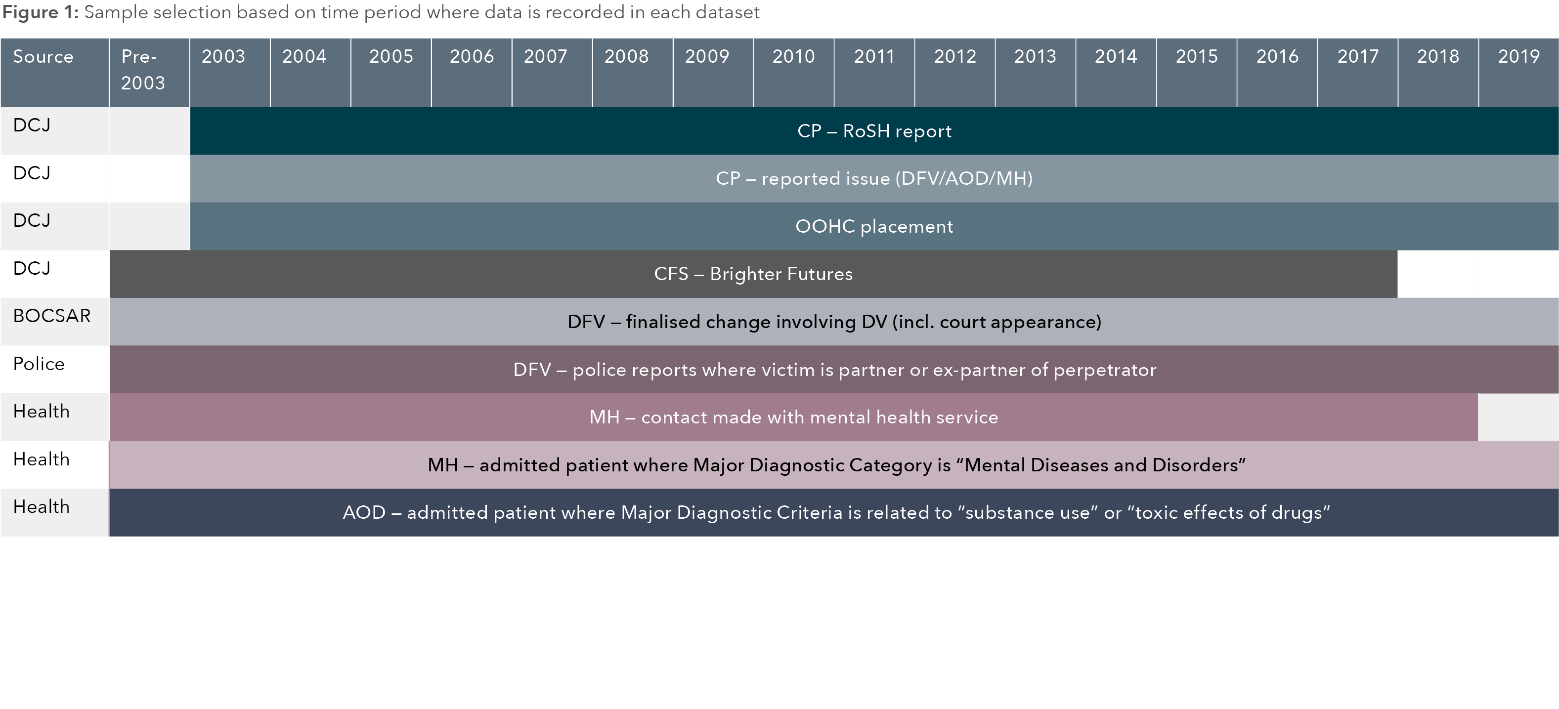
Data table for Figure 1:
|
Where data is recorded in each dataset |
Source |
Time period |
|---|---|---|
|
CP – RoSH report |
DCJ |
2003 – 2019 |
|
CP – reported issue (DFV/AOD/MH) |
DCJ |
2003 – 2019 |
|
OOHC placement |
DCJ |
2003 – 2019 |
|
Brighter Futures |
DCJ |
Pre-2003 – 2017 |
|
DFV – finalised change involving DV (including court appearance) |
BOSCAR |
Pre-2003 – 2019 |
|
DFV – police reports where victim is partner or ex-partner of perpetrator |
Police |
Pre-2003 – 2019 |
|
MH – contact made with mental health service |
Health |
Pre-2003 – 2018 |
|
MH – admitted patient where Major Diagnostic Category is “Mental Diseases and Disorders” |
Health |
Pre-2003 – 2019 |
|
AOD – admitted patient where Major Diagnostic Criteria is related to “substance use” or “toxic effects of drugs” |
Health |
Pre-2003 – 2019 |
Figure 2: Breakdown of final sample of children and parents included for analysis

Text alternative for figure 2
- 584,365 children with a first report to the Child Protection Helpline between January 2004 to June 2018
- 330,168 children with a child protection report could be linked to a parent identifier
-
- 217,181 mothers
- 234,331 “other” parents
- 257,842 children with available geographic location information after matching with parents.
For the analysis, dummy variables (which take the values of 0 and 1) were created to indicate the presence or absence of parental DFV, AOD use and MH issues based on issues reported at Helpline contact. It is important to note here that these issues are the focus of this study, but they were not necessarily the “only” issues identified in child concern reports. Other forms of maltreatment may have been present such as neglect, or physical, sexual or emotional abuse, but these were not used for analysis. Additional dummy variables were created to flag where there was co-occurrence between the risk factors; that is, whether reports were for DFV only, DFV alongside AOD use or MH issues, or there was co-occurrence of DFV, AOD use and MH issues. The total number of reports involving each risk factor (or their co‑occurrence) were also calculated based on: 1) the period 12 months after children’s first ever child concern report;as well as 2) the period before entry into OOHC for children who did enter care within 12 months of their first child concern report. Variables were also created to reflect the number of risk factors (1, 2 or 3) children were exposed to in the first 12 months after their first child concern report as well as before entry into OOHC.
Data analysis
Descriptive statistics for continuous variables and frequency distributions for categorical variables were calculated to outline the pattern of issues related to DFV, AOD use, MH issues and their co-occurrences, as reported in child protection Helpline reports. The prevalence and co-occurrence of parental AOD use, DFV and MH issues were first established based on reports made to the child protection Helpline between 2004 and 2018. This was followed by further descriptive statistical analysis to show how issues reported to child protection were associated with parents’ interactions with “external” services as recorded in police, court and health databases before the first Helpline report. The uptake of child and family services (i.e. the Brighter Futures program) by parents with multiple risk factors was also examined. Descriptive statistics of the co-occurrence of risk factors based on geographic location were carried out to determine differencesbetween metropolitan, regional and remote areas of NSW.
Finally, descriptive statistics of numbers of children who entered OOHC and had a history of child concern reports involving DFV, AOD use and MH issues were explored. Unadjusted and adjusted binomial logistic regression models were used to estimate the odds ratios and effect sizes for the impact of multiple risk factors on the probability of children entering OOHC within 12 months of the first child concern report. Data analysis was conducted using the statistical program Statistical Analysis Software (SAS) Studio for Windows, release 5.2. The procedure PROC GENMOD was used to run the binomial logistic regressions with entry into OOHC as the dependent variable. Generalised estimating equations (GEE) were used for the regression models to allow for dependence within clusters (i.e. sibling groups).
Results
What is the prevalence and co-occurrence of DFV, AOD use and MH issues in the sample?
Of the 584,365 children who had their first child concern reports from January 2004 to June 2018, 193,705 children had reports with concerns about parental DFV or concerns about parental DFV alongside AOD use and/or MH issues (33%) within the 12 months after their first report. As indicated in Figure 3, of these 193,705 children, 157,356 children had reports related to DFV only (81%); 18,492 had reports for co-occurring DFV and parental AOD use (10%); 13,225 had reports for co-occurring DFV and parental MH issues (7%); and 4,632 had reports for co-occurring DFV, parental AOD use and parental MH issues (2%).
The focus of the analysis will be on the 193,705 children who had child concern reports related to parental DFV and its co-occurrence with parental AOD use and/or MH issues. The categorisation of these children is based on the number of reported risk factors within the first 12 months after first child concern report and is as follows: 1) DFV only reports, referred to as “DFV-only”; 2) DFV alongside either AOD or MH reports, referred to as “DFV‑AOD/MH”; and 3) DFV alongside both AOD and MH reports, referred to as “DFV-AOD-MH”.
As depicted in Figure 4, for children who did not have reported issues related to DFV throughout their interactions with the child protection system, their average age at first Helpline report was 89.2 months (SD = 64.8) or about 7.4 years, total number of reports received was 1.8 (SD = 1.8) and total RoSH reports received was 1.1 (SD = 1.2). For children who had child concern reports related to DFV alone, the average age at first Helpline report was 66.7 months (SD = 58.8) or about 5.6 years. Children’s average age at first Helpline report decreased with more co-occurring risk factors related to parental AOD use and/or MH issues: 40.6 months (SD = 50.5) or 3.4 years for children with DFV‑AOD/MH reports, and 26.9 months (SD = 42.5) or 2.2 years for children with DFV-AOD-MH reports. A total of 217,181 sibling groups were identified based onchildren with the same mother and it was found that the size of sibling groups differed based on whether children in that sibling group experienced any DFV. The average size was 1.38 (SD = 0.7) for a sibling group that had not experienced DFV, whereas it was 1.74 (SD = 1.0) for a sibling group that had experienced DFV. It is noted, however, that there are limitations around calculating the sibling group size due to limited data quality and availability when relying on children being recorded as having the same mother in the RBDM dataset.
The total number of reports children received in the 12 months after their first child concern report from 2004 to 2018 displayed a similar pattern: children with DFV-only reports had an average total of 2.0 reports (SD = 1.8), 5.2 reports (SD = 3.7) for children with DFV-AOD/MH reports, and 9.0 reports (SD = 5.3) for children with DFV-AOD-MH reports. This pattern was the same for total number of reports that were considered RoSH: children with DFV-only reports had an average total of 1.1 RoSH reports (SD = 1.2), 3.2 RoSH reports (SD = 2.5) for children with DFV-AOD/MH reports, and 5.5 RoSH reports (SD = 3.6) for children with DFV-AOD-MH reports. Hence, children with more co-occurring risk factors relating to parental DFV, AOD use and MH issues tended to be younger at first report, had more Helpline reports and more Helpline reports considered to meet the RoSHthreshold.
A comparison of characteristics for the 330,168 children who could be linked with their parents with the 254,197 children who could not be so linked revealed that these two groups were similar in the distribution of gender and age at first Helpline report. However, there were differences in the number of reported risk factors in the 12 months following first child concern report. For instance, linked children generally had more co-occurring risk factors than non‑linked children, respectively: 31 per cent versus 22 per cent for DFV-only, 7 per cent versus 4 per cent for DFV‑AOD/MH, and 1 per cent versus 0.5 per cent for DFV-AOD-MH. Further, the total number of child concern reports was higher for linked children (M = 2.29, SD = 2.4) than for unlinked children (M = 1.78, SD = 1.9), as was the total number of RoSH reports. Such results suggest the sample of children linked with theirparents may be a biased sample in which these families are likely to be having more interactions with the child protection and OOHC systems overall, as well as other NSW services.
Figure 3: Breakdown of the nature of concerns across Helpline reports in the first 12 months after the first child concern report related to parental DFV and co-occurrence with parental AOD use and/or MH issues (n = 193,705 children) 2.4
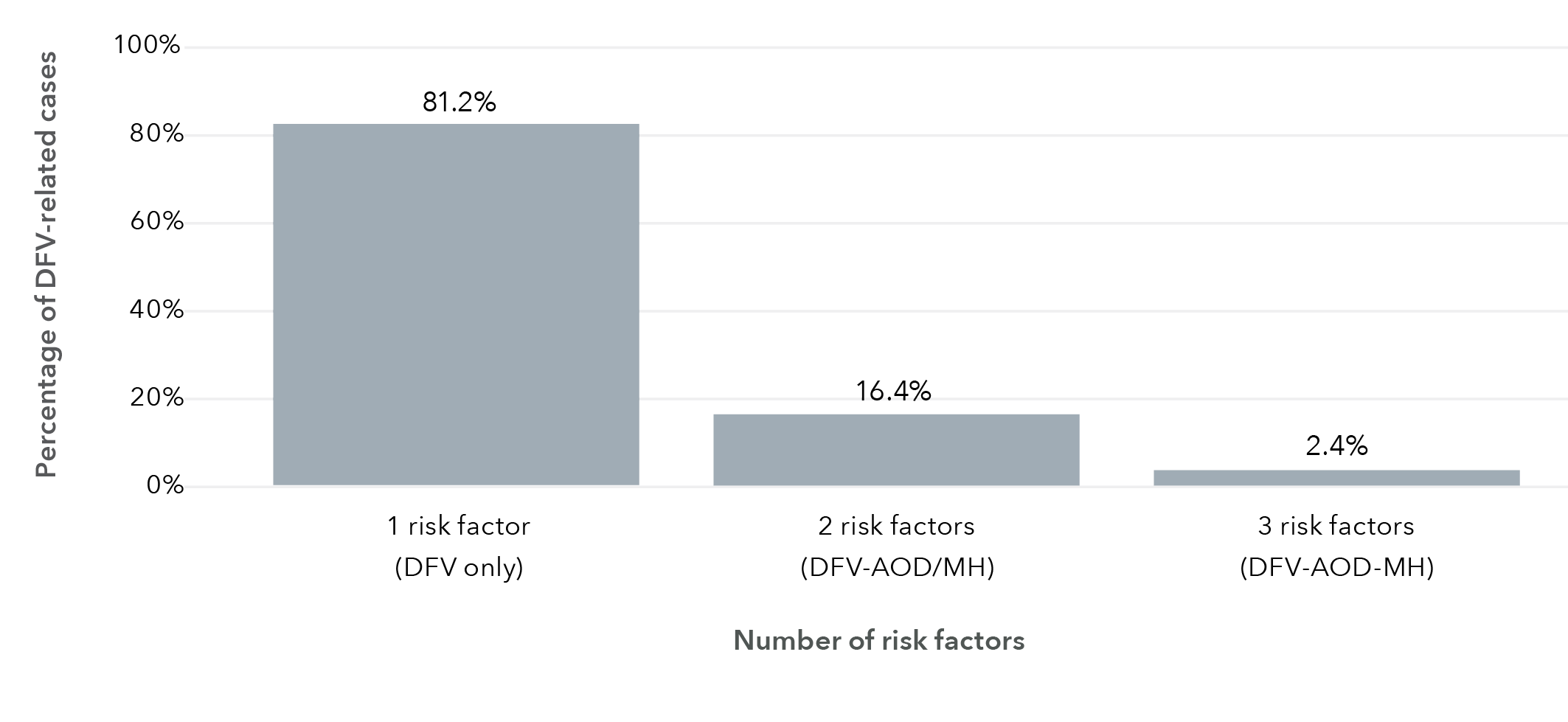
Data table for Figure 3:
|
Number of risk factors |
Percentage of DFV-related cases (%) |
|---|---|
|
1 risk factor (DFV only) |
81.2 |
|
2 risk factors (DFV-AOD/MH) |
16.4 |
|
3 risk factors (DFV-AOD-MH) |
2.4 |
Are these risk factors associated with other markers of DFV, AOD use and MH issues outside of the NSW child protection system?
This analysis examined the percentage of mothers and “other” parents who had a child concern report and engaged with other NSW services including police services as victims of DFV or perpetrators of DFV, mental health services, and admissions to hospital for AOD use. Table 1 shows the number and percentage of parents who had interactions with external systems related to DFV (i.e. police reports and finalised charges): 31 per cent of mothers and 9 per cent of “other” parents with children in the NSW child protection system were recorded in a police report as a victim of a DFV incident in which the perpetrator was a current or ex-partner at any point between 1997 and 2019. Of the “other” parents, 1 in 10 had a court appearance with a finalised charge for perpetrating DFV compared with less than 1 in 20 mothers. In addition, about 1 in 10 mothers and “other” parents were recorded as having interactions with mentalhealth services or were admitted to hospitals for MH issues or AOD use.
Focusing on the parents whose children had a child concern report involving parental DFV with co-occurring parental AOD use and/or MH issues, a pattern is apparent in relation to their interactions with police, courts, mental health services and hospitals prior to first Helpline report (Figure 5). To illustrate the differences in interactions based on combinations of risk factors, children with risk factors related to DV-AOD or DV-MH are shown separately here. The figure shows the percentage of children who had at least one parent[6] interact with an external service associated with DFV, AOD use and MH issues outside of child protection. It is evident that over two-fifths (40%) of children with child concern reports involving DFV issues, either alone or in conjunction with parental AOD use and/or MH issues,had at least one parent who was a victim of a DFV incident as recorded in police reports before the children’s first Helpline report. Further, about 1 in 20 children in the sample have at least one parent who had a finalised charge for DFV before their first Helpline report.
In addition, children with reports related to DFV-AOD-MH had parents with the highest level of interactions with mental health services and hospitals for MH issues or AOD use prior to their first Helpline report compared to children with reports involving only one or two of the risk factors of interest. Where children had risk factors related to MH issues in child concern reports, there were corresponding patterns of parents’ interactions with mental health services and hospitalisations for MH issues prior to first Helpline report. Similarly, where children had risk factors related to parental AOD use in child concern reports, there were corresponding patterns for parents admitted to hospitals for AOD use prior to first Helpline report in addition to admission for MH issues.
Figure 4: Comparisons between groups based on the nature of concerns across Helpline reports for a) mean age at first Helpline report; and b) total number of Helpline reports and total number of RoSH reports within 12 months after the first Helpline report (n = 584,365 children)
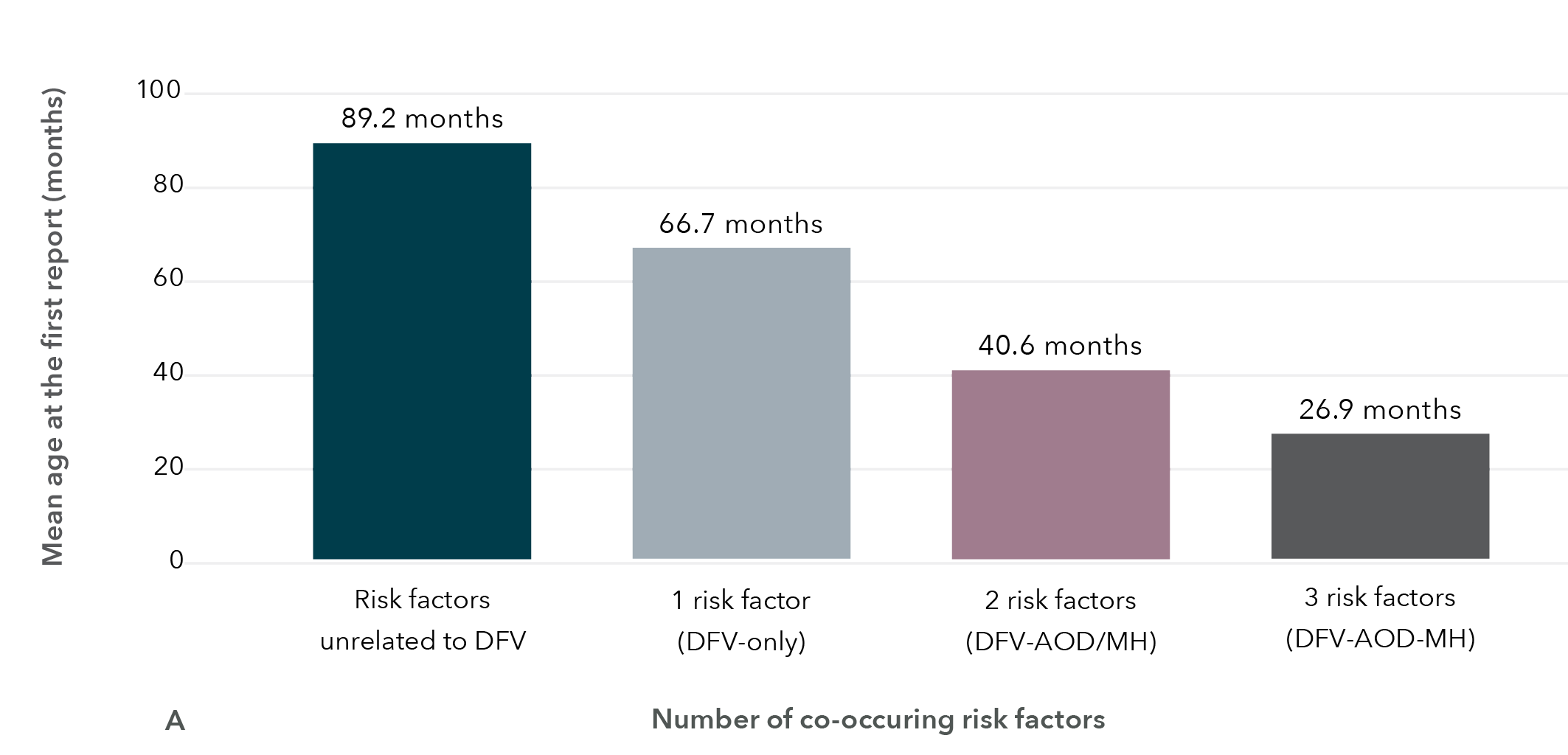
Data table for Figure 4-A:
|
Number of co-occurring risk factors |
Mean age at the first report (months) |
|---|---|
|
Risk factors unrelated to DFV |
89.2 |
|
1 risk factor (DFV-only) |
66.7 |
|
2 risk factors (DFV-AOD/MH) |
40.6 |
|
3 risk factors (DFV-AOD-MH) |
26.9 |
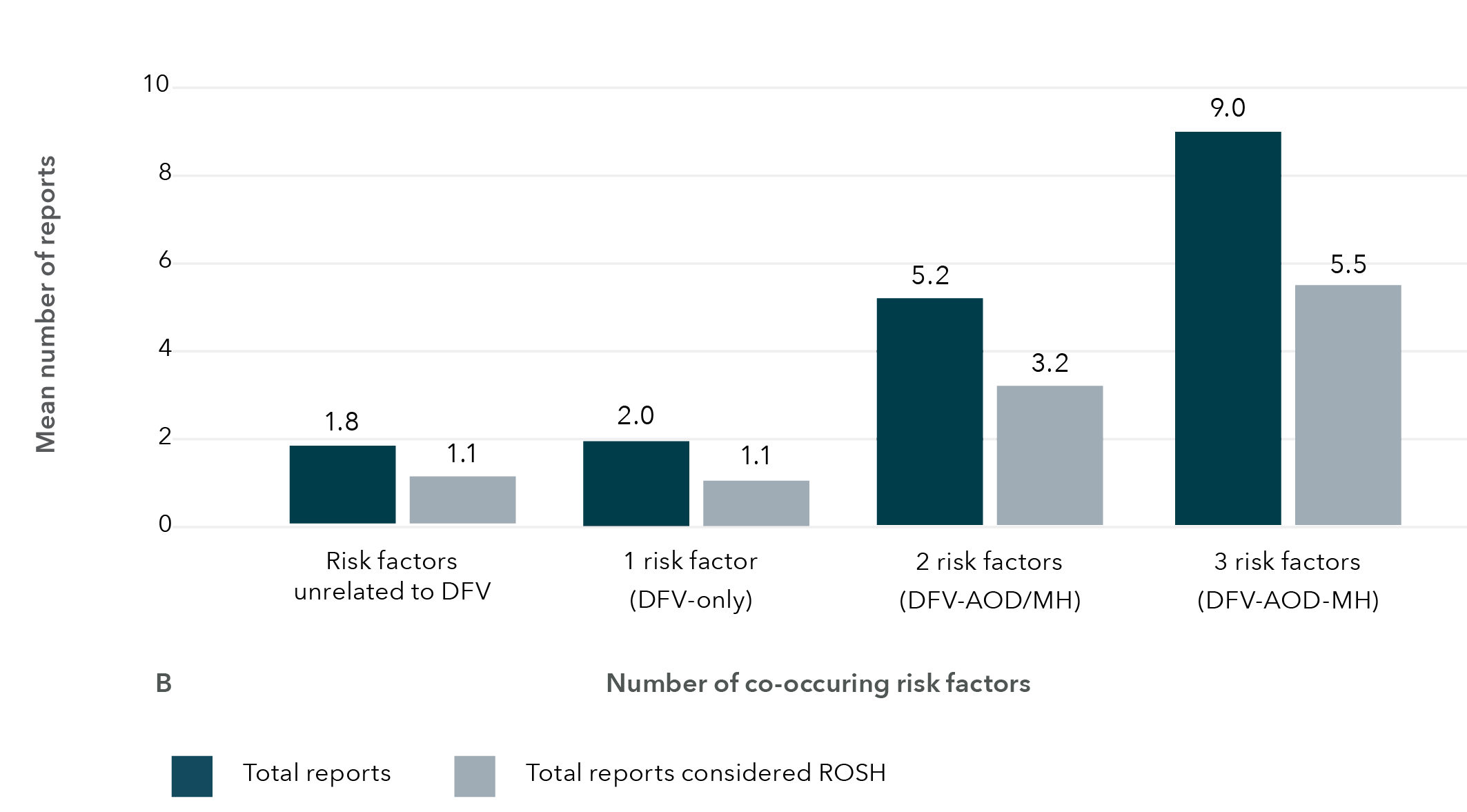
Data table for Figure 4-B:
|
Number of co-occurring risk factors |
Mean number of reports: Total reports |
Mean number of reports: Total reports considered RoSH |
|---|---|---|
|
Risk factors unrelated to DFV |
1.8 |
1.1 |
|
1 risk factor (DFV-only) |
2.0 |
1.1 |
|
2 risk factors (DFV-AOD/MH) |
5.2 |
3.2 |
|
3 risk factors (DFV-AOD-MH) |
9.0 |
5.5 |
Of particular interest was where parents interacted with external services for AOD use or MH issues but there was no corresponding record in child concern reports for these risk factors. For example, there were 102,130 children who had child concern reports flagging issues related only to DFV, but between 7 to 16 per cent of children had parents who used mental health services or were hospitalised for MH issues or AOD use prior to first Helpline report. Of 9,475 children with parental MH issues flagged in their child concern report, only about 26 per cent of children had at least one parent who had accessed mental health ambulatory services prior to first Helpline report, indicating that parental MH issues are possibly not being detected or addressed until there is contact with the child protection system. Such findings also suggest that there may be an underreporting of issues and risk factors within child concern reports, whether because theissue was not identified when the report was made to Helpline, or it was not the primary concern recorded.
Table 1: Number (and percentage) of mothers and other parents with children who had a child concern report and involvement with other NSW services for DFV, AOD use and MH issues
|
Mother (n = 217,181) |
Other parent (n = 234,331) |
|
|---|---|---|
|
Finalised charge – DFV |
8,400 (4%) |
22,976 (10%) |
|
DFV police reports (victim) |
68,283 (31%) |
19,999 (9%) |
|
MHAMB |
32,742 (15%) |
24,675 (11%) |
|
APDC mental health |
20,944 (10%) |
14,979 (6%) |
|
APDC alcohol/drugs |
31,712 (15%) |
36,195 (15%) |
Figure 5: Percentage of children who have had at least one parent interact with external services (police, courts, mental health services and hospital admissions) prior to children’s first Helpline report based on co-occurring risk factors
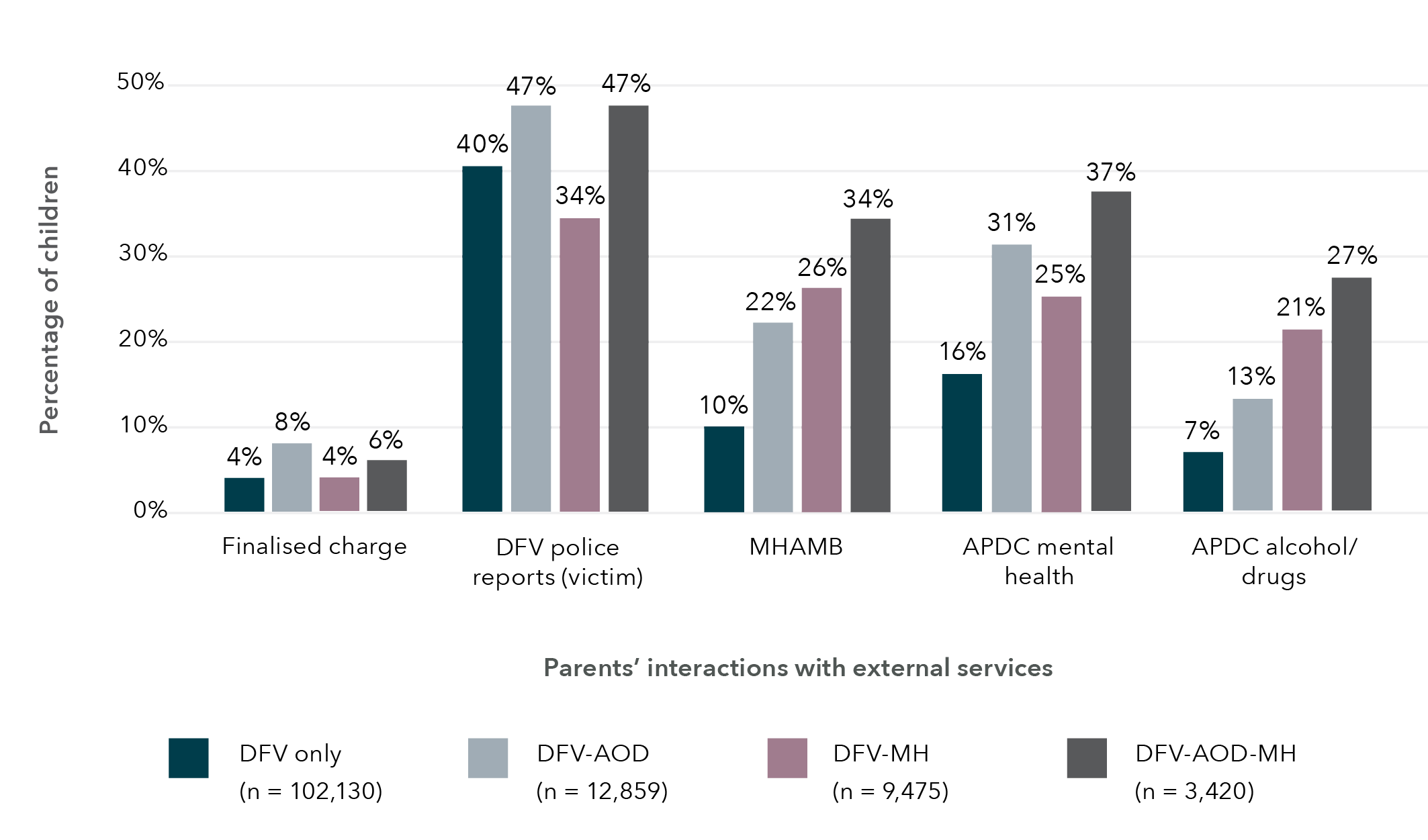
Data table for Figure 5:
|
Parents’ interactions with external services |
% DFV only (n=102,130) |
% DFV-AOD (n=12,859) |
% DFV-MH (n=9,475) |
% DFV-AOD-MH (n=3,420) |
|---|---|---|---|---|
|
Finalised charge |
4 |
8 |
4 |
6 |
|
DFV police reports (victim) |
40 |
47 |
34 |
47 |
|
MHAMB |
10 |
22 |
26 |
34 |
|
APDC mental health |
16 |
31 |
25 |
37 |
|
APDC alcohol/drugs |
7 |
13 |
21 |
27 |
To better capture the extent to which the number of issues flagged in child concern reports was associated with parents’ interactions with external services, Table 2 presents the average number of interactions mothers had with external services prior to the first Helpline report based on the combination of issues noted in child concern reports. In general, with increasing co-occurring risk factors, there were some increases in interactions with external services, although there is wide variability as indicated by the standard deviations. In general, for mothers who had interactions with courts, police, mental health services and hospitals prior to their children’s first Helpline report, the average number of interactions was about one or two times, with the exception of mental health service usage. Mothers of children with DFV-only reports interacted with mental health services an average of 8.3 times (SD = 42.3) and this increased forchildren with DFV-AOD/MH reports (M = 13.0, SD = 67.9) and DFV-AOD-MH reports (M = 10.0, SD = 40.4).
Similarly, Table 3 presents the average number of interactions “other” parents had with external services prior to the children’s first Helpline reports based on the combination of issues noted in child concern reports. The average number of interactions “other” parents had with courts, police, mental health services and hospitals prior to the children’s first Helpline report was comparable to that of mothers. However, there were substantial differences in use of mental health services, with “other” parents using these services about 20 times before first Helpline report.
Table 2: Mean (SD) number of mothers’ interactions with external services prior to the first Helpline report based on number of risk factors identified in child concern reports
|
DFV-only |
DFV-AOD/MH |
DFV-AOD-MH |
|
|---|---|---|---|
|
Finalised charge – DFV |
1.28 (0.7) |
1.48 (1.0) |
1.81 (1.4) |
|
DFV police reports (victim) |
1.41 (1.0) |
1.86 (1.6) |
1.87 (1.5) |
|
MHAMB |
8.26 (42.3) |
12.96 (67.9) |
9.98 (40.4) |
|
APDC mental health |
2.25 (7.0) |
2.73 (8.8) |
2.61 (3.2) |
|
APDC alcohol/drugs |
1.36 (1.5) |
1.70 (2.0) |
1.98 (2.0) |
Table 3: Mean (SD) number of other parents’ interactions with external services based on number of risk factors identified in child concern reports
|
DFV-only |
DFV-AOD/MH |
DFV-AOD-MH |
|
|---|---|---|---|
|
Finalised charge – DFV |
1.45 (0.9) |
1.62 (1.1) |
1.62 (1.0) |
|
DFV police reports (victim) |
1.16 (0.5) |
1.26 (0.7) |
1.40 (0.9) |
|
MHAMB |
21.14 (113.0) |
20.56 (104.8) |
19.83 (89.7) |
|
APDC mental health |
2.23 (5.0) |
2.45 (5.6) |
2.78 (6.9) |
|
APDC alcohol/drugs |
1.55 (2.0) |
1.74 (2.3) |
1.93 (2.2) |
What was the child and family service uptake of these families with co‑occurring risk factors?
For the overall sample, uptake of the Brighter Futures program was quite low, with just over 21,755 (10%) mothers and 9,921 “other” parents (4%) engaged in the program. There is an observed interaction between families having one or more risk factors related to DFV, AOD use, MH issues and parents’ participation in Brighter Futures. As the Brighter Futures program targets families with a child under 9 years at risk of entering the child protection system, Figure 6 depicts the percentage of children aged under 9 years at first Helpline report whose parent engaged with the Brighter Futures program before their children’s first report was recorded. In general, engagement with the program was low: 4 per cent for DFV-only, and a slight increase at 7 per cent for DFV-AOD/MH, and 6 per cent for DFV-AOD-MH. In examining the number of engagements with the program prior to child protection involvement, Table 4 indicates that most parents wereinvolved on average at least once, and mothers participated in the program more often than “other” parents.
As a further illustration of the overrepresentation of mothers in the Brighter Futures program, Figure 7 shows the breakdown of participation before the child’s first Helpline report by region type. Within each region type, mothers comprised nearly three-quarters (69–77%) of program participants and “other” parents less than a third (23‑31%) of participants. Hence, there is a clear focus on involvement of mothers over “other” parents (i.e. typically fathers).
How do risk factors differ by region classification?
While it is important to note that data on geographic locations were not available for all families (i.e. only 257,842 or 44% of children who could be matched with their parents), analysis was conducted where possible. Figure 8 shows the percentage of children with co-occurring risk factors flagged in child concern reports within each of the different region types (metropolitan, inner regional, outer regional, remote/very remote). In general, DFV-only was the most common risk factor across region types (over 74%) and percentages decreased with more co-occurring risk factors. The percentage of children flagged for all three risk factors (DFV-AOD-MH) were similar across all region types at about 2 to 4 per cent.
Figure 6: Percentage of children aged under 9 years at first child concern report who have at least one parent engaged in the Brighter Futures program before the children’s first Helpline report based on the combination of DFV, AOD and MH risk factors reported
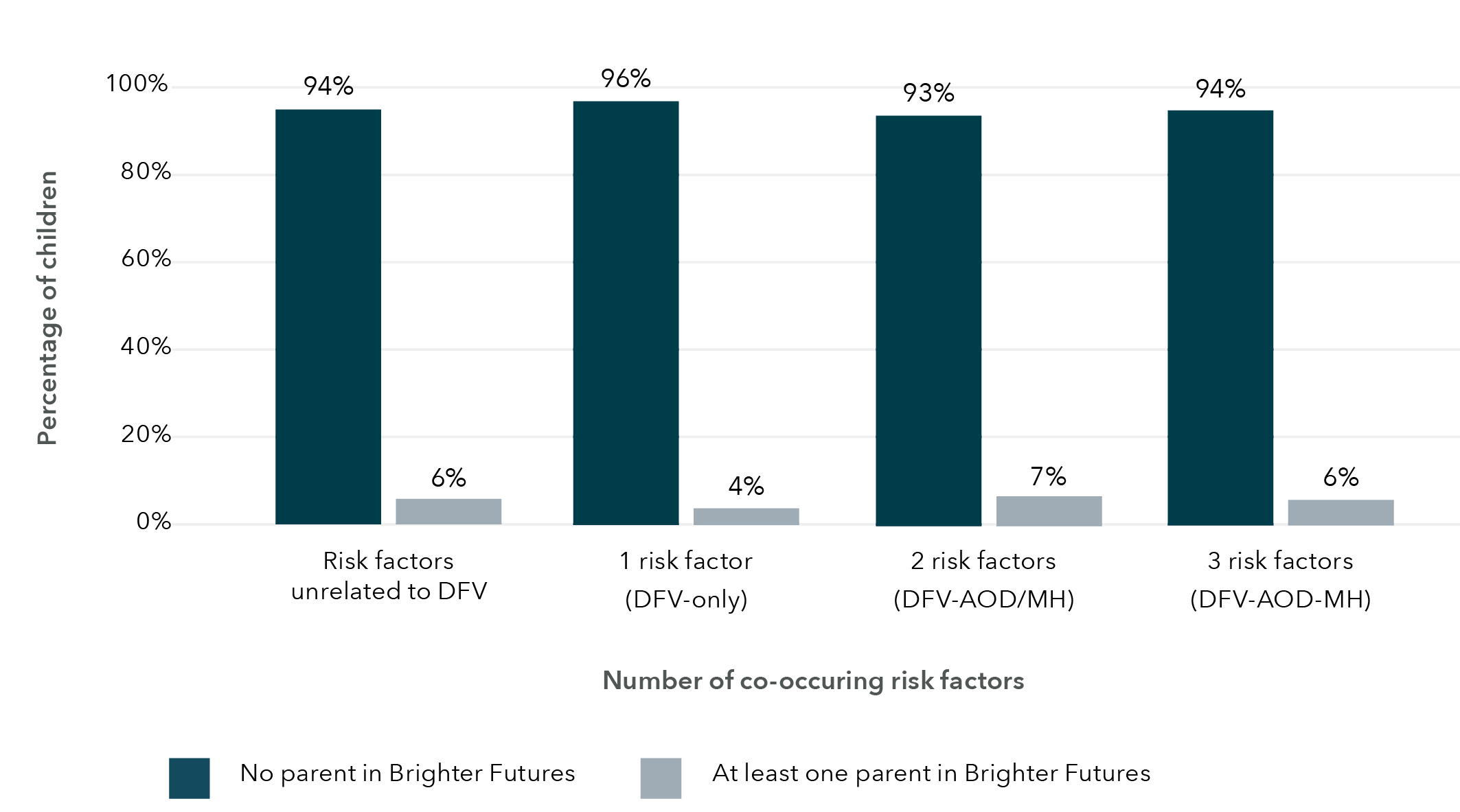
Data table for Figure 6:
|
Number of co-occurring risk factors |
Percentage of children (%): |
Percentage of children (%): |
|---|---|---|
|
Risk factors unrelated to DFV |
94 |
6 |
|
1 risk factor (DFV-only) |
96 |
4 |
|
2 risk factors (DFV-AOD/MH) |
93 |
7 |
|
3 risk factors (DFV-AOD-MH) |
94 |
6 |
Table 4: Mean number (SD) of engagements with Brighter Futures prior to the children’s first Helpline report based on the number of risk factors flagged in the child concern report
|
DFV-only (1 risk factor) |
DFV-AOD/MH (2 risk factors) |
DFV-AOD-MH (3 risk factors) |
|
|---|---|---|---|
|
Brighter Futures – mother |
1.21 (0.5) |
1.27 (0.6) |
1.35 (0.7) |
|
Brighter Futures – “other” parent |
1.12 (0.4) |
1.15 (0.5) |
1.27 (0.7) |
Using SA2 geographic locations where available, it was possible to calculate the total number of children in each area based on the number of co-occurring risk factors flagged in child concern reports within the 12 months after first child concern report and determine the top quartile of SA2s with the highest combined prevalence of these issues reported from 2004 to 2018. These are shown in Table 5, in which a ● indicates that the SA2 was listed in the top quartile based on the number of co-occurring issues. For instance, the SA2 area of Liverpool was in the top quartile for DFV-only, DFV-AOD/MH, DFV-AOD-MH, and for overall reported issues, whereas the SA2 area of Kempsey was in the top quartile for DFV-AOD/MH only. For ease of identifying locations, the list is divided into metropolitan (Sydney), metropolitan (outside Sydney), and inner regional. Indicators of disadvantage based on the Index of Relative Socio‑economic Disadvantage (IRSD) in theSocio-Economic Indexes for Areas (SEIFA) 2016 are also provided with each SA2 area listed (ABS, 2018).
Certain SA2s appeared in the top quartile for all categories of DFV-only, DFV-AOD/MH, DFV-AOD-MH, and all combinations. These are: Sydney metropolitan SA2 areas of Blacktown (East) – Kings Park, Jamisontown – South Penrith, Kingswood – Werrington, Liverpool, Mount Druitt – Whalan, Rosemeadow – Glen Alpine and St Marys – North St Marys; metropolitan SA2 areas outside Sydney of Bateau Bay – Killarney Vale, Gosford – Springfield, Warnervale – Wadalba; and inner regional SA2 areas of Dubbo – South, Orange – North, Tamworth – East, and Wagga Wagga – South. Other SA2 areas appear in the top quartile for only one category of co-occurring risk factors: Kempsey and Taree (DFV-AOD/MH); Gorokan – Kanwal – Charmhaven, Kurri Kurri – Abermain, Maitland – East, and Grafton (DFV-AOD-MH). Across the top quartile of SA2 areas listed, about 42 per cent were in the first decile, which are considered the most disadvantaged areas in NSW. Overall, nearly80 per cent of the SA2 areas in this top quartile have a SEIFA decile of 4 or lower.
Figure 7: Percentage of mothers and “other” parents who have participated in the Brighter Futures program prior to the child’s first Helpline report, across different region types
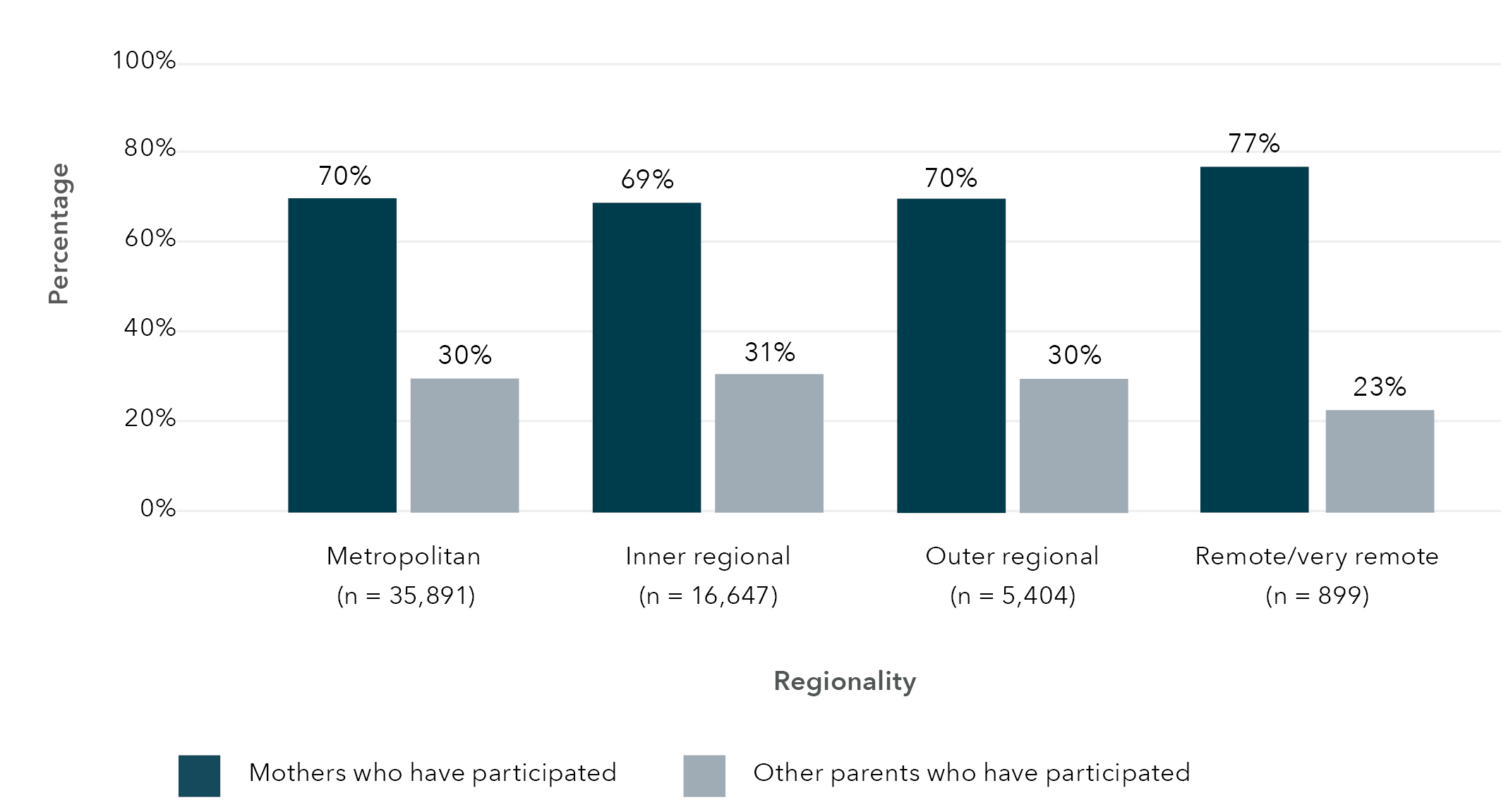
Data table for Figure 7:
|
Region type |
Mothers who have participated (%) |
Other parents who have participated (%) |
|---|---|---|
|
Metropolitan (n = 35,891) |
70 |
30 |
|
Inner regional (n=16,647) |
69 |
31 |
|
Outer regional (n=5,404) |
70 |
30 |
|
Remote/very remote (n=899) |
77 |
23 |
Figure 8: Percentage of children with flags for co-occurring risk factors within different region types (n = 103,532)
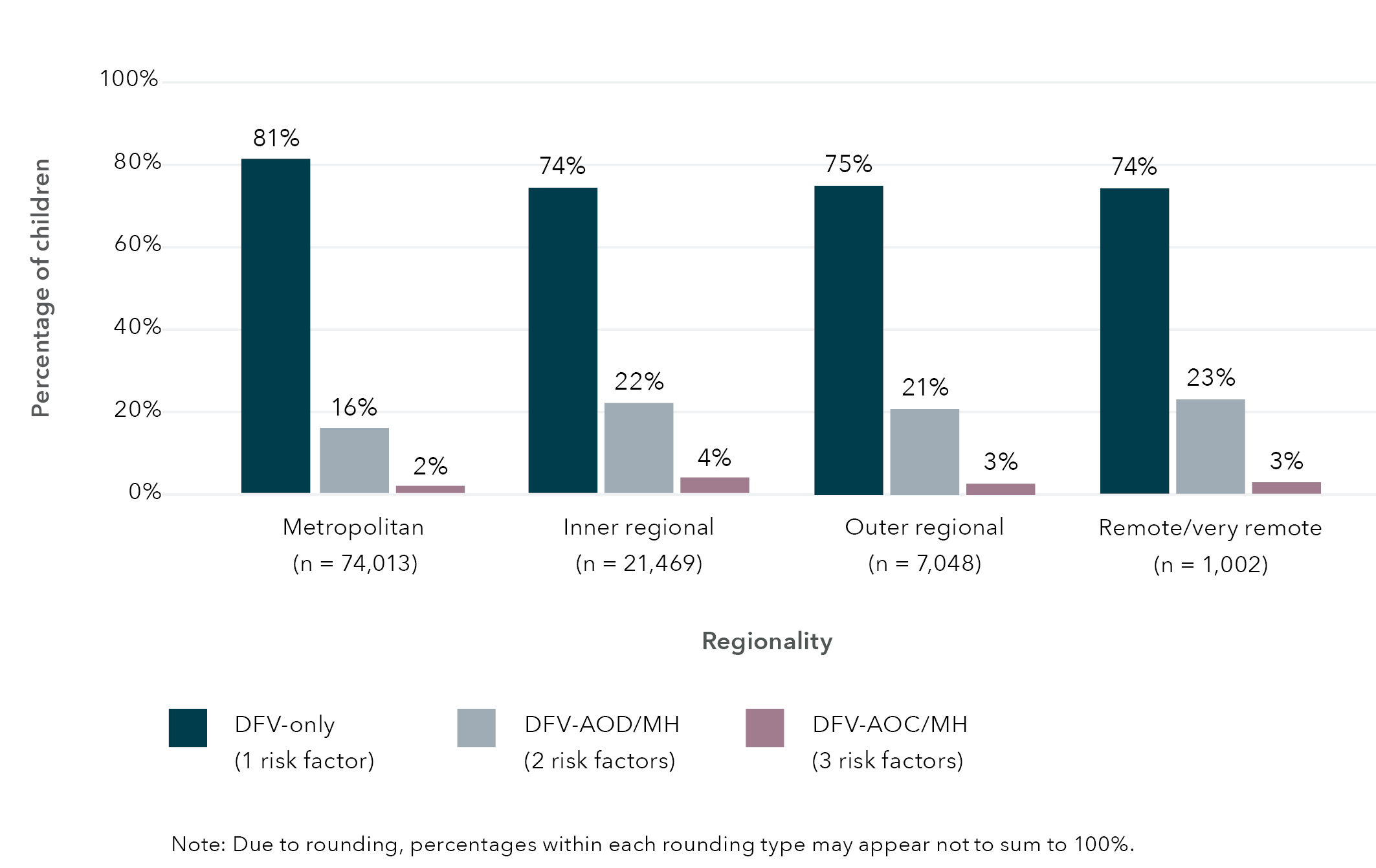
Data table for Figure 8:
|
DFV-only (1 risk factor) |
DFV-AOD/MH (2 risk factors) |
DFV-AOC/MH (3 risk factors) |
|
|---|---|---|---|
|
Metropolitan (n=74,013) |
81% |
16% |
2% |
|
Inner regional (n=21,469) |
74% |
22% |
4% |
|
Outer regional (n=7,048) |
75% |
21% |
3% |
|
Remote/very remote (n=1,002) |
74% |
23% |
3% |
Due to rounding, percentages within each rounding type may appear not to sum to 100%
Number of children who entered OOHC for the first time in the 12 months after the first child concern report and associations with co-occurring risk factors
Of the 584,365 children who received their first child concern report between 2004 and 2018, 4.8 per cent (n = 28,235) had a recorded entry into OOHC, and 2 per cent (n = 11,746) entered OOHC for the first time in the 12 months after their first child concern report. Of the 11,476 children who entered care in the 12 months after their first child concern report, most were initially placed in foster care (65%) or kinship care (33%), with the remaining children in residential care (2%). The average number of placements was 2.82 (SD = 2.7), and average age at first placement was 51.0 months (SD = 50.9) or 4.3 years, ranging from birth to 215 months (or 17.9 years).
Compared to the 572,619 children who did not enter care in the 12 months after their first child concern report, the 11,746 children who did enter care in the 12 months were younger at first child concern report, had more child concern reports overall and total reports considered RoSH (Table 6). In addition, the average number of co-occurring risk factors related to parental DFV, AOD use and MH issues was higher for children who had entered care in the 12 months after their first child concern report than those who did not.
Figure 9 presents the percentage of children with flags in their child concern reports for parental DFV, AOD use and/or MH issues prior to entering OOHC for the first time between 2004 and 2019. For comparison, the left-hand side of the figure includes percentages of children who entered care where flags in their child concern reports were not related to DFV. It is not suggested that other types of maltreatment (including neglect) are not relevant to a child’s entry into OOHC; however, the focus of this study is on DFV alongside parental AOD use and/or MH issues, and the findings of this study suggest that having a history of these risk factors is strongly associated with a child’s entry into OOHC. As shown in Figure 9, percentages of children with a flag for DFV-only were comparable to children with flags for issues unrelated to DFV in terms of entry into OOHC. However, where there was increasing co-occurrence between parental DFVwith AOD use and/or MH issues, the percentages of children entering OOHC for the first time also increased.
In focusing on the children who have a flag for DFV with co-occurring parental AOD use and/or MH issues, Figure 10 shows the number of children entering OOHC for the first time between 2004 and 2018 with flags in child protection reports for parental DFV, AOD use and/or MH issues in the 12 months following the children’s first Helpline report. The years 2004 to 2018 are shown since these are complete calendar years in which data were available. In general, the highest number of first entries into OOHC within the 12 months following the first child concern report were seen for children who had flags for parental DFV alongside either parental AOD use or MH issues, followed by children who had flags for only DFV and children who had flags for all three risk factors (DFV-AOD-MH). Interestingly, peaks and dips were observed in the periods between 2009 and 2011, as well as from 2014 onwards. These changes could, in part, reflect the Keep Them Safe(KTS) and Safe Home for Life (SHFL) reforms that came into effect in January 2010 and October 2014 respectively (DCJ, 2020). These periods of reforms will be factored into the regression modelling in the next section when determining the odds of children’s first entry into OOHC associated with the co-occurrence of parental DFV, AOD use and MH issues.
Table 5 (A-C): Top quartile of SA2 regions (in alphabetical order) based on total number of children with co-occurring factors and SEIFA decile indicating socio-economic disadvantage in the state
● Black circle indicates that the SA2 location is represented in the top quartile based on the number and combination of co-occurring risk factors.
A) Metropolitan (Sydney)
|
SA2 name |
DV-only (1 risk factor) |
DV-AOD/MH (2 risk factors) |
DV-AOD-MH (3 risk factors) |
All combinations of risk factors |
SEIFA 2016 decile a |
|---|---|---|---|---|---|
|
Ashcroft – Busby – Miller |
● Black circle |
● Black circle |
● Black circle |
1 |
|
|
Auburn – Central |
● Black circle |
● Black circle |
1 |
||
|
Bankstown – North |
● Black circle |
● Black circle |
1 |
||
|
Blacktown (East) – Kings Park |
● Black circle |
● Black circle |
● Black circle |
● Black circle |
4 |
|
Cabramatta – Lansvale |
● Black circle |
● Black circle |
1 |
||
|
Fairfield – West |
● Black circle |
● Black circle |
1 |
||
|
Greystanes – Pemulwuy |
● Black circle |
● Black circle |
● Black circle |
7 |
|
|
Jamisontown – South Penrith |
● Black circle |
● Black circle |
● Black circle |
● Black circle |
6 |
|
Kingswood – Werrington |
● Black circle |
● Black circle |
● Black circle |
● Black circle |
4 |
|
Lakemba |
● Black circle |
● Black circle |
1 |
||
|
Liverpool |
● Black circle |
● Black circle |
● Black circle |
● Black circle |
1 |
|
Merrylands – Holroyd |
● Black circle |
● Black circle |
2 |
||
|
Mount Druitt – Whalan |
● Black circle |
● Black circle |
● Black circle |
● Black circle |
1 |
|
Punchbowl |
● Black circle |
1 |
|||
|
Rosemeadow – Glen Alpine |
● Black circle |
● Black circle |
● Black circle |
● Black circle |
3 |
|
St Marys – North St Marys |
● Black circle |
● Black circle |
● Black circle |
● Black circle |
1 |
B) Metropolitan (outside Sydney)
|
SA2 name |
DV-only (1 risk factor) |
DV-AOD/MH (2 risk factors) |
DV-AOD-MH (3 risk factors) |
All combinations of risk factors |
SEIFA 2016 decile a |
|---|---|---|---|---|---|
|
Bateau Bay – Killarney Vale |
● Black circle |
● Black circle |
● Black circle |
● Black circle |
5 |
|
Cessnock |
● Black circle |
● Black circle |
1 |
||
|
Gorokan – Kanwal – Charmhaven |
● Black circle |
2 |
|||
|
Gosford – Springfield |
● Black circle |
● Black circle |
● Black circle |
● Black circle |
4 |
|
Kurri Kurri – Abermain |
● Black circle |
2 |
|||
|
Maitland – East |
● Black circle |
4 |
|||
|
Warnervale – Wadalba |
● Black circle |
● Black circle |
● Black circle |
● Black circle |
6 |
C) Inner Regional
|
SA2 name |
DV-only (1 risk factor) |
DV-AOD/MH (2 risk factors) |
DV-AOD-MH (3 risk factors) |
All combinations of risk factors |
SEIFA 2016 decile a |
|---|---|---|---|---|---|
|
Coffs Harbour – North |
● Black circle |
● Black circle |
3 |
||
|
Dubbo – South |
● Black circle |
● Black circle |
● Black circle |
● Black circle |
5 |
|
Grafton |
● Black circle |
1 |
|||
|
Kempsey |
● Black circle |
1 |
|||
|
Lismore |
● Black circle |
● Black circle |
2 |
||
|
North Nowra – Bomaderry |
● Black circle |
● Black circle |
5 |
||
|
Orange – North |
● Black circle |
● Black circle |
● Black circle |
● Black circle |
6 |
|
Tamworth – East |
● Black circle |
● Black circle |
● Black circle |
● Black circle |
4 |
|
Taree |
● Black circle |
1 |
|||
|
Wagga Wagga – South |
● Black circle |
● Black circle |
● Black circle |
● Black circle |
4 |
Notes:
a Based on the Index of Relative Socio-economic Disadvantage (IRSD) in the Socio-Economic Indexes for Areas (SEIFA) 2016 within NSW.
Table 6: Mean (SD) age at first child concern report, total number of reports, total RoSH and non-RoSH reports, and number of co-occurring risk factors based on entry into OOHC within 12 months after the first Helpline report, n = 584,365
|
Characteristics |
Entered OOHC n = 11,746 |
Did not enter OOHC within 12 months after first Helpline report n = 572,619 |
|---|---|---|
|
Age at first child concern report in months |
22.33 (44.8) |
81.17 (63.8) |
|
Total number of child concern reports |
6.18 (5.0) |
1.98 (2.0) |
|
Total number of RoSH reports |
3.81 (3.1) |
1.17 (1.4) |
|
Total number of non-RoSH reports |
2.37 (3.0) |
0.82 (1.2) |
|
Number of co-occurring risk factors related to DFV, AOD and MH issues |
1.89 (0.7) |
0.53 (0.6) |
Odds of entering OOHC within a year of first child concern report based on the number of co‑occurring risk factors
Two binomial logistic regressions were conducted to determine odds ratios (ORs) and 95% confidence intervals for entry into care within a year of the first child concern report based on the number of co-occurring risk factors (i.e. non-DFV issues, DFV-only, DFV-AOD/MH, and DFV-AOD-MH). The first model looked at the individual associations between entry into OOHC within a year of the first child concern report with the number of co-occurring risk factors: child’s sex; age at first child protection Helpline report; total RoSH and non-RoSH reports before entry into OOHC; regionality (i.e. metropolitan, inner regional, outer regional/remote/very remote); policy reform period; and order and number of siblings. The second adjusted model explored the association between co-occurring risk factors and entry into OOHC within a year of the first child concern report while controlling for the other aforementioned variables given their relationshipto entry into OOHC. Robust standard errors were estimated to account for clustering due to the sibling group (i.e. having the same mother). Descriptive statistics are provided in Table 7, and estimates from the regression are outlined in Table 8.
Prior to conducting the logistic regression models, checks were made for multicollinearity between variables. Correlations between the continuous variables were produced to check for high correlations, and 2 x 2 contingency tables between the categorical variables were produced to examine whether there were disproportionate cell sizes or substantial overlap between variables. Due to small cell sizes, the geographical categories for “outer regional”, “remote” and “very remote” were collapsed into a combined category. In addition, a categorical variable to represent sibling order based on date of birth was created and included in the model. It is noted that this variable reflects sibling order rather than actual birth order as not all children within a sibling group may have been identified or have a child concern report. An additional categorical variable to reflect changes in policies related to KTS and SHFL was also generated and includedin the model to control for the year of the first Helpline report.
Figure 9: Percentage of children with flags in their child concern reports for parental DFV, AOD use and/or MH issues prior to entering OOHC for the first time (n = 584,365)
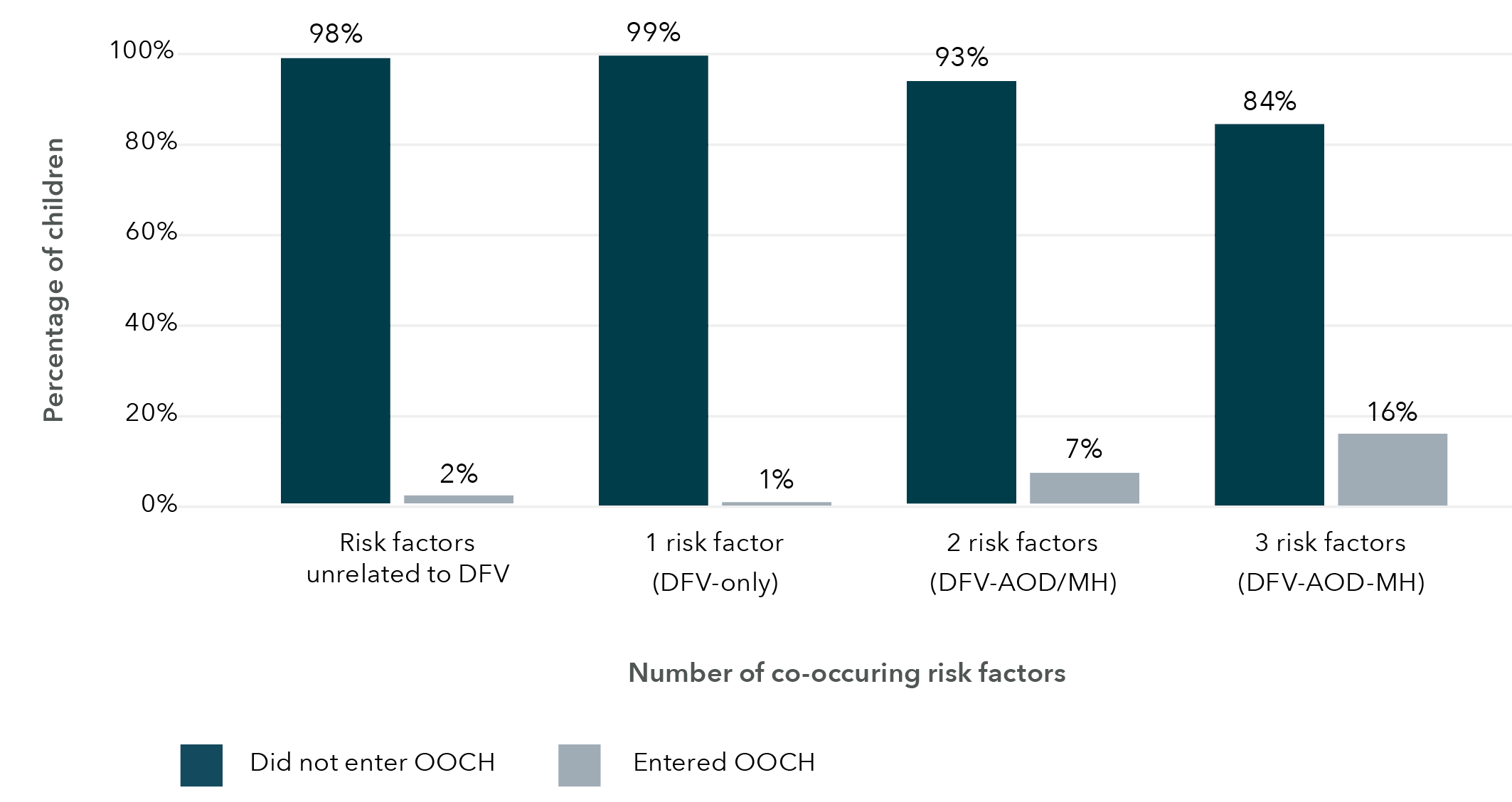
Data table for Figure 9:
|
Did not enter OOCH (%) |
Entered OOCH (%) |
|
|---|---|---|
|
Risk factors unrelated to DFV |
98 |
2 |
|
1 Risk factor (DFV-only) |
99 |
1 |
|
2 risk factors (DFV-AOD/MH) |
93 |
7 |
|
3 risk factors (DFV-AOD-MH) |
84 |
16 |
Figure 10: Number of children entering OOHC for the first time with flags in child protection reports for parental DFV, AOD use and/or MH issues within 12 months of their first Helpline report – 2004 to 2018
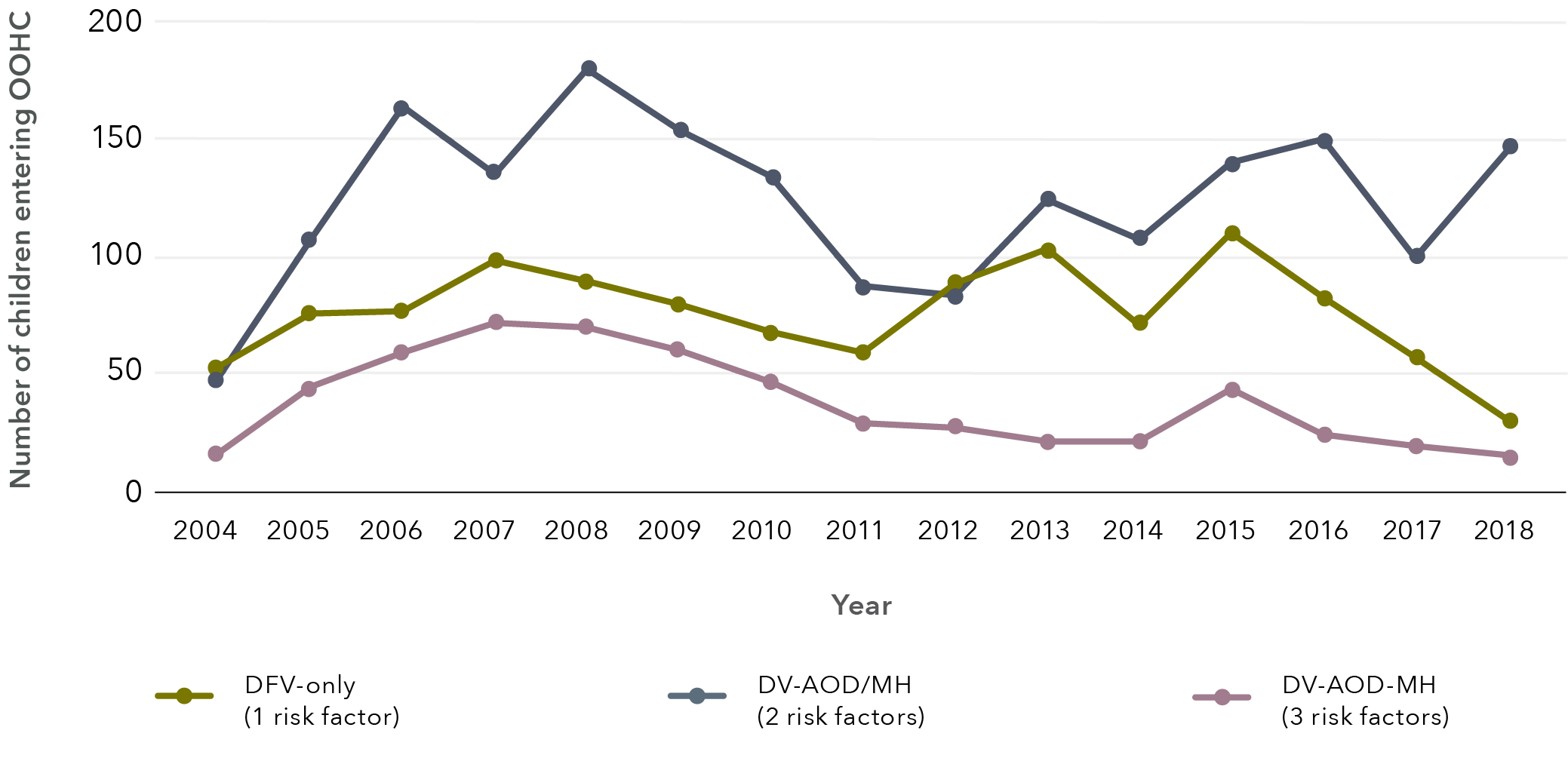
Data table for Figure 10:
|
DFV-only (1 risk factor) |
DV-AOD/MH (2 risk factors) |
DV-AOD-MH (3 risk factors) |
|
|---|---|---|---|
|
2004 |
53.5 |
47.7 |
16.8 |
|
2005 |
76.1 |
107.7 |
44.5 |
|
2006 |
77.4 |
163.2 |
60.0 |
|
2007 |
99.4 |
137.4 |
72.9 |
|
2008 |
89.7 |
180.6 |
70.3 |
|
2009 |
80 |
154.2 |
61.3 |
|
2010 |
68.4 |
134.8 |
47.7 |
|
2011 |
59.4 |
87.7 |
29.7 |
|
2012 |
89.7 |
83.2 |
28.4 |
|
2013 |
103.2 |
125.2 |
21.9 |
|
2014 |
72.9 |
109.0 |
22.6 |
|
2015 |
110.3 |
140.6 |
43.9 |
|
2016 |
83.2 |
150.3 |
25.2 |
|
2017 |
58.7 |
100.6 |
20.0 |
|
2018 |
31.0 |
147.7 |
15.5 |
Table 7 (A-G): Descriptive statistics of characteristics based on entry to OOHC (N = 245,352)
A) Number of co-occurring factors
|
Characteristics |
Entered OOHC: No |
Entered OOHC: Yes |
|---|---|---|
|
DFV only (1 risk factor) |
79,165 (33%) |
487 (10%) |
|
DFV-AOD/MH (2 risk factors) |
17,151 (7%) |
950 (20%) |
|
DFV-AOD-MH (3 risk factors) |
2,384 (1%) |
325 (7%) |
|
Factors unrelated to DV |
141,949 (59%) |
2,941 (63%) |
B) Regionality
|
Characteristics |
Entered OOHC: No |
Entered OOHC: Yes |
|---|---|---|
|
Metropolitan |
169,625 (70%) |
3,233 (69%) |
|
Inner regional |
52,046 (22%) |
1,100 (23%) |
|
Outer regional/remote/very remote |
18,978 (8%) |
370 (8%) |
C) Child’s sex
|
Characteristics |
Entered OOHC: No |
Entered OOHC: Yes |
|---|---|---|
|
Female |
116,863 (49%) |
2,291 (49%) |
|
Male |
123,786 (51%) |
2,412 (51%) |
D) Age at first CP report
|
Characteristics |
Entered OOHC: No |
Entered OOHC: Yes |
|---|---|---|
|
0–1 years |
68,077 (28%) |
4,062 (86%) |
|
2–5 years |
77,426 (32%) |
434 (9%) |
|
6–10 years |
63,537 (26%) |
145 (3%) |
|
11–15 years |
31,609 (13%) |
62 (1%) |
E) Policy reform period
|
Characteristics |
Entered OOHC: No |
Entered OOHC: Yes |
|---|---|---|
|
Pre-KTS (before Jan 2010) |
109,974 (46%) |
1,696 (36%) |
|
KTS reforms (Jan 2010 to Oct 2014) |
70,783 (29%) |
2,024 (43%) |
|
SHFL reforms (Oct 2014 onwards) |
59,892 (25%) |
983 (21%) |
F) Sibling order
|
Characteristics |
Entered OOHC: No |
Entered OOHC: Yes |
|---|---|---|
|
First |
146,245 (61%) |
2,062 (44%) |
|
Second |
62,859 (26%) |
1,292 (27%) |
|
Third |
21,957 (9%) |
699 (15%) |
|
Fourth or younger |
9,588 (4%) |
650 (14%) |
G) M (SD)
|
Entered OOHC: No |
Entered OOHC: Yes |
|
|---|---|---|
|
Total RoSH reports |
1.32 (1.5) |
3.81 (2.8) |
|
Total non-RoSH reports |
0.93 (1.4) |
2.67 (2.2) |
|
Total number of siblings |
1.13 (1.2) |
1.75 (1.6) |
Table 8 (A-L): Parameter estimates from the risk factors generalised estimation equations (GEE) analysis
A) Number of co-occurring factors: Unadjusted model
|
Characteristics |
Beta estimate |
Std error |
Odds ratio |
OR 95%CI: Min. |
OR 95%CI: Max. |
|---|---|---|---|---|---|
|
DFV only (1 risk factor) |
|||||
|
DFV-AOD/MH (2 risk factors) |
2.20**** |
0.06 |
6.58 |
5.76 |
7.51 |
|
DFV-AOD-MH (3 risk factors) |
3.10**** |
0.08 |
22.16 |
18.87 |
26.03 |
|
Factors unrelated to DV |
1.21**** |
0.05 |
2.46 |
2.13 |
2.85 |
B) Number of co-occurring factors: Adjusted model
|
Characteristics |
Beta estimate |
Std error |
Odds ratio |
OR 95%CI: Min. |
OR 95%CI: Max. |
|---|---|---|---|---|---|
|
DFV only (1 risk factor) |
|||||
|
DFV-AOD/MH (2 risk factors) |
0.87**** |
0.07 |
0.53 |
0.43 |
0.65 |
|
DFV-AOD-MH (3 risk factors) |
0.75**** |
0.11 |
2.13 |
1.70 |
2.66 |
|
Factors unrelated to DV |
1.40**** |
0.06 |
0.89 |
0.73 |
1.09 |
C) Regionality: Unadjusted model
|
Characteristics |
Beta estimate |
Std error |
Odds ratio |
OR 95%CI: Min. |
OR 95%CI: Max. |
|---|---|---|---|---|---|
|
[Metropolitan] |
|||||
|
Inner regional |
0.10** |
0.04 |
1.08 |
0.95 |
1.24 |
|
Outer regional/remote/very remote a |
0.02 |
0.06 |
1.11 |
1.03 |
1.20 |
D) Regionality: Adjusted model
|
Characteristics |
Beta estimate |
Std error |
Odds ratio |
OR 95%CI: Min. |
OR 95%CI: Max. |
|---|---|---|---|---|---|
|
[Metropolitan] |
|||||
|
Inner regional |
-0.22**** |
0.04 |
1.04 |
0.90 |
1.20 |
|
Outer regional/remote/very remote a |
-0.26** |
0.07 |
0.80 |
0.73 |
0.88 |
E) Age at first CP report: Unadjusted model
|
Characteristics |
Beta estimate |
Std error |
Odds ratio |
OR 95%CI: Min. |
OR 95%CI: Max. |
|---|---|---|---|---|---|
|
0–1 years |
|||||
|
2–5 years |
-2.37**** |
0.06 |
0.35 |
0.26 |
0.46 |
|
6–10 years |
-3.26**** |
0.10 |
0.86 |
0.64 |
1.16 |
|
11–15 years |
-3.42**** |
0.14 |
0.03 |
0.03 |
0.04 |
F) Age at first CP report: Adjusted model
|
Characteristics |
Beta estimate |
Std error |
Odds ratio |
OR 95%CI: Min. |
OR 95%CI: Max. |
|---|---|---|---|---|---|
|
0–1 years |
|||||
|
2–5 years |
-2.24**** |
0.06 |
0.24 |
0.18 |
0.33 |
|
6–10 years |
-3.20**** |
0.11 |
0.63 |
0.46 |
0.88 |
|
11–15 years |
-3.65**** |
0.15 |
0.03 |
0.02 |
0.03 |
G) Child’s sex: Unadjusted model
|
Characteristics |
Beta estimate |
Std error |
Odds ratio |
OR 95%CI: Min. |
OR 95%CI: Max. |
|---|---|---|---|---|---|
|
[Female] |
|||||
|
Male |
-0.01 |
0.03 |
0.99 |
0.94 |
1.05 |
H) Child’s sex: Adjusted model
|
Characteristics |
Beta estimate |
Std error |
Odds ratio |
OR 95%CI: Min. |
OR 95%CI: Max. |
|
|---|---|---|---|---|---|---|
|
[Female] |
||||||
|
Male |
-0.02 |
0.03 |
0.98 |
0.92 |
1.05 |
I) Policy reform period: Unadjusted model
|
Characteristics |
Beta estimate |
Std error |
Odds ratio |
OR 95%CI: Min. |
OR 95%CI: Max. |
|---|---|---|---|---|---|
|
[SHFL reforms 2014 onwards] |
|||||
|
KTS reforms (2010 to 2014) |
-0.06 |
0.05 |
1.06 |
0.97 |
1.16 |
|
Pre-KTS (before 2010) |
0.56**** |
0.04 |
0.57 |
0.53 |
0.63 |
J) Policy reform period: Adjusted model
|
Characteristics |
Beta estimate |
Std error |
Odds ratio |
OR 95%CI: Min. |
OR 95%CI: Max. |
|---|---|---|---|---|---|
|
[SHFL reforms 2014 onwards] |
|||||
|
KTS reforms (2010 to 2014) |
0.12* |
0.05 |
2.16 |
1.93 |
2.41 |
|
Pre-KTS (before 2010) |
-0.77**** |
0.06 |
0.89 |
0.81 |
0.98 |
K) Sibling order: Unadjusted model
|
Characteristics |
Beta estimate |
Std error |
Odds ratio |
OR 95%CI: Min. |
OR 95%CI: Max. |
|---|---|---|---|---|---|
|
[First] |
|||||
|
Second |
0.38**** |
0.03 |
3.30 |
2.98 |
3.65 |
|
Third |
0.81**** |
0.04 |
2.13 |
1.92 |
2.37 |
|
Fourth or younger |
1.57**** |
0.05 |
4.81 |
4.36 |
5.31 |
|
Total RoSH reports |
0.38**** |
0.01 |
1.46 |
1.44 |
1.48 |
|
Total non-RoSH reports |
0.34**** |
0.01 |
1.41 |
1.39 |
1.44 |
|
Total number of siblings |
0.30**** |
0.01 |
1.35 |
1.32 |
1.38 |
L) Sibling order: Adjusted model
|
Characteristics |
Beta estimate |
Std error |
Odds ratio |
OR 95%CI: Min. |
OR 95%CI: Max. |
|---|---|---|---|---|---|
|
[First] |
|||||
|
Second |
-0.01 |
0.04 |
0.91 |
0.79 |
1.06 |
|
Third |
-0.08 |
0.06 |
0.98 |
0.86 |
1.13 |
|
Fourth or younger |
-0.10 |
0.08 |
0.91 |
0.77 |
1.07 |
|
Total RoSH reports |
0.28**** |
0.01 |
1.32 |
1.30 |
1.34 |
|
Total non-RoSH reports |
0.18**** |
0.01 |
1.19 |
1.17 |
1.21 |
|
Total number of siblings |
0.19**** |
0.02 |
1.21 |
1.17 |
1.26 |
Notes:
Reference group is indicated using square brackets.
a Includes categories “outer regional”, “remote” and “very remote” due to small cell sizes.
**p < .01 ***p < .001 **** p < .0001.
In the unadjusted model, each combination of co-occurring risk factors, as well as other risk factors not related to DFV, were associated with greater odds of entering OOHC within a year of the first child concern report compared to having parental DFV as a risk factor in the absence of parental AOD use or MH issues. Odds of entering OOHC increased with more co-occurring risk factors related to parental AOD use and/or MH issues compared to children who experienced DFV alone: 6.6 times (OR = 6.58, 95%CI [5.76, 7.51]) for two risk factors (DFV-AOD/MH), and 22.2 times (OR = 22.16, 95%CI [18.87, 26.03]) for three risk factors (DFV-AOD-MH). Odds of entering OOHC where children experienced risk factors unrelated to DFV was 2.5 times greater (OR = 2.46, 95%CI [2.13, 2.85]) than for DFV alone. Other key variables in the unadjusted model were associated with entry into OOHC within a year of the first child concernreport. Compared to living in metropolitan areas, there were increased odds of entering OOHC by 1.08 times or 8 per cent (OR = 1.08, 95%CI [0.95, 1.24]) for inner regional areas. Children had decreased odds of entering OOHC the older they were at first Helpline report when compared to children aged 0 to 1 year at first Helpline report: a reduction of 65 per cent (OR = 0.35, 95%CI [0.26, 0.46]) for 2 to 5-year-olds, 14 per cent (OR = 0.86, 95%CI [0.64, 1.16]) for 6 to 10-year-olds, and 97 per cent (OR = 0.03, 95%CI [0.03, 0.04]) for 12 to 15-year-olds. When compared to the period where SHFL came into effect (from 2014 onwards), the odds of a child entering OOHC within a year of their first concern report was reduced by 43 per cent (OR = 0.57, 95%CI [0.53, 0.63]) during the period before the KTS reforms (which came into effect in 2010). Further, siblings who were born later, whencompared to the oldest sibling involved in the child protection system, appeared to have greater odds of entering OOHC: 3.3 times (OR = 3.30, 95%CI [2.98, 3.65]) for the second oldest sibling; 2.1 times (OR = 2.13, 95%CI [1.92, 2.37]) for the third oldest sibling; and 4.8 times (OR = 4.81, 95%CI [4.36, 5.31]) for the fourth oldest or younger sibling. An additional RoSH report was associated with increased odds of entering OOHC by 1.46 times or 46 per cent (OR = 1.46, 95%CI [1.44, 1.1.48]), and each additional sibling was associated with an increased odds of entering OOHC by 1.35 times or 35 per cent (OR = 1.35, 95%CI [1.32, 1.38]).
In focusing on the key variable of interest, the results of the adjusted regression model suggest that when all other variables are held constant, the co-occurrence of risk factors was associated with the odds of entering OOHC in the 12 months after the first child concern report when compared to children who experienced DFV alone: a decrease of 0.53 times (OR = 0.53, 95%CI [0.43, 0.65]) for DFV-AOD/MH, and an increase by 2.1 times (OR = 2.13, 95%CI [1.70, 2.66]) for DFV-AOD-MH. Odds of entering OOHC where children experienced risk factors unrelated to DFV decreased by 0.89 times or 11 per cent (OR = 0.89, 95%CI [0.73, 1.09]) than for DFV alone. Although the odds ratios were attenuated in the adjusted model, associations with entry to OOHC within a year of the first child concern report for the other variables remained statistically significant, with the exception of sibling order.
Discussion
While there has long been recognition that families who come to the attention of the child protection system have complex needs that include DFV, AOD use and MH issues, this study is the first in the Australian context to quantify the prevalence of these factors for children reported for child protection concerns. For the children included in this study, 33 per cent had child concern reports indicating the presence of parental DFV on its own or in combination with parental AOD use and MH issues. This is likely to be an undercount due to limitations in the way that data were collected, and, as suggested, by instances where parents had interacted with police, mental health or hospitals but there was no record of concerns related to DFV, AOD use and MH issues in their child’s Helpline reports. However, data on parents’ interactions with services also reinforce the Helpline information with over40 per cent of children who have parental DFV (either alone or in conjunction with parental AOD use and/or MH issues) flagged in child concern reports having at least one parent, predominantly a mother, who is recorded in police reports as a victim of a DFV incident prior to the children’s first Helpline report.
In alignment with the cumulative risk framework (Raviv et al., 2010), there are strong associations between the presence of parental DFV and its co-occurrence with parental AOD use and/or MH issues and child protection involvement as well as the use of other services. Children who had a child concern report related to DFV only or in combination with parental AOD use and/or MH issues were younger when the first report was made to the Helpline than children for whom these concerns were not reported. The presence of parental AOD use and/or MH issues alongside DFV is associated with increased numbers of reports – more than three times as many reports when two risk factors were identified and more than four times as many reports when all three factors were reported. Likewise, the presence of parental AOD use or MH issues with DFV is associated with almost three times the rate of RoSH reports as DFV alone and this increases to more than six timeswhen all three factors are reported. As indicated by the cumulative risk framework (Raviv et al., 2010), the number or combination of risks facing the child’s caregiver is associated with child protection involvement, rather than the presence of a specific risk factor.
These findings align with current safety and risk assessment practice in DCJ which recognises the associations of DFV, MH issues and AOD use with children’s safety. DCJ use a suite of Structured Decision Making (SDM) tools to support decisions and assessments made surrounding the safety and risk of children living with a household member subject to a RoSH report in NSW. SARA is the acronym for “safety and risk assessment” and encompasses “safety assessments” that support decisions concerning the child’s safety in the household and the need for a safety plan, and “risk assessments” that guide the practitioner in deciding whether a case requires ongoing services or may be closed (Curijo, 2021). Criteria that inform a safety assessment include, among others, “drug use impairing parenting”, “domestic/family violence”, “psychological harm”, and “parent unable to provide care”. Ultimately, this model of risk assessment is designed toelicit professional judgement to guide decision making and classifies families according to the likelihood of subsequent or ongoing child maltreatment (Curijo, 2021).
This association is also observed in entries to OOHC. Controlling for other factors, additional risk factors were associated with odds of entry relative to having only experienced DFV alone: by 0.53 times for parental DFV alongside AOD use or MH issues and by 2.1 times for co-occurring DFV, AOD use and MH issues. This suggests that children are more likely to enter OOHC within the year after their first child concern report when they were experiencing all three co‑occurring risk factors of parental DFV, AOD use and MH issues. An association between co-occurring risk factors flagged in child concern reports is also observed in service data, with more risk factors associated with, on average, more court appearances, police victim reports for DFV incidents, use of mental health services, and hospitalisations for AOD use or MH issues. NSW legislation introduced in 2018 specifies that the Children’s Court must assess whether there is a realisticpossibility of restoration to parental care (also called reunification) within “a reasonable period” (within 24 months), as the preferred goal for children who enter OOHC (Children and Young Persons [Care and Protection] Amendment Act 2018 [NSW]). Previous Australian research has found that reunification is less likely when parents experience substance abuse, serious mental health problems and DFV as individual and joint risk factors (Fernandez & Lee, 2011), with substance abuse standing out as a key factor (Delfabbro et al., 2015). The introduction of specified timeframes for reunification places significant pressure on families experiencing complex needs, who need access to often scarce mental health, AOD and DFV services, and intensive case management.
Children whose families experienced DFV in combination with AOD use and MH issues showed greater likelihood of entering OOHC. It is important to recognise the potential for early intervention to support families in need. For a subsample of children, the study identified geographic areas in NSW where families experiencing DFV only and DFV in combination with AOD use and MH issues are more likely to be reported to child protection. These identified areas should be familiar to policymakers and practitioners aware of the geography of disadvantage in NSW, with nearly four-fifths (79%) of the SA2 regions represented in the top quartile of co-occurring risk factors having a SEIFA decile of 4 or lower.[7] The geographic distribution of families experiencing parental DFV alone and in combination with parental AOD useand MH issues in rural and remote as well as regional and urban areas highlights the importance of service access and pathways that are responsive to place-based needs and reach families before they are in crisis.
The location-based findings need to be interpreted with caution. Investigations into policing practices suggest that some communities, including Aboriginal and Torres Strait Islander communities, are disproportionately surveilled by police (Law Enforcement Conduct Commission, 2020; Redfern Legal Centre, 2023), which could inflate the number of records in areas where these communities live. There is also limited health and police access in some rural and remote regions, which may reduce the likelihood of reports to child protection. It is also crucial to note that areas of high socio-economic disadvantage often have less access to services and resources that promote wellbeing and could help families and communities break cycles of ill health and violence (Australian Institute of Health and Welfare [AIHW], 2022b). In addition, there are associations between the effects of trauma and socio-economic wellbeing (AIHW, 2022c; Abedzadeh-Kalahroudi et al.,2018; Brattström et al., 2015). Individuals who have experienced trauma are more likely to face socio-economic challenges due to disruptions to education and employment opportunities. Combined with cumulative stress and the limited access to resources to assist, this may then further exacerbate socio-economic disparities. Overall, the relationships between child protection involvement with factors such as geographic location, socio-economic disadvantage, health care, policing resources and housing are complex and multi-faceted. Parental DFV, AOD use and MH issues are a serious problem in communities across NSW; the findings are intended to highlight areas in NSW which would benefit from additional DFV, AOD and MH services – areas where health, social and psychological support services for families may have been under-resourced until now.
This study also found relatively low participation in the voluntary Brighter Futures program with only a small fraction of parents (10% of mothers and 4% of “other” parents) of children aged under 9 participating in the program. While the Brighter Futures program is targeted to families who experience DFV, MH issues and AOD use where the number of RoSH reports is not high and for whom restoration is the likely case plan goal, the low uptake suggests that there may be selection bias in which only certain families accept the offer, or it may reflect current risk thresholds or issues with referral processes, service availability or capacity. It is difficult to examine the associations between parent participation in the Brighter Futures program and entry to OOHC for their children using available data. Such an examination would require further investigations and better data collection mechanisms to unpack therole of early intervention programs for families experiencing multiple risk factors.
This study adds to the body of evidence on families with complex needs including parental DFV, AOD use and/or MH issues and their interactions with child protection systems. As noted in the introduction, there has been little empirical research exploring these issues using administrative data in the Australian context, and, with the previous studies conducted in Queensland, Western Australia (Orr et al., 2019; O’Leary et al., 2020) and an unnamed Australian jurisdiction (Meikans et al., 2021), this is the first study reporting on NSW. Unlike the studies reported in the introduction, this study contributes to the literature by tracking prevalence in the co-occurrence of DFV, AOD use or MH issues in families over time and associations with rates of entry into OOHC. The findings reinforce other research, including from the STACY project (Humphreys et al., 2020; Heward-Belle et al., 2020), on the overlapping experiences of DFV, AOD use and MH issues inthe lives of families who come to the attention of child protection and the exacerbation of child protection concerns leading to entry to care in the absence of early intervention.
Strengths and limitations
As noted in the background section of this report, there is very little research literature that has empirically examined the co-occurrence of DFV, AOD use and MH issues with child protection involvement for families in Australia. For the first time, this study has generated population-level statistics on the co-occurrence of DFV, AOD use and MH issues with child protection involvement in NSW.
The strengths of the study highlight the value of linked administrative data. First, there is a line of sight that is not available through other data sources. The study used data collected across different service systems rather than relying exclusively on administrative data compiled by child protection workers. This allows for confirmation of the presence of risk factors in other data sources (e.g. whether DFV reported in police data emerges in child protection data), and the ability to uncover risk factors that may be otherwise unknown and undercounted (e.g. where DFV emerges in police data but not child protection data). Second, the whole population of children involved with child protection is included in the study, not a sample that has self-nominated to take part in research. This minimises sampling bias and the bias that can come from missing data if participants are lost to follow-up or withdraw from a study. However, it should be noted thatthere were issues in this study where the sample was reduced due to an inability to link parent records to all children in the child protection dataset. Third, there is also the advantage of being able to measure trajectories over long periods of time. In this case, it is possible to observe the nature of child concern reports and association with subsequent entry to care.
There are also limitations in the use of administrative data for research in the context of child protection. First, since administrative data are not collected for research purposes, key variables are sometimes not documented in the dataset. Similarly, the depth and quality of information recorded in the dataset may be insufficient for research purposes. That is, administrative data may not capture information that offers a complete picture of individual, familial and environmental factors and circumstances that are relevant for research purposes. For example, cultural background is not consistently recorded, and it was not possible to calculate the number of siblings each child had at their first child concern report due to data quality and availability issues. However, linked administrative data can overcome some of these limitations by including data collected across multiple and different service systems with clear indicationsof the timing for each interaction or event.
Second, under-reporting or under-recording can lead to a biased understanding of the incidence of particular risk factors or outcomes. For example, there may be a bias towards reporting physical violence and under-reporting of other forms of violence. In addition, lack of available data for particularly hard-to-reach cohorts may impact the generalisability of results across a population. For example, data about fathers is often not routinely captured by child protection services but is captured about mothers. This can result in correlations being made about maternal characteristics and child protection involvement that may be misleading and that do not accurately convey the influence of fathers’ behaviours on child safety and wellbeing. Understanding paternal characteristics and child protection involvement is particularly salient in this context given that perpetrators of DFV are predominantly fathers. Yet little data is collected aboutthem hence it is difficult to develop and implement policy to redress the risks they pose to children and their mothers. Enhancing perpetrator accountability is a cornerstone of national policy to reduce violence against women and children. Making fathers who use domestic violence more visible within systems – including data management systems – is key to collecting accurate epidemiological data to develop meaningful policy. Issues with data linkage resulted in about 44 per cent of children unable to be linked to a parent. As the RBDM dataset used for linkage comprised only records of children whose births were registered in NSW, there may be a degree of bias in the estimates of co-occurring risk factors and parental service interactions as the linked data excludes children born interstate or overseas. Based on the analysis conducted in this report, it appears that those children who could be linked with their parents tended to have more co‑occurring riskfactors related to parental DFV, AOD use and MH issues and more interactions with the child protection and OOHC system than those who could not be linked. There were also limitations around using the location information recorded in RBDM data as it may not reliably reflect the family’s location at first child concern report. Further studies using alternative datasets for parent-child linkage such as those held by DCJ would be able to address this limitation of the study.
There are also limitations based on issues of data quality and availability due to changes in administrative data systems over time in response to legislative, policy and practice reforms precipitated by major inquiries or reviews. For example, the outcome of the Wood Special Commission of Inquiry into Child Protection Services in NSW conducted in 2008 was the KTS reforms introduced in 2009 (DCJ, 2020). With these reforms came the introduction of SDM, a comprehensive case management system that structures decisions at several key points in case processing using assessment tools (Wood, 2008). As noted in the “Methods” section, NSW child protection administrative data also changed in 2003 and again in 2017. It is difficult to tease apart whether families have become more complex over time or whether there is simply more information about these families. Further, increases or reductions in types of maltreatment may not only reflect changes in familybehaviours but also changes in the actions and decisions of practitioners and their managers. While the analysis attempted to account for changes in policy over time, more research is needed to unpack how different child protection and OOHC policy reforms introduced in the last decade have influenced risk categorisation and assessment.
Data on parental service usage is also limited. For example, more data collection is needed around interventions for high‑risk families as the present study was not able to examine engagement in intensive family preservation programs (e.g. IFS-IFP) given its limited timeframe of available data. Further, no data are available in the HSDS on use and effectiveness of DFV services. Similarly, there is limited information on AOD treatments other than from hospital admissions. As mentioned in “Methods”, the diagnostic criteria used to categorise parental hospitalisation for AOD issues may overestimate actual incidence because the variable also captures non-AOD reasons for hospitalisation, such as injury and allergic reactions. It would be valuable to utilise other types of diagnostic criteria in future studies to provide a better indicator of AOD hospitalisations, such as the International Classification of Diseases (ICD), Australian Classification ofHealth Interventions (ACHI) or Australian Refined Diagnosis Related Group (AR-DRG) codes. In addition, while not available to the investigators or necessarily in alignment with the time period used in this study, alternative datasets on AOD use, such as the Alcohol and Other Drug Treatment Services National Minimum Data Set (AODTS NMDS) and Non-Admitted Patient (NAP) Data Collection, may be useful for future explorations. The NAP captures valuable information about domestic and family violence support provided by NSW Health and enables an additional perspective on engagement with family support services.
It is also noted that the study is limited in its focus on specific initiatives within government agencies that involve design and implementation of programs and services to address the intersection of parental DFV, AOD use and MH issues because these data were not available within the HSDS. For instance, NSW Health has made significant progress under strategic direction set out in their Violence, Abuse and Neglect Redesign Program and Integrated Prevention and Response to Violence, Abuse and Neglect Framework (NSW Ministry of Health, 2019). Specific programs in NSW Health targeted to children and families include: the Domestic Violence Routine Screening Program that mandates domestic violence routine screening in AOD and MH settings; specialist services such as Whole Family Teams that provide in-home and community-based interventions for children and families with complex MH and AOD issues where one or more children have a substantiated RoSHreport; the Child Wellbeing Unit, an early intervention model that supports health care, education and NSW Police frontline staff with responding to intersections of parental DFV, AOD use and MH issues; and the SAFE START model that focuses on early identification of psychosocial risk and depressive symptoms and timely access to appropriate interventions for pregnant women and families with infants up to two years of age and is delivered in each local health district. The significance of such programs in the service landscape underscores the need for routine data collection and sharing of data by agencies to provide a complete picture of child and family needs and engagement.
Finally, and most importantly for families, risk factors exist on a continuum in relation to their impact on children. However, the available data for this study do not capture these nuances. Instead, the research could only capture these as the presence or absence of risk factors as an all or nothing phenomenon based upon the imperfect proxies of child concern reports and service usage records. These limited data do not allow for discernment of the degrees to which these risk factors interfere with caregiving ability. Future research that included scoring from actuarial risk tools, like the SDM tool, could shed light on the degree to which these risk factors impact upon parenting.
Directions for future research
Future research can delve more deeply into these data and more comprehensively explore the experiences of families with intersecting DFV, AOD use and MH issues. For instance, future studies could construct “profiles” of these families based on incidence, combinations of risk factors and likely outcomes. Event history analysis methods, such as survival analysis, could also be used to account for differences in follow-up time to further explore the influence of co-occurring risk factors on entry into OOHC. In addition, there could be a further unpacking of the concentration and distribution of child concern reports for children throughout their involvement with the child protection system. For example, future analyses could explore whether child concern reports are clustered around certain periods of events or are sporadic and spaced apart over time as well as the contribution of having siblings reported together or already in the child protectionsystem, which could suggest different types of family dynamics or characteristics. This would include an examination of issues recorded at phases beyond the Helpline stage including those recorded in risk and field assessments. According to the Australian Institute of Health and Welfare (2022a), only about a third of notifications are investigated. The RoSH indicator used in the current study only captures risks for children at Helpline which may be less precise than face-to-face assessments. Future studies can distinguish between recording of co-occurring risk factors of DFV, AOD use and MH issues at Helpline compared to subsequent assessments and whether there are differences in reporting and risk assessment across geographic regions.
Further exploration of the type of reporters who contact the Helpline would assist in determining whether reports are driven by professionals in health and law enforcement or whether reports are themselves driving interactions with systems outside of child protection. This could also help discern whether initial reports are centred on DFV with the emergence of later co‑occurring issues of AOD use and/or MH issues, or whether these issues are co-occurring from the start of child protection involvement. Future research utilising administrative data could also examine other challenges facing families including disability, homelessness, poverty, factors associated with the impact of historic and ongoing colonisation, intergenerational trauma, and other indicators of drug use or treatment such as the Controlled Drugs Data Collection (CoDDaC).
An exploration of protective factors that mitigate the likelihood of children entering the child protection system would complement this study’s focus on risk. For instance, future analyses could approach the data from a different perspective: by first considering parents’ records of interactions with specific services (i.e. police victim reports, court records, mental health service use, and hospitalisations for MH issues and/or AOD use), and then examining whether their children have a child concern report in the child protection system. Moreover, future research must explore the adequacy of policy and practice in relation to the extent to which it is “domestic violence informed” and targeted at ensuring that women survivors and their children are assisted to remain “safe and together”. Moreover, future research must explore the extent to which efforts are made to hold perpetrators of domestic violence accountable and, where appropriate, invite them toengage in behavioural change. Future research should also seek to understand what efforts are made to help children heal from their experiences and the extent to which they are seen as individual survivors who have their own unique needs which are commonly overlooked.
There is an overrepresentation of Aboriginal and Torres Strait Islander children in the OOHC system. This study did not specifically focus on Aboriginal and Torres Strait Islander children, and the research team does not include Aboriginal or Torres Strait Islander researchers. These factors limit the capacity of this report to make practice and policy recommendations in relation to Aboriginal and Torres Strait Islander families. Future analyses are needed to distinguish the prevalence and co-occurrence of risk factors and parental service interactions for Aboriginal and Torres Strait Islander children and families, for which current whole-of-population services may not be effective nor culturally safe. The sensitivity of this topic necessitates significant engagement with Aboriginal and/or Torres Strait Islander organisations and communities.
While this study focused on parental DFV and co-occurring parental AOD use and/or MH issues, it does not preclude the potential to understand how other types of maltreatment (i.e. physical abuse, emotional abuse, sexual abuse and neglect) are tied into the complexity of issues experienced by children and families. This is important because research has identified a strong association between DFV and all maltreatment types (e.g. Devaney, 2008; Victor et al., 2019). Finally, since the analysis in the current study focused on children’s “first” entry into OOHC for pragmatic purposes, further explorations of children’s trajectories after entry into OOHC would be useful. For example, a better understanding of what happens “after” children enter OOHC following these co-occurring risk factors would aid in identifying possible supports and services. This includes strengthening our knowledge of how long children stay in OOHC after firstentry, how many placements they have, whether they exit care through reunification or through guardianship or adoption, or re-enter care, and whether children continue to experience or be exposed to the same co‑occurring risk factors present prior to their entry into OOHC.
In building upon the findings from analysis of administrative data, futures studies should engage in a deep dive through case file data or interviews with service providers and workers to better understand the nuances of practice and data that are collected during assessment phases in relation to the co-occurrence of DFV, AOD use and MH issues.
Implications and recommendations for policy and practice
There are important policy and practice implications for early intervention. The evidence suggests that risk to children escalates in the presence of co-occurring factors by way of increased number of child concern reports, increased numbers of reports that met the RoSH threshold and a greater likelihood of entering OOHC. Models of care that integrate mental health and AOD services and therapies to address comorbidities are critical for parents experiencing these issues (Mental Health and Drug and Alcohol Office, 2015; Marel et al., 2022), as well as evidence-based trauma-specific and trauma-informed early intervention approaches for children in these contexts.
Few families are accessing Brighter Futures which suggests a missed opportunity for early intervention to avert child protection involvement. The Brighter Futures program is specifically targeted to families who experience DFV, MH issues and AOD use, yet the rates of engagement among these families are low. Referrals to the program are accepted from community agencies, with the family’s permission, and via the DCJ Helpline. To maximise engagement with families experiencing these co-occurring needs, DCJ should examine referrals to the program and promote the program among DFV, MH and AOD services to build referral pathways, as well as ensure that referrals are made by the Helpline for families where these issues are indicated. The low rates of engagement may also suggest capacity issues. The analyses have also indicated that preventative services should be particularly targeted in NSW to geographic areas where there is a high incidence offamilies experiencing the co-occurrence of factors. This speaks to the value of improving the recording of geographical location in routinely collected datasets to assist with targeting services where they are most needed.
It is important that the high prevalence and co-occurrence of parental DFV, AOD use and MH issues is considered across all service systems. NSW mental health and AOD services consistently report that the majority (70–90%) of their patients have a history of violence, abuse and neglect (NSW Ministry of Health, 2019). These frontline service providers need ongoing staff training and professional development focused on working with families experiencing the intersection of DFV, MH issues and AOD use and making appropriate referrals to early intervention programs like Brighter Futures. The NSW Ministry of Health and participating Local Health Districts have been involved in training and supervision in the STACY project and this type of specialist training needs to be ongoing to ensure that services and practitioners are equipped to respond to multiple and interlocking issues experienced by families. Workforce development is a key component ofaddressing the intersection of parental DFV, AOD use and MH issues. NSW Health’s Education Centre Against Violence provides a suite of staff training and professional development for relevant workers (NSW Ministry of Health, 2019). More research is needed to assess the capacity of frontline workers to meet the needs of families with complex needs, as well as better and routine data collection of current programs, including Brighter Futures, to evaluate the effectiveness of programs in supporting children, parents and families.
Understanding how these risk factors, both separately and in conjunction, affect the odds of children’s entry into OOHC should inform primary and secondary prevention and intervention services that address DFV, AOD use and MH issues through an integrated approach. The findings support the need for services that are integrated and holistic rather than siloed, as is typical in many parts of the current service system. For example, AOD services rarely engage in addressing DFV although most clients have experienced trauma that includes violence and abuse. These services often respond in an adult-centric way that does not recognise the specificity of lived experiences of children, and the same can be said for mental health services (Heward-Belle et al., 2020). By contrast, a more integrated approach would assess the experiences and impacts of AOD use and MH issues where DFV is present and use this to guide interventions within services andacross service providers. Indeed, existing efforts in the NSW service delivery landscape to provide an integrated approach to the intersections of DFV, AOD use and MH issues (e.g. by NSW Health) need to continue to be bolstered. It is critical that child protection workers pay attention to the behaviours of men who use violence and the associated impacts. This includes the ways that perpetrators can use their MH issues and AOD use as tactics of coercive control (Humphreys et al., 2022). The strength and resilience of mothers and children must also be recognised; for example, recognising and reframing protective behaviours, such as a non-offending parent sensing escalating DFV and disconnecting from services, rather than viewing this behaviour without context (Humphreys et al., 2022).
Conclusion
This report adds to the current knowledge base by identifying the prevalence of co-occurring DFV, AOD use or MH issues in families in the NSW child protection system and the associations with entry into OOHC. Combined with information on where families are geographically concentrated, these new findings can inform the development of more effective local early intervention systems for families, and improved collaborations between child and family services and adult-focused services in DFV, AOD and MH, aimed at preventing child maltreatment and strengthening families experiencing complex needs.
Author contributions
The authors confirm contribution to the paper as follows: study conception and design – Wright; analysis and interpretation of results – Luu; advice on analysis – Schurer; draft manuscript preparation – Luu, Wright, Heward-Belle, Collings, Barrett, Metcalfe. All authors reviewed the results and approved the final version of the manuscript.
References
Abedzadeh-Kalahroudi, M., Razi, E., & Sehat, M. (2018). The relationship between socioeconomic status and trauma outcomes. Journal of Public Health, 40(4), e431–e439. https://doi.org/10.1093/pubmed/fdy033
Austin, A. E., Gottfredson, N. C., Marshall, S. W., Halpern, C. T., Zolotor, A. J., Parrish, J. W., & Shanahan, M. E. (2020). Heterogeneity in risk and protection among Alaska Native/American Indian and non-native children. Prevention Science, 21, 86–97. https://doi.org/10.1007/s11121-019-01052-y
Australian Bureau of Statistics. (2016a). Australian Statistical Geography Standard (ASGS): Volume 1 – Main Structure and Greater Capital City Statistical Areas, July 2016 (ABS Catalogue no. 1270.0.55.001). ABS. https://www.abs.gov.au/ausstats/abs@.nsf/mf/1270.0.55.001
Australian Bureau of Statistics. (2016b). ASGS Geographic Correspondences. ABS Geospatial Solutions. https://data.gov.au/dataset/ds-dga-23fe168c-09a7-42d2-a2f9-fd08fbd0a4ce/details
Australian Bureau of Statistics. (2018). Socio-Economic Indexes for Areas (SEIFA) 2016 (ABS Catalogue no. 2033.0.55.001). ABS. https://www.abs.gov.au/AUSSTATS/abs@.nsf/Lookup/2033.0.55.001Main+Features12016?OpenDocument
Australian Institute of Health and Welfare. (2022a). Child protection Australia 2020–21. AIHW. https://www.aihw.gov.au/reports/child-protection/child-protection-australia-2020-21/contents/about
Australian Institute of Health and Welfare. (2022b). Social determinants of health. AIHW. https://www.aihw.gov.au/reports/australias-health/social-determinants-of-health
Australian Institute of Health and Welfare. (2022c). Mental health services in Australia: Stress and trauma. AIHW. https://www.aihw.gov.au/reports/mental-health/stress-and-trauma
Ayer, L., Woldetsadik, M. A., Malsberger, R., Burgette, L. F., & Kohl, P. L. (2016). Who are the men caring for maltreated youth? Male primary caregivers in the child welfare system. Child Maltreatment, 21(4), 278–287. https://doi.org/10.1177/1077559516664985
Baldwin, H., Biehal, N., Allgar, V., Cusworth, L., & Pickett, K. (2020). Antenatal risk factors for child maltreatment: Linkage of data from a birth cohort study to child welfare records. Child Abuse & Neglect, 107, Article 104605. https://doi.org/10.1016/j.chiabu.2020.104605
Brattström, O., Eriksson, M., Larsson, E., & Oldner, A. (2015). Socio-economic status and co-morbidity as risk factors for trauma. European Journal of Epidemiology, 30(2), 151–157. https://doi.org/10.1007/s10654-014-9969-1
Chikwava, F., Cordier, R., Ferrante, A., O’Donnell, M., Speyer, R., & Parsons, L. (2021). Research using population-based administration data integrated with longitudinal data in child protection settings: A systematic review. PLoS ONE, 16(3), Article e0249088. https://doi.org/10.1371/journal.pone.0249088
Children and Young Persons (Care and Protection) Amendment Act 2018 (NSW).
Council of Australian Governments. (2010). National Plan to Reduce Violence against Women and their Children 2010–2022. Commonwealth of Australia. https://www.dss.gov.au/women/programs-services/reducing-violence/the-national-plan-to-reduce-violence-against-women-and-their-children-2010-2022
Crenshaw, K. (1991). Mapping the margins: Intersectionality, identity politics, and violence against women of color. Stanford Law Review, 43(6), 1241–1299. https://doi.org/10.2307/1229039
Curijo. (2021). SDM® Safety and Risk Assessments. PSP Learning Hub. https://psplearninghub.com.au/wp-content/uploads/SDM%C2%AE-Safety-and-Risk-Assessments.pdf
De Simone, T., & Heward-Belle, S. (2020). Evidencing better child protection practice: Why representations of domestic violence matter. Current Issues in Criminal Justice, 32(4), 403–419. https://doi.org/10.1080/10345329.2020.1840957
Delfabbro, P., Fernandez, E., McCormick, J., & Ketter, L. (2015). An analysis of reunification from out-of-home care in three Australian states. Child Indicators Research, 8(2), 359–373. https://doi.org/10.1007/s12187-014-9238-6
Department of Communities and Justice. (2019a). Types of out-of-home care. NSW Government. https://www.facs.nsw.gov.au/families/out-of-home-care/about-out-of-home-care/care-types
Department of Communities and Justice. (2019b). Should I call to report a child at risk? NSW Government. https://www.facs.nsw.gov.au/families/Protecting-kids/reporting-child-at-risk/should-i-call
Department of Communities and Justice. (2019c). Brighter futures. NSW Government. https://www.facs.nsw.gov.au/families/support-programs/all-families/brighter-futures
Department of Communities and Justice. (2019d). About relative and kinship care. NSW Government. https://www.facs.nsw.gov.au/families/carers/about-relative-and-kinship-care
Department of Communities and Justice. (2020). Out-of-home policy context – 2010–2018: Wave 1–4 data collection period. Pathways of care longitudinal study: Outcomes of children and young people in out-of-home care (Technical report no. 17). NSW Government. https://www.facs.nsw.gov.au/__data/assets/pdf_file/0009/778734/OOHC-policy-context-during-the-POCLS-data-collection.pdf
Department of Communities and Justice. (2023). What is ChildStory? NSW Government. https://www.facs.nsw.gov.au/families/childstory/what-is-childstory
Department of Health and Human Services. (2020). Child Protection Decision Support Tool. State Government of Victoria. https://www.health.vic.gov.au/maternal-child-health/child-development-information-system
Department of Social Services. (2021). Safe and Supported: The National Framework for Protecting Australia’s Children 2021–2031. Commonwealth of Australia. https://www.dss.gov.au/sites/default/files/documents/12_2021/dess5016-national-framework-protecting-childrenaccessible.pdf
Department of Social Services. (2022). National Plan to End Violence against Women and Children 2022–2032. Commonwealth of Australia. https://www.dss.gov.au/the-national-plan-to-end-violence-against-women-and-children/the-national-plan-to-end-violence-against-women-and-children-2022-2032
Devaney, J. (2008). Chronic child abuse and domestic violence: Children and families with long‐term and complex needs. Child & Family Social Work, 13(4), 443–453. https://doi.org/10.1111/j.1365-2206.2008.00559.x
Douglas, L., Wenitong, M., Cox, D., Muir, W., Martin-Pederson, M., Masterton, G., Mosby, E., Ah Kit, C., Dowling, C., Taylor, H., Ngahere, J., Ricky, P., Wells, S., Salmon, M., Hovane, V., Bassani, M., Martin, C., Rosengrave, J., Frawley, P., … Huggins, J. (2018, May 15–17). Warawarni-gu Guma Statement [Conference presentation]. ANROWS 2nd National Research Conference on Violence against Women, Sydney, NSW, Australia. https://www.anrows.org.au/warawarni-gu-guma-statement/
FACSIAR. (2020). Out-of-home care overtime 2018–19: Documentation and data dictionary. FACSIAR.
Family and Community Services. (2017). Brighter Futures service provision guidelines. NSW Government. https://www.facs.nsw.gov.au/__data/assets/file/0007/419218/Brighter_Futures_Service_Provision_Guidelines_2017_Ver0717.pdf
Fernandez, E., & Lee, J. S. (2011). Returning children in care to their families: Factors associated with the speed of reunification. Child Indicators Research, 4(4), 749–765. https://doi.org/10.1007/s12187-011-9121-7
Freisthler, B. (2004). A spatial analysis of social disorganization, alcohol access, and rates of child maltreatment in neighborhoods. Children and Youth Services Review, 26(9), 803–819. https://doi.org/10.1016/j.childyouth.2004.02.022
Healey, L., Heward-Belle, S. Humphreys, C., Isobe, J., Tsantefski, M., & Young, A. (2020). Final report: Working at the intersections of domestic and family violence, parental substance misuse and/or mental health issues. https://vawc.com.au/wp-content/uploads/2020/10/STACY-working-with-complexity-Final-Report.pdf
Health Records and Information Privacy Act 2002 (NSW).
Heward-Belle, S., Healey, L., Isobe, J., Roumeliotis, A., Links, Erin, Mandel, D., Tsantfski, M., Young, A., & Humphreys, C. (2020). Practice guide: Working at the intersections of domestic and family violence, parental substance misuse and/or mental health issues. https://vawc.com.au/wp-content/uploads/2020/10/STACY-Practice-Guide-Working-with-Complexity.pdf
Heward-Belle, S., Humphreys, C., Healey, L., Toivonen, C., & Tsantefski, M. (2019). Invisible practices: Interventions with men who use violence and control. Affilia: Feminist Inquiry in Social Work, 34(3), 369–382. https://doi.org/10.1177/0886109919848750
Holly, J., & Horvath, M. A. H. (2012). A question of commitment – improving practitioner responses to domestic and sexual violence, problematic substance use and mental ill-health. Advances in Dual Diagnoses, 5(2), 59–67. https://doi.org/10.1108/17570971211241912
Humphreys, C., & Healey, L. (2017). PAThways and Research Into Collaborative Inter-Agency practice: Collaborative work across the child protection and specialist domestic and family violence interface: Final report (ANROWS Horizons, 03/2017). ANROWS. https://www.anrows.org.au/publication/pathways-and-research-into-collaborative-inter-agency-practice-collaborative-work-across-the-child-protection-and-specialist-domestic-and-family-violence-interface-the-patricia-project-final-report/
Humphreys, C., Healey, L., & Mandel, D. (2018). Case reading as a practice and training intervention in domestic violence and child protection. Australian Social Work, 71(3), 277–291. https://doi.org/10.1080/0312407X.2017.1413666
Humphreys, C., Heward‐Belle, S., Tsantefski, M., Isobe, J., & Healey, L. (2022). Beyond co‐occurrence: Addressing the intersections of domestic violence, mental health and substance misuse. Child & Family Social Work, 27(2), 299–310. https://doi.org/10.1111/cfs.12885
Humphreys, C., Kertesz, M., Parolini, A., Isobe, J., Heward-Belle, S., Tsantefski, M., O’Leary, P., Tan, W. W., Jeffreys, C., Bornemisza, A., Young, A., Fogden, L., & Healey, L. (2020). Safe & Together Addressing ComplexitY for Children (STACY for Children) (Research report, 22/20). ANROWS. https://www.anrows.org.au/publication/safe-together-addressing-complexity-for-children-stacy-for-children/
Kohl, P. L., Jonson-Reid, M., & Drake, B. (2011). Maternal mental illness and the safety and stability of maltreated children. Child Abuse & Neglect, 35(5), 309–318. https://doi.org/10.1016/j.chiabu.2011.01.006
Krakouer, J., Tan, W. W., & Parolini, A. (2021). Who is analysing what? The opportunities, risks and implications of using predictive risk modelling with Indigenous Australians in child protection: A scoping review. Australian Journal of Social Issues, 56(2), 173–197. https://doi.org/10.1002/ajs4.155
Law Enforcement Conduct Commission. (2020). An investigation into the formulation and use of the NSW Police Force Suspect Targeting Management Plan on children and young people: Operation Tepito, Interim Report pursuant to Part 6 LECC Act. State of New South Wales. https://media.opengov.nsw.gov.au/pairtree_root/00/d7/3b/2e/75/50/4f/9f/ab/55/ef/48/4a/d3/9c/3f/obj/operation_tepito_interim_report_january_2020.pdf
Lucenko, B. A., Sharkova, I. V., Huber, A., Jemelka, R., & Mancuso, D. (2015). Childhood adversity and behavioural health outcomes for youth: An investigation using state administrative data. Child Abuse & Neglect, 47, 48–58. https://doi.org/10.1016/j.chiabu.2015.07.006
Marel, C., Siedlecka, E., Fisher, A., Gournay, K., Deady, M., Baker, A., Kay-Lambkin, F., Teesson, M., Baillie, A., & Mills K. L. (2022). Guidelines on the management of co-occurring alcohol and other drug and mental health conditions in alcohol and other drug treatment settings. The Matilda Centre for Research in Mental Health and Substance Use, University of Sydney. https://comorbidityguidelines.org.au/pdf/comorbidity-guideline.pdf
Meiksans, J., Arney, F., Flaherty, R., Octoman, O., Chong, A., Ward, F., & Taylor, C. (2021). Risk factors identified in prenatal child protection reports. Children and Youth Services Review, 122, Article 105905. https://doi.org/10.1016/j.childyouth.2020.105905
Mental Health and Drug and Alcohol Office. (2015). Effective models of care for comorbid mental illness and illicit substance use: Evidence check review. NSW Ministry of Health. https://www.health.nsw.gov.au/mentalhealth/resources/Publications/comorbid-mental-care-review.pdf
Morton, C. M., Simmel, C., & Peterson, N. A. (2014). Neighborhood alcohol outlet density and rates of child abuse and neglect: Moderating effects of access to substance abuse services. Child Abuse & Neglect, 38(5), 952–961. https://doi.org/10.1016/j.chiabu.2014.01.002
NSW Ministry of Health. (2019). Integrated prevention and response to violence, abuse and neglect framework. NSW Ministry of Health. https://www.health.nsw.gov.au/parvan/Publications/iparvan-framework.pdf
NSW Ministry of Health. (2020). Data dictionaries: NSW Admitted Patient Data Collection (APDC). NSW Ministry of Health. https://www.cherel.org.au/datasets
Octoman, O., Arney, F., Meiksans, J., Flaherty, R., Chong, A., Ward, F., & Taylor, C. (2023). Subsequent child protection contact for a cohort of children reported to child protection prenatally in one Australian jurisdiction. Child Abuse Review, 32(1), Article e2808. https://doi.org/10.1002/car.2808
O’Leary, C., Lawrence, D., Hafekost, K., Zubrick, S. R., & Bower, C. (2020). Maternal alcohol-use disorder and child outcomes. Obstetrical & Gynecological Survey, 75(8), 461-462. https://doi.org/10.1097/01.ogx.0000697380.77419.29
Orr, C., Fisher, C., Sims, S., Preen, D., Glauert, R., & O’Donnell, M. (2019). Hospitalisations for maternal assault are associated with increased risk of child protection involvement. Child Abuse & Neglect, 95, Article 104014. https://doi.org/10.1016/j.chiabu.2019.05.007
Privacy and Personal Information Protection Act 1998 (NSW).
Raviv, T., Taussig, H. N., Culhane S. E., & Garrido E. F. (2010). Cumulative risk exposure and mental health symptoms among maltreated youth placed in out-of-home care. Child Abuse & Neglect, 34(10), 742–751. https://doi.org/10.1016/j.chiabu.2010.02.011
Redfern Legal Centre. (2023). NSW Police person searches: A disproportionate impact. Redfern Legal Centre. https://rlc.org.au/news-and-media/news/nsw-police-person-searches-disproportionate-impact
Sokol, R. L., Victor, B. G., Mariscal, E. S., Ryan, J. P., & Perron, B. E. (2021). Using administrative data to uncover how often and why supervisory neglect happens: Implications for child maltreatment prevention. Child Abuse & Neglect, 122, Article 105321. https://doi.org/10.1016/j.chiabu.2021.105321
Their Futures Matter. (2019). Forecasting future outcomes: Stronger Communities Investment Unit – 2018 insights report. NSW Government. https://apo.org.au/sites/default/files/resource-files/2019-07/apo-nid246396.pdf
Victor, B. G., Henry, C., Gilbert, T. T., Ryan, J. P., & Perron, B. E. (2019). Child protective service referrals involving exposure to domestic violence: Prevalence, associated maltreatment types, and likelihood of formal case openings. Child Maltreatment, 24(3), 299–309. https://doi.org/10.1177/1077559519843605
Williams, C. C., & Dzhekova, R. (2014). Evaluating the cross-national transferability of policies: A conceptual framework. Journal of Developmental Entrepreneurship, 19(4), Article 1450022. https://doi.org/10.1142/S1084946714500228
Wood, J. (2008). Report of the Special Commission of Inquiry into Child Protection Services in NSW: State of NSW through the Special Commission of Inquiry into child protection services in NSW (Vol. 1 and 2). NSW Department of Premier and Cabinet. https://apo.org.au/node/2851
World Health Organization. (2024). Mental health. WHO. https://www.who.int/news-room/fact-sheets/detail/mental-health-strengthening-our-response
Wright, A. C., Metcalfe, L., Heward-Belle, S., Collings, S., & Barrett, E. (2021). Critical interpretive synthesis: Child protection involvement for families with domestic and family violence, alcohol and other drug issues, and mental health issues (Research report, 06/2021). ANROWS. https://www.anrows.org.au/publication/critical-interpretive-synthesis-child-protection-involvement-for-families-with-domestic-and-family-violence-alcohol-and-other-drug-issues-and-mental-health-issues/
Yampolskaya, S., Sharrock, P., Armstrong, M. I., Strozier, A., & Swanke, J. (2014). Profile of children placed in out-of home care: Association with permanency outcomes. Children and Youth Services Review, 36, 195–200. https://doi.org/10.1016/j.childyouth.2013.11.018
Endnotes
-
ChildStory and KiDs are client information record systems used by the NSW Department of Communities and Justice. ChildStory replaced the legacy directory system, KiDS, in December 2017. For more information, see Department of Communities and Justice. (2023). What is ChildStory? NSW Government. https://www.facs.nsw.gov.au/families/childstory/what-is-childstory
-
Pre-2017 data in KiDS is likely to reflect an underestimate of the co-occurrence of risk factors due to how the data was recorded in the administrative system and which variables were accessed by the researchers. KiDS enabled the capture of only three reported issues (one primary issue and two other issues) at Helpline report; ChildStory allowed capture of every reported issue (i.e. more than three). The researchers accessed only the primary recorded issue in KiDS but all reported issues recorded in ChildStory.
-
Brighter Futures is a voluntary, targeted intervention program designed to minimise RoSH for families with a child under 9 years who show issues that increase a risk of escalating within the child protection system. For more information, see Department of Communities and Justice. (2019c). Brighter futures. NSW Government. https://www.facs.nsw.gov.au/families/childstory/what-is-childstory
-
Kinship (or relative) care is a type of care that places a child or young person with a relative or someone they already know, for example a grandparent. For more information, see Department of Communities and Justice. (2019d). About relative and kinship care. NSW Government. https://www.facs.nsw.gov.au/families/carers/about-relative-and-kinship-care
-
Data on fathers of children in the RBDM dataset are not available because it is not explicitly collected but is listed under the category of “other” parent.
-
“At least one parent” refers to instances in which the child has at least one parent (i.e. mother, “other” parent, or both) who had a recorded interaction with the service.
-
A decile of 1 represents the areas of highest socio-economic disadvantage, and a decile of 10 represents the areas of lowest socio-economic disadvantage.