

Features
The system we have vs the system we need: Advancing integrated family violence system reform
Estimated read time: 4 minutes
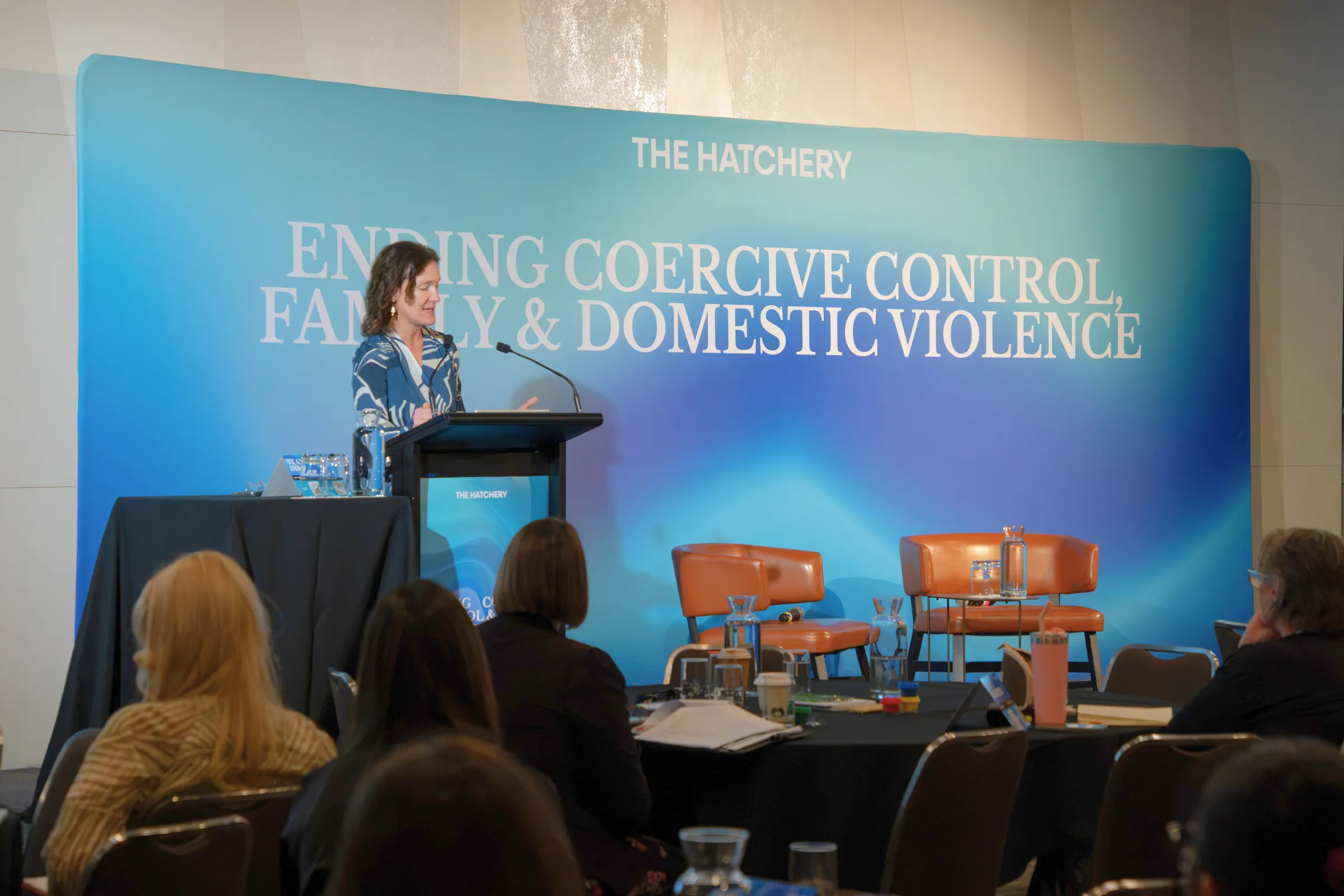
At the Ending Coercive Control and Family Violence Conference Western Australia, ANROWS CEO Dr Tessa Boyd-Caine explored what meaningful systems integration requires in domestic and family violence.
“I just felt like I was running around in a circle.”
Tessa opened her keynote with these words from a victim-survivor of domestic and family violence describing her experience of seeking help. They bring attention back to how the system is experienced by the people navigating it, something that is often missed when reform is discussed primarily through frameworks and processes.
For Tessa, this experience raised a broader question about how responses to domestic and family violence are organised. Violence can extend across many parts of a person’s life, while the institutions responding to it are organised around specific incidents, programs, professional disciplines and organisational responsibilities.
Integration seeks to bridge those divisions through mechanisms such as referral pathways, information sharing, shared risk frameworks and coordinated responses.
Tessa emphasised that the value of integration should be judged by whether better-connected systems actually produce safer, more coherent responses for the people who encounter them.
A school might see a child disengaging from education.
A health service may see the consequences of violence without knowing what sits behind them.
Police may recognise a residence from repeated callouts without any single encounter revealing the full pattern.
Seen separately, each institution holds a fragment.
When those fragments are brought together, they can reveal a pattern of violence, escalating risk or an opportunity to intervene. In working to integrate systems, our efforts must ultimately make women and children safer as a result.
Extending accountability across services and institutions
Integration also matters for how systems respond to people using violence.
Research shows that people who use violence may already be encountering health, housing, child and family services, courts and other institutions. In these settings, violence is not always recognised. Often, the service sees only the immediate issue for which the person is presenting.
These encounters create opportunities for earlier intervention, but they also raise questions about responsibility.
If someone disengages from an intervention, who is made aware?
Who follows up?
Who retains sight of the risk and the pattern of behaviour as that person navigates between different parts of the system?
Without that continuity, responsibility can migrate back to the victim-survivor. They may be left to repeatedly explain the history, navigate different services and monitor the risk to themselves and their children.
Evidence from the Australian Domestic and Family Violence Death Review Network demonstrates why patterns over time matter. ANROWS’ work with the Network found that over an eight-year period, more than three-quarters of children killed by a parent or carer died in a domestic and family violence context. In 88% of these cases, there was also a history of intimate partner violence.
An integrated system needs to have the capacity to recognise those connections while maintaining a line of sight over the person using violence.
Tessa talked about where she has seen practitioners working across different service systems to recognise the complex and intersecting needs faced by people who are experiencing domestic or family violence.
For example, healthcare services can be a vital first point of contact or disclosure for someone experiencing violence. Many health professionals already have strong capability to identify chronic conditions like diabetes and know where to refer people for help with those conditions.
We can leverage those same skills to enable healthcare professionals to ask someone if they are safe in their relationships or at home, and to know what to do about it when a person discloses they are not.
To do that, we need to build the capability of the healthcare and other workforces who are highly trusted by the community, to identify issues like violence against women and children and connect them with specialist and other service responses.
Organising systems around people and outcomes
Integration can raise a concern about what might be lost when different parts of a system are brought into closer alignment, particularly the specialist expertise developed within family violence, health, legal and other services.
Tessa emphasised that these are not competing objectives. Integration looks at how expertise can work together without requiring victim-survivors to navigate siloed services themselves. Rather, systems need to be organised around achieving outcomes for victim-survivors: safety for women and children; accountability for the person using violence; recovery and healing; and economic security.
Integrated systems also need to accommodate diverse needs.
Research with Aboriginal and Torres Strait Islander communities, including in Fitzroy Crossing, has demonstrated the importance of place-based responses designed, owned and led by Aboriginal communities.
Regional and remote communities have different service landscapes, while Aboriginal community-led organisations hold knowledge, relationships and expertise that mainstream systems cannot reproduce.
A national or statewide system needs to recognise violence and risk across the system without assuming that effective responses will look the same in every community. It needs to accommodate different contexts, relationships and forms of expertise.

Learning from systems reform
Across Australia, including Western Australia, substantial work is underway to strengthen risk assessment, information sharing, coordinated responses and workforce capability.
Alongside understanding whether new structures and processes are being implemented as intended, we need to consistently evaluate what they change in practice.
This includes whether better information leads to different action, whether patterns of risk are recognised earlier, and whether victim-survivors experience greater safety, agency and less fragmentation.
Tessa concluded by acknowledging that Western Australia’s current work towards integration offers lessons that are relevant well beyond the state. The National Plan to End Violence against Women and Children provides a shared national commitment to prevention, early intervention, response, recovery and healing.
The experience emerging from Western Australia can contribute to a deeper collective understanding of how those commitments translate into systems that work in practice.
Resource
What is a health justice partnership – Health Justice Australia
Explore the evidence
Improved accountability: The role of perpetrator intervention systems
Innovative models in addressing violence against Indigenous women
Support is available
If you or someone else, including a child, is in immediate danger, call 000.
Visit our support directory to find national, state and territory helplines and services, including 24-hour support and interpreting assistance.
Find support services
Media contact:
Emmagness Ruzvidzo,
Media and Communications Manager, ANROWS
E: Emmagness.Ruzvidzo@anrows.org.au
M: 0468 322 800
About ANROWS
Australia’s National Research Organisation for Women’s Safety (ANROWS) was established by the Commonwealth, state and territory governments under Australia’s first National Plan to Reduce Violence against Women and their Children (2010–2022). As an ongoing partner to the National Plan, ANROWS continues to build, strengthen and translate the evidence base that informs the current National Plan to End Violence against Women and Children (2022–2032).
With more than 150 research projects led, commissioned or contributed to, ANROWS delivers targeted evidence to inform practice, policy, and systems reform. We engage closely with victim-survivors, communities, service providers, governments and researchers to ensure our work reflects lived experience and supports collective action.
ANROWS is a not-for-profit company jointly funded by the Commonwealth and all state and territory governments. We are a registered harm prevention charity and deductible gift recipient, governed by the Australian Charities and Not-for-profits Commission (ACNC).